Lean manufacturing is often introduced through a familiar set of terms — waste, 5S, kaizen, kanban, Just-in-Time — and those ideas matter. But they can also make lean look like a toolbox: put labels on the floor, reduce inventory, run a kaizen event. The deeper idea is more important than any single tool on that list.
Lean manufacturing is a way of thinking about how value moves through a production system. It asks what the customer actually needs, which activities create that value, where the product waits or moves unnecessarily or gets reworked, and what prevents the process from flowing reliably.
For a mechanical engineer, these questions matter because production performance is shaped not only by machine design or cycle time, but by layout, setup, equipment reliability, quality, process capability, material handling and maintenance — the system a machine sits inside.
Lean Enterprise Institute describes lean as a way of creating needed value with fewer resources and less waste, while continuously experimenting to improve how the work is performed. The important word is system. A technically excellent machine can exist inside a badly performing production system.
Lean is not simply "do more with less"
That phrase is sometimes used to explain lean, and it is incomplete. If "do more with less" becomes fewer workers, faster machines, less maintenance and lower inventory without understanding the production system, the result can be worse, not better.
Lean begins with value. The goal is to remove activity that consumes time, material, equipment capacity or labour without improving what the customer actually requires — a different objective from simply cutting resources.
Where lean manufacturing came from
Modern lean thinking is closely connected to the Toyota Production System. Toyota developed a production system built on Just-in-Time, jidoka, flow, pull, standardization and continuous improvement — covered in detail in how the Toyota Production System shaped modern manufacturing. Later research into Toyota and other automotive manufacturers helped popularize the broader term lean production.
Lean Enterprise Institute describes lean thinking through five principles originally articulated by James Womack and Daniel Jones: specify value, identify the value stream, create flow, establish pull, and pursue perfection. Those principles remain a useful way to understand lean manufacturing, and they are the backbone of this article.
Lean manufacturing and TPS are related, but not identical
Toyota Production System refers specifically to Toyota's own production system and its historical development through figures like Sakichi Toyoda, Kiichiro Toyoda and Taiichi Ohno. Lean manufacturing is the broader manufacturing philosophy, strongly influenced by TPS, that was adapted across many industries after researchers studied Toyota and other automakers.
So this article does not repeat that history. It focuses on a narrower question: what should an engineer do differently when they think lean?
The five lean principles
The five principles form a loop rather than a checklist. Pursuing perfection does not mean the factory becomes finished — it means the definition of value and the map of the value stream get revisited again.
Principle 1: Value
Lean begins with value from the customer's perspective. For a mechanical product, value may include required geometry, function, tolerance, surface finish, reliability and delivery timing. The important distinction is that activity is not automatically value.
Imagine a machined component. The customer requires two mounting holes, specified dimensions and a required surface finish — machining those features contributes directly to the required product. Now imagine the component travels from Machine A, fifty metres across the factory, into a storage rack, into another queue, and on to Machine B. The transport consumes time, floor space and handling, but the component has not become more useful to the customer simply because it travelled. That is the lean distinction between activity and value creation.
Value is not decided only on the shop floor. A drawing that specifies an extremely tight tolerance where the function does not require one can force more precise machining, additional inspection, slower processing and greater rejection risk — the product becomes more expensive without becoming more valuable. Mechanical engineers create or remove waste during design, tolerance selection, material selection and manufacturing-process selection, which means lean thinking extends upstream of the machine.
Principle 2: Value Stream
A value stream is the set of steps required to bring a product through production. Some steps add value; others are currently necessary but do not directly create it; others may be unnecessary entirely. Lean Enterprise Institute uses value-stream thinking to examine material and information flow across the whole process rather than individual departments in isolation.
This matters for mechanical engineers because engineering work naturally encourages close attention to individual machines — can cycle time be reduced, is spindle speed correct, can the actuator move faster. Those are valid questions, but lean asks another one first: is this machine actually where the production system is losing time?
Consider a component whose actual machining time is four minutes, but whose complete journey looks like: Machine A, wait 35 minutes, transport, wait 90 minutes, inspection, wait again, Machine B. An engineer improves machining time from 4.0 to 3.5 minutes — a genuine technical improvement — but total lead time barely changes, because the dominant problem was waiting and flow, not machining.
A value-stream map represents both material and information flow through the process, typically capturing cycle times, WIP, queues, information signals, changeovers and transport. The purpose is not a beautiful diagram — it is to reveal where value is actually flowing and where it is stopping.
My perspective from manufacturing work
In practical manufacturing environments, I have encountered this problem in its general form more than once: focusing improvement effort on one machine did not necessarily solve the wider production issue, because material was still waiting, a setup was slow, a piece of equipment was unreliable, a quality problem remained, or another process was limiting the whole line. That distinction is important because engineering improvements are often technically correct at the local level — the harder question is whether the change helped the system. Lean manufacturing makes that question explicit.
The Lean Engineering Lens
This is the framework I use, personally, to walk through a production process as a mechanical engineer. It is not an official Lean Enterprise Institute framework — it is my own way of turning the five lean principles into questions that point at a machine, a layout or a process.
| # | Lens | The question |
|---|---|---|
| 1 | Value | What transformation does the customer actually require? |
| 2 | Flow | Where does material stop, queue or travel unnecessarily? |
| 3 | Capability | Can each process consistently produce what the next process needs? |
| 4 | Pull | Is production responding to downstream demand, or maximizing local output? |
| 5 | Stability | What failures, variation, setup losses or defects disrupt flow? |
| 6 | Improvement | Which change improves the complete manufacturing system? |
That last question is what stops lean from collapsing into local machine optimization — the best local improvement is not necessarily the best system improvement.
Principle 3: Create Flow
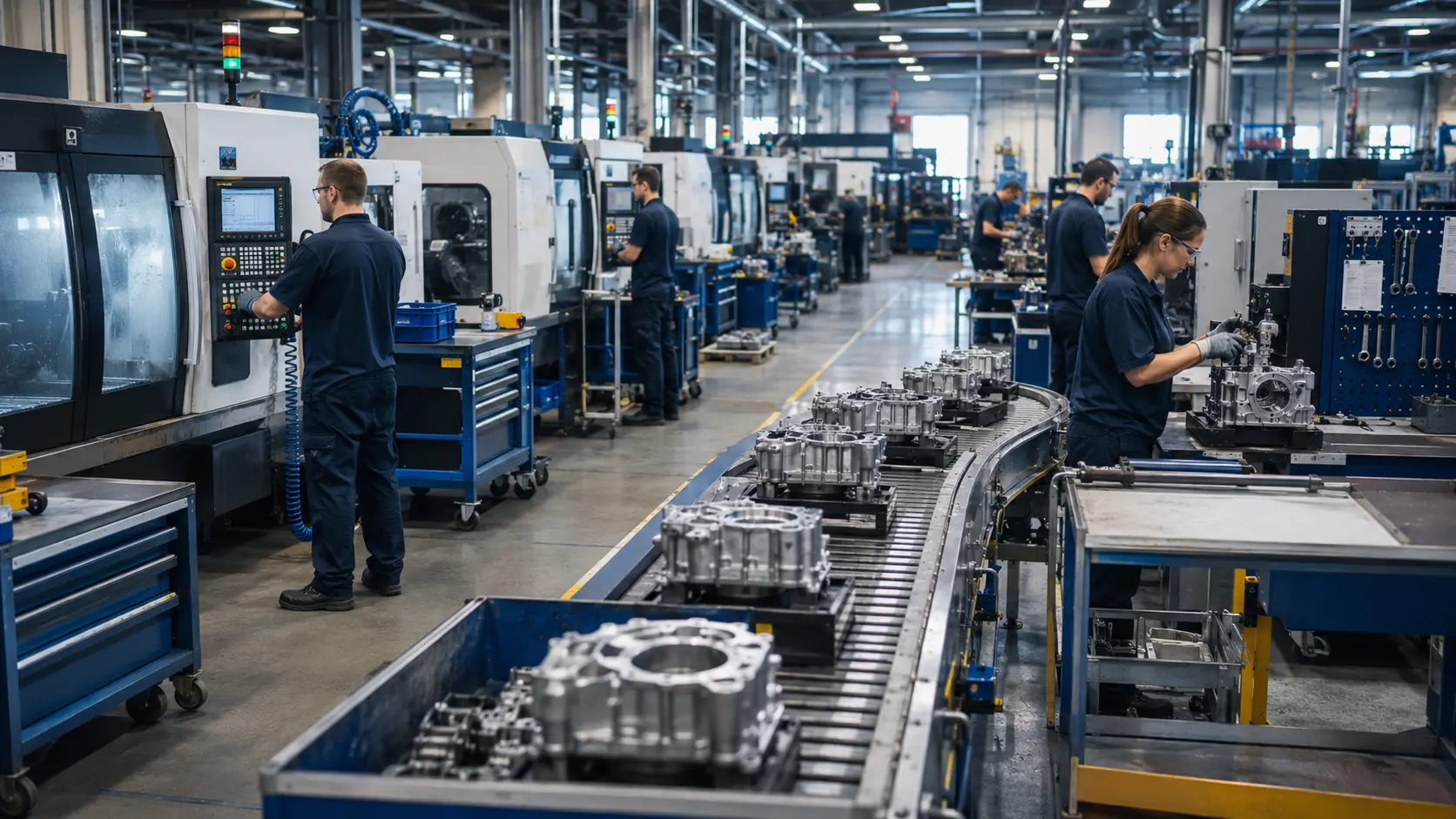
Flow means allowing work to move through the process with as little unnecessary interruption as practical. Mechanical engineers strongly influence flow through factory layout, machine selection, cycle-time matching, automation, process integration and material-handling design.
Layout often creates waste before a single part is manufactured. If related processes sit at opposite ends of a building, every part requires transport, handling and temporary storage. Arranged instead according to actual process sequence, the same product can move through fewer metres, fewer transfers and fewer queues. Lean therefore treats layout as a production-performance decision, not simply a facilities one.
Principle 4: Establish Pull
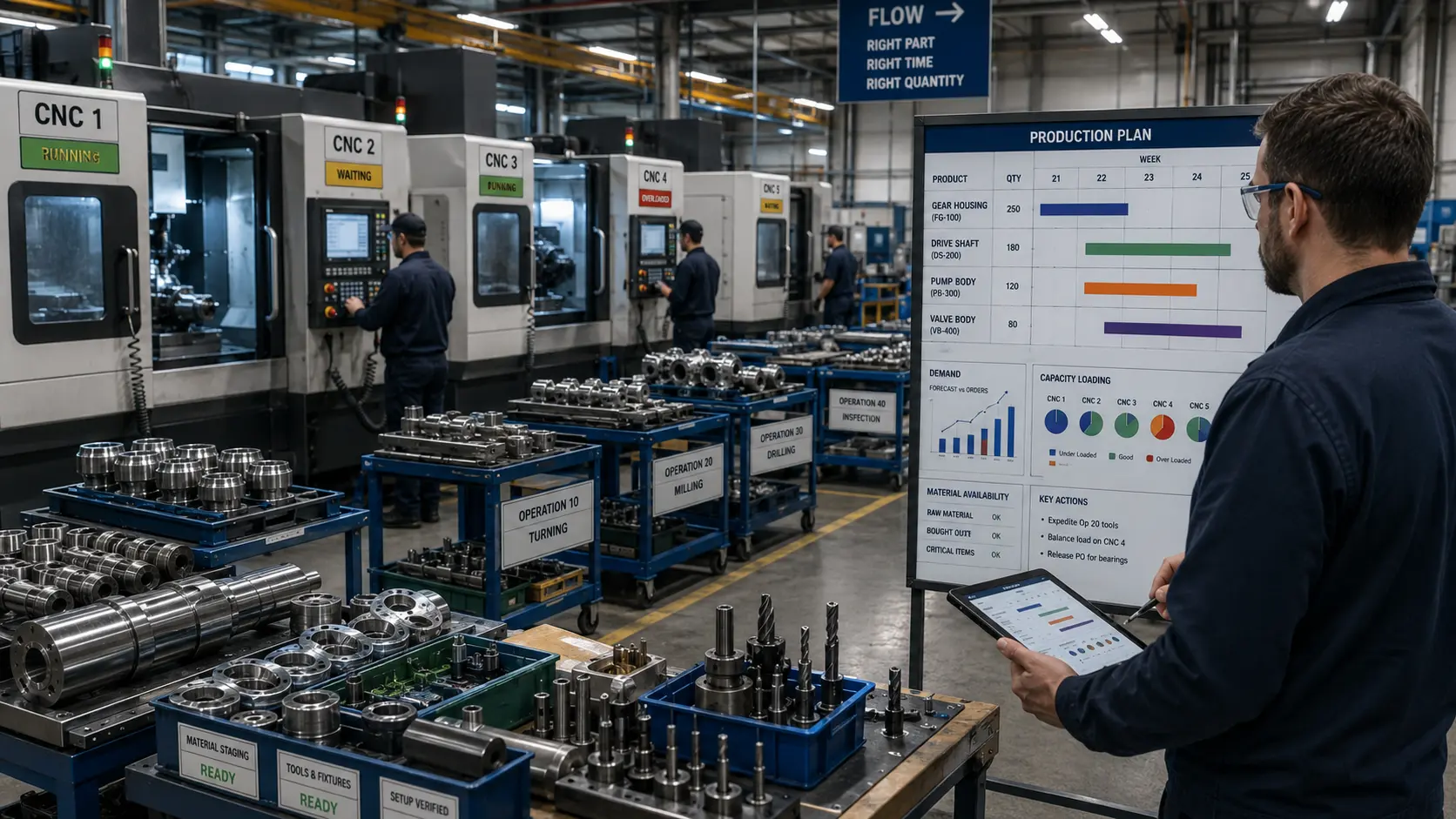
Pull means downstream need triggers upstream production. Lean Enterprise Institute describes pull as downstream processes obtaining what they need from upstream processes, which then replenish what was consumed.
Suppose Machine A has a capacity of 100 units per hour, but Machine B only requires 60 units per hour. If Machine A produces continuously simply because it can, inventory accumulates at 40 excess units every hour. Machine A may show impressive utilization, but the production system now carries more WIP, more material handling, more storage and more capital tied up. The ability to produce something does not mean the system needs it produced now.
This should not be read as pull meaning zero inventory. Real pull systems may use controlled inventory or supermarkets where continuous flow is not practical — Lean Enterprise Institute explicitly discusses controlled supermarket pull as one way of connecting processes when continuous flow cannot be achieved. Lean does not ask how do we eliminate every component from inventory; it asks why is this inventory here, and how much is actually required to support reliable flow.
Principle 5: Pursue Perfection
The final classic principle is often described as pursuing perfection, and it should not be read as the factory must become perfect. Instead, improvement becomes continuous: reduce one queue, and another problem becomes visible; improve a setup, and production flexibility improves. The new process becomes the next baseline. Improvement does not prove the work is finished — it reveals the next opportunity.
The seven classic wastes
One of the most practical lean concepts is the classification of waste. Lean Enterprise Institute commonly identifies seven classic wastes, and understanding them through mechanical-engineering examples makes them far more useful than the labels alone.
| Waste | What it looks like | Mechanical-engineering example |
|---|---|---|
| Overproduction | Producing before, faster, or in greater quantity than needed | Machine A makes 1,000 components against downstream demand of 700 — the extra 300 need handling, storage and tracking, and widen the exposure if a quality problem is found later |
| Waiting | Operator, machine or material sitting idle | A machine waiting for material, or an operator waiting for inspection results, while lead time keeps running |
| Transport | Unnecessary movement of components, tools or WIP | Poor layout routing parts across the factory between related operations — automating that route does not remove the waste, it just moves it faster |
| Overprocessing | Doing more work than the function requires | Unnecessary surface finishing, tolerances tighter than required, or duplicate inspection steps |
| Inventory | Raw material, WIP or finished goods beyond what flow needs | Large WIP that quietly hides unreliable equipment, long setups, poor scheduling or quality issues |
| Motion | Unnecessary movement by people or equipment | An operator repeatedly walking for tools or reaching awkwardly because of poor workstation layout |
| Defects / correction | Scrap, rework, additional inspection, replacement production | A defective component that has already passed through several expensive processes before the defect is discovered |
Many modern lean discussions add underutilized human knowledge or talent as a later, commonly added eighth waste. It was not part of the original classic seven, but the idea is still valuable: operators and technicians often know where a machine repeatedly jams, which setup creates trouble, or what sound appears before a fault. An engineer who ignores that observation may be ignoring high-quality process knowledge.
Toyota also discusses muda, mura and muri — waste, unevenness and overburden — covered in more depth in the Toyota Production System article. The relationship still matters here: uneven demand or scheduling can overload people, machines or processes, and that overburden can then create failure, defects or waiting. Visible waste is often the symptom of instability somewhere else in the process, which is why the sixth lens question asks what improves the complete system rather than the symptom in front of you.
Takt time vs cycle time
Takt time provides a useful bridge between customer demand and production rate: Takt Time = Available Production Time ÷ Customer Demand. If available production time is 420 minutes per shift and demand is 210 units per shift, takt time is 420 ÷ 210 = 2 minutes per unit — the system needs to complete roughly one unit every two minutes to match demand. Lean Enterprise Institute describes takt time as the rate at which products need to be completed to satisfy customer demand.
Takt time and cycle time are not the same thing. Takt time is determined by available time and demand; cycle time is determined by how long the process actually takes. If takt is 2.0 minutes per unit and the process cycle time is 1.2 minutes per unit, the process has sufficient rate capability — but that does not mean the machine should run continuously. If downstream demand does not require the additional output, continuous production simply creates overproduction. If cycle time is instead 2.8 minutes per unit, the process cannot currently satisfy demand, and the response might involve cycle-time improvement, reliability improvement, parallel capacity or process redesign — lean gives that improvement a system context rather than treating faster as automatically better.
Bottlenecks illustrate the same idea. Imagine three sequential processes: A at 30 seconds per unit, B at 70 seconds per unit, C at 40 seconds per unit. Process B limits the flow. If an engineer improves A from 30 to 20 seconds, A has genuinely gotten faster, but the line still waits on B — the likely result is simply more inventory piling up between A and B. The best local improvement is not necessarily the best system improvement.
Setup time and batch size
Suppose changing a machine from Product X to Product Y takes 90 minutes. Large batches become attractive because the organization wants to avoid repeated setup, but large batches also create excess inventory, longer lead time and slower response to demand. Lean challenges the assumption that setup is long, so batches must be large, and asks instead why setup takes 90 minutes — whether tooling can be prepared externally, fixtures simplified, adjustment reduced, or locating features improved. Reducing setup can change the economics of the whole process, which is where mechanical design and lean manufacturing intersect directly.
Lean depends on reliable equipment
Continuous flow becomes difficult if critical machinery fails unpredictably, and low WIP means downstream operations feel breakdowns quickly. That raises the importance of equipment reliability, preventive maintenance, condition monitoring, predictive maintenance and root cause analysis — maintenance is not separate from lean; machine reliability is one of the conditions that allows flow to exist in the first place.
This is also where Overall Equipment Effectiveness needs interpretation rather than blind optimization. A non-bottleneck machine may show low utilization simply because downstream production does not currently require more parts — running it continuously to improve its OEE score can just create inventory. OEE can help identify losses, but lean thinking helps decide whether increasing output at that particular machine actually improves the production system.
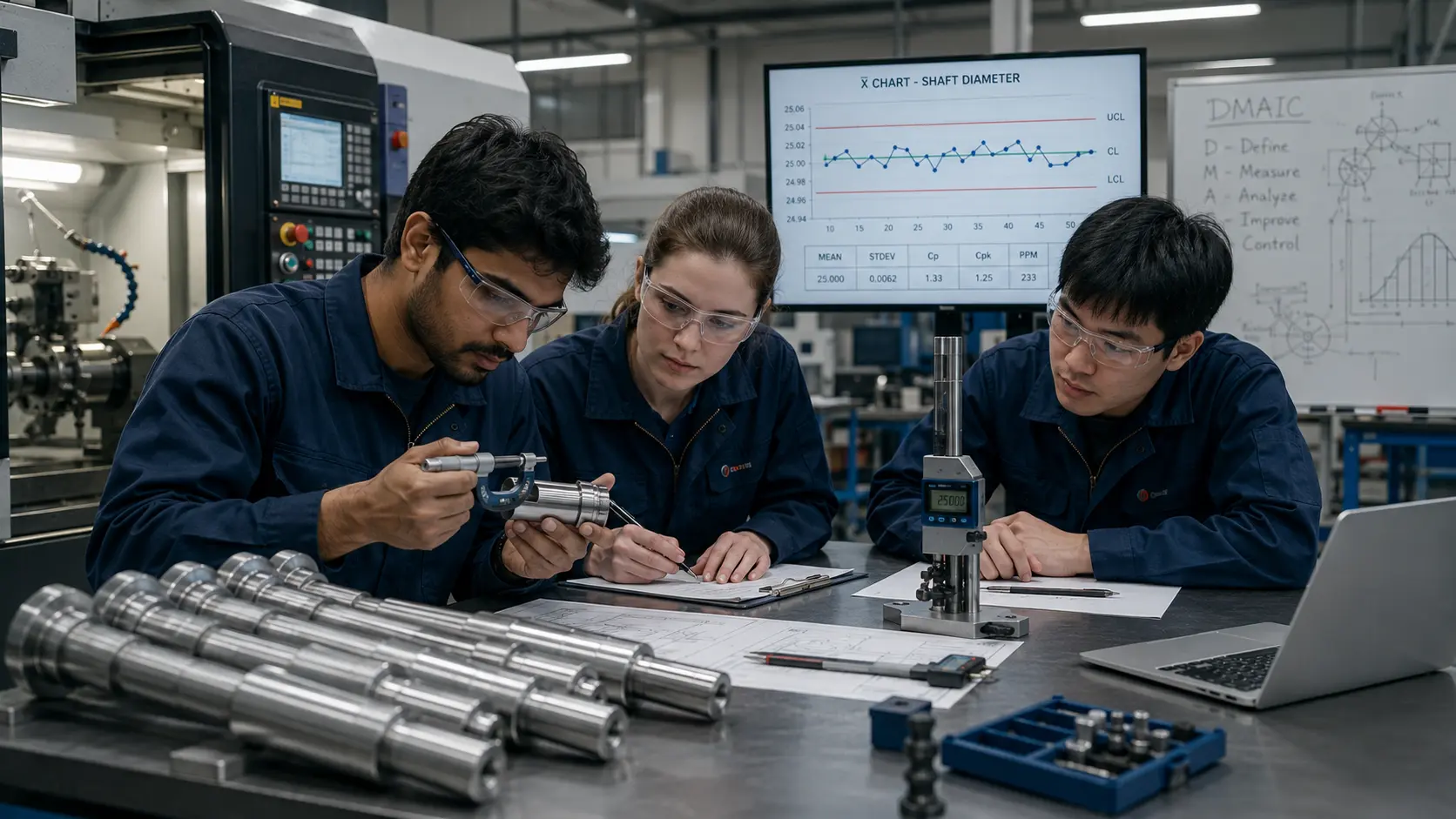
Quality plays the same supporting role. A process cannot flow effectively if products repeatedly require rework, sorting or replacement, so lean favours catching defects close to where they occur rather than relying only on final inspection — do not let defects accumulate more value-added work before they are detected.
Where 5S fits
5S — sort, set in order, shine, standardize, sustain — is one of the most visible lean practices, and a well-organized workspace can reduce searching, excess movement, confusion and unsafe conditions. But 5S is not lean manufacturing by itself. A factory can have perfectly organized toolboards and clean machines and still suffer excess WIP, poor flow, long lead times and overproduction. 5S supports lean; it does not replace system thinking.
Common lean misunderstandings
Lean does not mean making people work faster. If an operator walks unnecessarily because components are poorly positioned or tools are distant, the lean solution is to remove the unnecessary movement, not to ask the operator to move faster. Toyota's production philosophy explicitly connects its approach with reducing overburden and making work easier for workers, and lean improvement should reduce awkward work, unnecessary motion, repeated correction and preventable waiting — not simply increase effort.
Lean should not be reduced to cutting jobs, either. Continuous improvement depends on people identifying problems, and if workers learn that every efficiency gain threatens someone's job, they have little reason to expose waste. Operators should be treated as a source of process knowledge, with the objective of improving the work system rather than reducing headcount.
Automation and AI can support lean, but they do not make a process lean automatically. A robot moving unnecessary WIP across an unnecessary route is still moving unnecessary WIP — it is simply automated waste. The same logic applies to industrial AI: it can strengthen quality inspection, predictive maintenance and anomaly detection, but lean asks what production problem needs solving first. If waiting exists because the layout is poor, a model will not fix that; if a defect keeps recurring because one fixture is inconsistent, fixing the fixture may deliver more value than training a predictive model. Connected manufacturing systems and Industry 4.0 skills can add real visibility into downtime, cycle time, quality and equipment condition — but that visibility only matters once engineers know which lean questions to ask of it. Do not automate waste before asking whether the activity should exist at all.
What every mechanical engineer should understand about lean
- Machine performance is not system performance. A faster machine does not automatically create a faster factory.
- Equipment reliability supports flow. Breakdowns disrupt the entire value stream.
- Layout can create waste permanently. Unnecessary transport can be engineered into the factory.
- Design specifications affect production waste. Excessive tolerance or complexity can create unnecessary processing.
- Setup time influences manufacturing flexibility. Better fixture and process design can enable smaller batches.
- Quality should be controlled close to its source. Late inspection lets more resources accumulate on defective output.
- Operators possess useful engineering knowledge. Practical improvement requires understanding how the process actually behaves.
- Demand matters. The goal is not maximum output from every machine.
- Data need context. OEE, IIoT and AI should support production decisions, not replace them.
- Improvement is continuous. Today's improved method becomes tomorrow's baseline.
Common lean-manufacturing mistakes
- Treating lean as cost cutting. Lean is primarily about value and process improvement.
- Starting with tools. 5S and kanban are methods, not the complete system.
- Maximizing every machine. This can simply produce excess WIP.
- Removing inventory without improving stability. Buffers can disappear before the underlying causes are fixed.
- Ignoring maintenance. Poor equipment reliability destroys flow.
- Ignoring workers. Process knowledge often sits closest to the machine.
- Automating the current process without questioning it. Technology can simply automate waste.
- Measuring everything but solving nothing. Dashboards only help when the information leads to action.
Key takeaway
Lean manufacturing is often introduced as waste elimination. That is correct, but incomplete. The deeper idea is to create a production system where customer value is clear, the value stream is understood, work flows, production responds to actual need, waste and instability become visible, and the process improves continuously.
For mechanical engineers, lean adds an important discipline: do not evaluate equipment only by how well the equipment itself performs — evaluate how it contributes to the complete production system. A machine can be fast, reliable and highly utilized and still create little additional value if material waits downstream, another process is the bottleneck, defects require rework, or output simply exceeds demand.
“Optimize the flow of value — not merely the activity of the machine.”
References and further reading
- Lean Enterprise Institute — What Is Lean Thinking? A current definition of lean as creating needed value with fewer resources and less waste while continuously improving how work is performed.
- Lean Enterprise Institute — Lean Thinking and Practice. The primary source for the classic five principles of value, value stream, flow, pull and perfection.
- Lean Enterprise Institute — Operations. A useful reference for the traditional seven wastes and lean production-system thinking.
- Lean Enterprise Institute — Understanding the Fundamentals of Value-Stream Mapping. Useful for understanding why seeing material and information flow across the whole process matters more than optimizing any single step.
- Toyota Motor Corporation — Toyota Production System. Primary background source for TPS, Just-in-Time, pull and the worker-centred philosophy behind jidoka.