Engineering laboratories have traditionally been associated with physical spaces — students interact with machines, test rigs, sensors and instruments, set up experiments, collect measurements and compare them with theory. Digital technology has created another possibility: simulations, virtual laboratories, remote laboratory systems and digital models. This has produced a common but incomplete question: can virtual laboratories replace physical laboratories?
A better question is: what do we expect the student to learn, and which laboratory environment can provide valid evidence of that learning? That distinction is important because virtual and physical laboratories can support overlapping learning outcomes while still developing different forms of engineering competence.
Current ABET engineering criteria expect students to be able to conduct appropriate experimentation, analyze and interpret data, and use engineering judgement. They also require laboratories and equipment to be suitable for achieving program outcomes rather than simply existing as facilities.
“The quality of an engineering laboratory should be judged by what students learn and demonstrate — not merely by whether the laboratory is physical or digital.”
What is an engineering laboratory actually for?
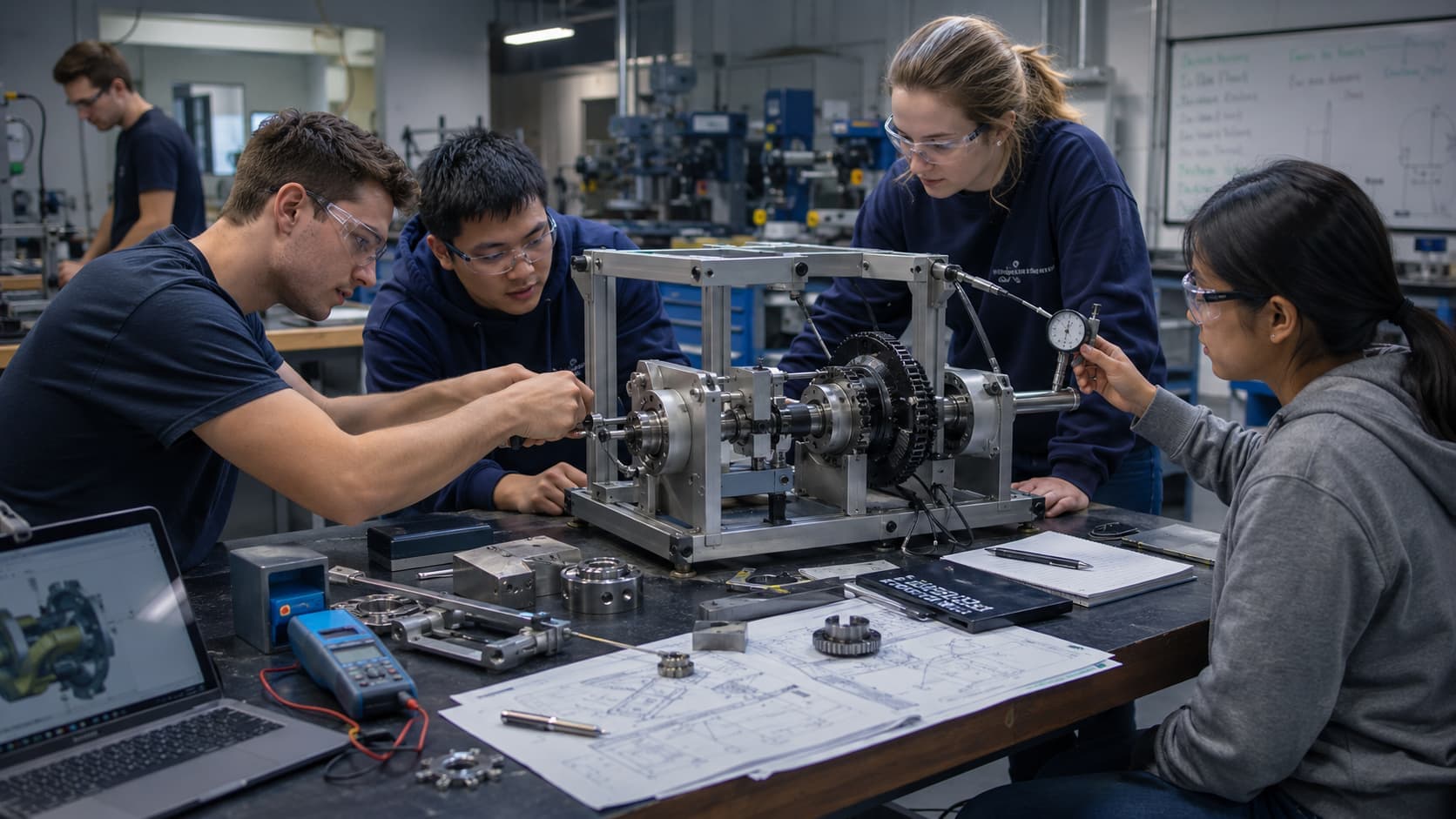
Before comparing virtual and physical laboratories, we need to ask why engineering programs use laboratories in the first place. A laboratory can help students learn to connect theory with observed behaviour, conduct experiments, manipulate variables, collect measurements, operate instruments, interpret data, recognize uncertainty, troubleshoot, work safely with equipment, and make engineering judgements.
Not every laboratory needs to develop all of these abilities. One experiment may focus mainly on understanding a theoretical relationship. Another may focus on correct physical measurement. A third may focus on diagnosing why a machine behaves unexpectedly. These are different learning outcomes.
“Before asking whether a virtual laboratory can replace a physical one, first define what the laboratory is supposed to teach.”
What is a virtual laboratory?
A virtual laboratory uses a digital environment to reproduce or model some part of an experimental process. Students may interact with simulated equipment, adjustable parameters, virtual instruments, generated experimental data and visualized system behaviour.
A virtual mechanical engineering laboratory might allow students to change load, temperature, damping, fluid flow, material properties or operating speed, and the system then calculates or simulates the resulting behaviour. Virtual laboratories can vary greatly in sophistication — some are relatively simple interactive simulations, others recreate experimental equipment and procedures in much more detail. The important feature is that the experimental system itself is primarily represented digitally.
Virtual laboratories are not the same as remote laboratories
These concepts are often confused. In a virtual laboratory, the experimental system is simulated or digitally represented. In a remote laboratory, the learner interacts through the internet with real physical equipment located somewhere else — for example, a student might remotely change an input, operate an experimental rig and receive measurements while the actual physical equipment exists in another laboratory.
That distinction matters because remote laboratories can provide real physical data even though the learner is not physically beside the apparatus. The broader educational question remains the same: what learning outcome can the environment actually support?
What is a physical laboratory?
A physical laboratory requires students to interact directly with actual equipment or materials. Depending on the activity, students may install sensors, align equipment, connect instruments, prepare specimens, operate machinery, make measurements, adjust components and observe physical behaviour.
The learner is therefore not only interacting with a representation of the experiment — they are participating directly in the physical system. That creates educational opportunities that are difficult to reproduce completely through software.
The Laboratory Learning Outcome Test
A practical way of choosing between virtual and physical laboratory experiences is to start with eight questions — an explanatory framework developed for this article.
- 1. Concept — does the student primarily need to understand a relationship or engineering principle?
- 2. Experiment — must the student learn how to design or conduct an investigation?
- 3. Measurement — must the student physically obtain and judge real measurements?
- 4. Equipment — must they manipulate real machines, tools or instruments?
- 5. Variability — does learning depend on encountering uncertainty, noise or imperfect physical behaviour?
- 6. Safety — must safe physical behaviour itself be demonstrated?
- 7. Troubleshooting — does the student need to diagnose a real physical system?
- 8. Access — would virtual access allow meaningful experimentation that would otherwise be unavailable?
After answering these questions, the appropriate learning environment may be virtual, physical or hybrid.
“Choose the laboratory format from the required competence — not from the technology available.”
Virtual laboratories are powerful for visualization
Some engineering phenomena are difficult to observe physically. Consider heat conduction through a component — in a physical experiment, students may have temperature readings at several locations, which are useful, but do not allow students to literally see the complete temperature field inside the material. A virtual environment can visualize thermal gradients, heat flow and changing boundary conditions.
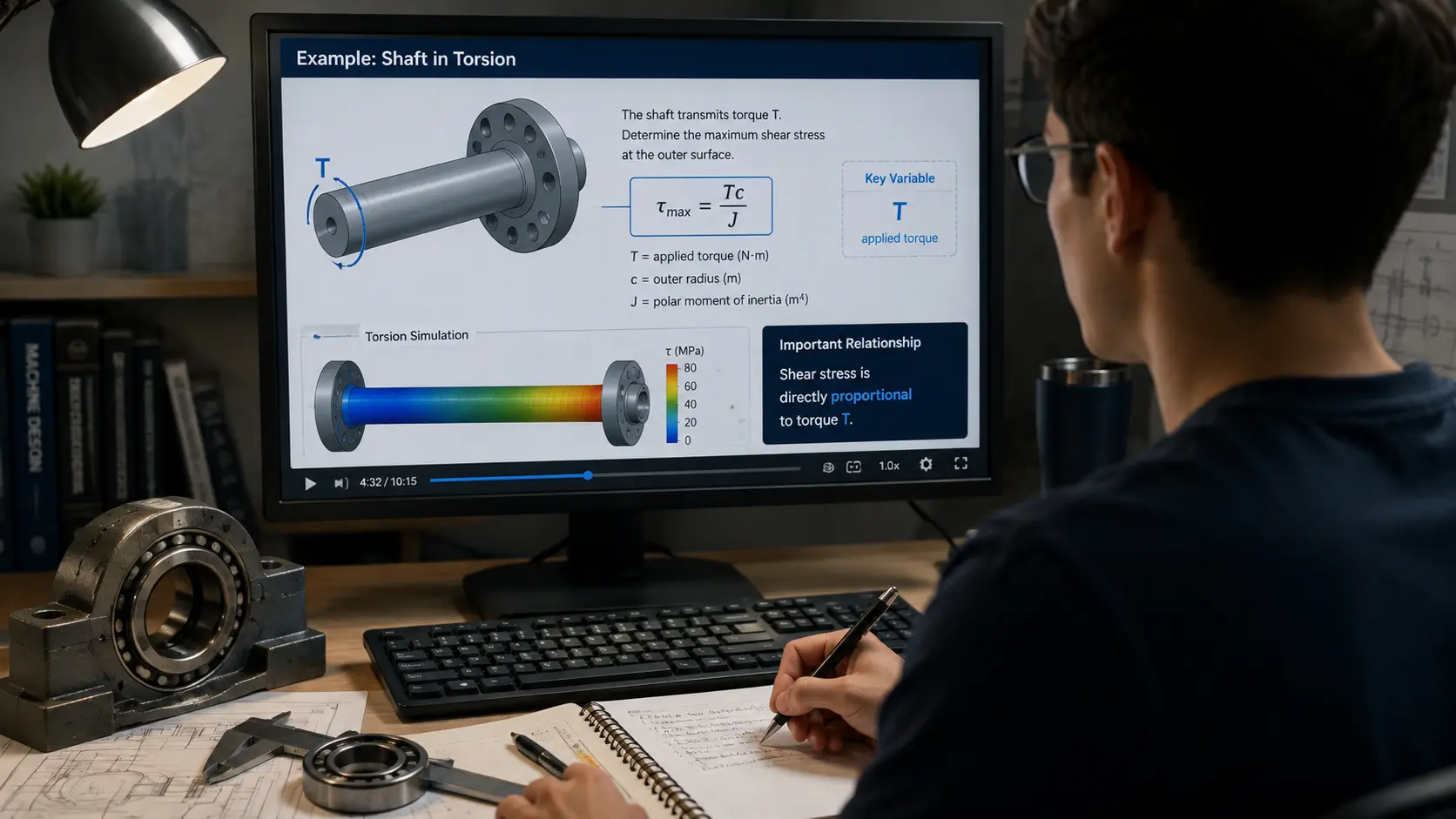
Similar benefits occur in solid mechanics, where students can visualize stress, strain and deformation; in fluid mechanics, where they may inspect flow patterns, velocity fields and pressure distribution; and in vibration, where they can see mode shapes, transient response and resonance behaviour. Virtual environments can therefore expose relationships that are difficult to observe directly in physical experiments.
Virtual laboratories allow rapid repetition
A physical experiment may require significant preparation — equipment must be available, configured, reset and cleaned. Repeating the experiment several times may consume considerable laboratory time. Virtual experiments can often be reset quickly, letting students ask what if I double this parameter, what if I reduce damping, what if I change the material, or what happens beyond the range we used before.
This creates opportunities for exploratory learning. A 2024 systematic review of virtual laboratories in engineering education identified flexibility, accessibility and safe experimentation among their recurring advantages, while also noting limitations including technical problems and restricted interactivity.
Controlled parameter exploration can clarify relationships
Imagine a mass-spring-damper experiment. A virtual environment can allow students to vary mass, stiffness and damping one at a time, with the resulting change in system behaviour displayed immediately. This can be educationally powerful because the learner can isolate relationships.
In a physical system, changing the mass may also slightly alter friction, geometry or mounting. That physical complexity is valuable for some learning outcomes. But when the immediate goal is understanding a conceptual relationship, controlled virtual exploration can be extremely effective.
Virtual laboratories support safe exploration
Mechanical engineering laboratories may involve rotating equipment, pressure, high temperatures, electricity and moving components. Students cannot safely be encouraged to explore every incorrect configuration physically. A virtual environment can allow learners to investigate what would happen if this operating limit were exceeded, without exposing students or equipment to actual danger. This is a legitimate advantage.
However, there is an important distinction: understanding a safety principle virtually is not the same as demonstrating safe behaviour physically. If the learning outcome is explain why an unsafe condition is dangerous, virtual learning may be appropriate. If the outcome is safely operate the equipment, physical evidence may still be necessary.
Virtual laboratories increase access
Physical laboratories have finite capacity — one laboratory may contain one test rig, one machine and several instruments, while a class may contain dozens of students. Access therefore becomes constrained by timetable, equipment availability, room capacity and staff availability. Virtual laboratories can increase opportunities for students to interact with experimental environments before class, after class, remotely and repeatedly. This matters especially where institutions have limited equipment.
A 2024 meta-analysis of engineering virtual laboratories found an overall positive effect on educational outcomes across the included studies, and particularly strong effects reported for motivation and engagement. However, the same study concluded that virtual laboratories currently should not be treated as complete substitutes for hands-on laboratories.
That is an important balance. Virtual access can extend experimental learning. It should not automatically be interpreted as identical to physical practical experience.
Accessibility deserves more attention than simply "online access"
Virtual laboratories are often described as accessible because they can be used remotely. But accessibility involves more than internet access. A 2024 systematic review examining accessibility in virtual laboratories identified several dimensions, including support for learners with different abilities, linguistic and cultural considerations, instructional design, content availability and interaction features. It also identified continuing accessibility gaps.
“A virtual laboratory is not automatically accessible simply because it runs in a browser. Its interface and instructional design still matter.”
Virtual preparation can improve physical laboratory time
This is one of the strongest reasons to combine both environments. Imagine students are preparing to work with a CNC machine. Before entering the workshop, a virtual learning activity could help them explore machine axes, coordinate systems, workpiece reference, basic sequence and toolpath behaviour.
When they reach the physical machine, less time is required to explain basic interface concepts. Physical time can focus more heavily on setup, measurement, workholding, machine verification and equipment interaction.
“Virtual laboratories can make physical laboratory time more valuable rather than simply replacing it.”
Real measurement is fundamentally different
Suppose a virtual laboratory displays shaft diameter equals 20.02 mm. The student records the result. Now consider a real component — the student needs to select an appropriate instrument, position it correctly, establish appropriate contact, read the measurement, repeat it, and decide whether the result is trustworthy.
The final number may again be 20.02 mm. But the learning process is not the same. Physical measurement contains procedural knowledge. The learner has to understand how this number was produced — that is a crucial engineering question.
Measurement systems introduce their own uncertainty
Real measurement may be influenced by instrument resolution, calibration, operator technique, positioning, environmental conditions and surface condition. A virtual environment can simulate measurement noise, but simulated uncertainty is still constructed by the software designer. Physical measurement forces students to interact with the actual measurement process.
This links naturally to manufacturing quality and Measurement System Analysis: the measurement process itself can contribute variation. A laboratory that aims to develop physical measurement competence therefore needs evidence beyond simply interpreting a displayed number.
Real equipment is imperfect
Engineering theory often begins with simplified systems — we may assume rigid components, negligible friction, ideal boundary conditions and perfect sensors. Physical equipment does not always cooperate. Students may observe backlash, friction, vibration, wear, heat loss, sensor noise and misalignment.
These differences are sometimes treated as problems that make the laboratory inconvenient. But educationally, they can be extremely valuable. Students must ask why the experimental result differs from the theoretical prediction — that question lies at the centre of engineering experimentation.
My perspective from engineering learning
In my own engineering learning and practical work, I have found that virtual or simulated activities can make a concept much easier to understand. They can help clarify relationships, sequences and expected system behaviour. But working with the physical system adds another layer — the learner encounters setup, measurement, actual equipment behaviour and physical imperfections.
That difference is important. A model can help us understand how the system should behave under its assumptions. Physical experimentation helps us understand how the system actually behaves. Engineering competence requires learning how to reason between the two.
Troubleshooting changes when the system becomes physical
Virtual laboratories can include simulated faults, such as a failed sensor, an incorrect parameter or a leaking system. That can be useful. But physical troubleshooting introduces additional possibilities — the issue could be a loose connection, incorrect alignment, damaged component, poorly positioned sensor or incorrect setup.
The student may need to observe, listen, inspect and measure. This kind of troubleshooting involves interaction with real physical evidence. It is difficult to reproduce completely in a predetermined digital environment.
Physical safety is a practical competence
Suppose a student completes a virtual machining safety exercise successfully. The student understands required PPE, hazard zones, emergency controls and prohibited actions. That is useful evidence of safety knowledge. But does it prove that the student will behave safely around actual moving machinery? Not completely.
Practical safety may involve correct body position, disciplined handling, proper isolation and physical response to abnormal conditions.
“Knowledge of safety and demonstrated safe physical behaviour are related but different learning outcomes.”
This distinction is especially important when laboratories are used for competency assessment.
Virtual laboratories can become unrealistically perfect
A virtual experiment must be programmed. Someone determines the governing equations, measurement behaviour, uncertainty, interface and possible faults. If the environment is too ideal, students may learn that experiments always produce clean theoretical relationships — a predicted value of 10.00 and a virtual measurement of 10.00, every time. Real engineering rarely behaves that cleanly.
Well-designed virtual laboratories can intentionally incorporate realistic noise, parameter variation and uncertainty. But additional realism should serve a learning purpose — adding complexity simply to make software appear sophisticated may increase difficulty without increasing learning.
Physical laboratories can also be educationally weak
It would be equally misleading to assume physical laboratory equals authentic learning. Imagine students receive a laboratory worksheet: switch on the machine, record Value A, adjust the knob, record Value B, substitute into the equation, submit report. Students interact with physical equipment, but how much engineering reasoning occurs? Perhaps very little — they may not understand why the variable was changed, what the instrument measures, why results differ, or what conclusion follows.
“Physical presence does not automatically create meaningful practical learning. Laboratory design matters in both environments.”
Virtual laboratories can sometimes be stronger for conceptual learning
Consider vibration theory. Students need to understand how damping, stiffness and mass affect system response. A physical rig might permit only a few available configurations during a short laboratory period. A virtual system could allow many combinations to be tested quickly, letting students compare response curves and identify patterns. For that outcome, the virtual environment may provide more opportunities for conceptual exploration.
This is why the question "which laboratory is better?" needs to become "better for what learning outcome?"
Physical laboratories are stronger for many procedural skills
Now suppose the learning outcome is to measure a shaft diameter accurately using a micrometer. A virtual instrument can teach scale interpretation, basic instrument structure and reading principles. But physical competence may require holding the instrument, aligning it, controlling contact, repeating measurements and recognizing poor technique. A student cannot demonstrate all of that through a mouse or touchscreen. So again: better for what?
Virtual and physical laboratories provide different evidence
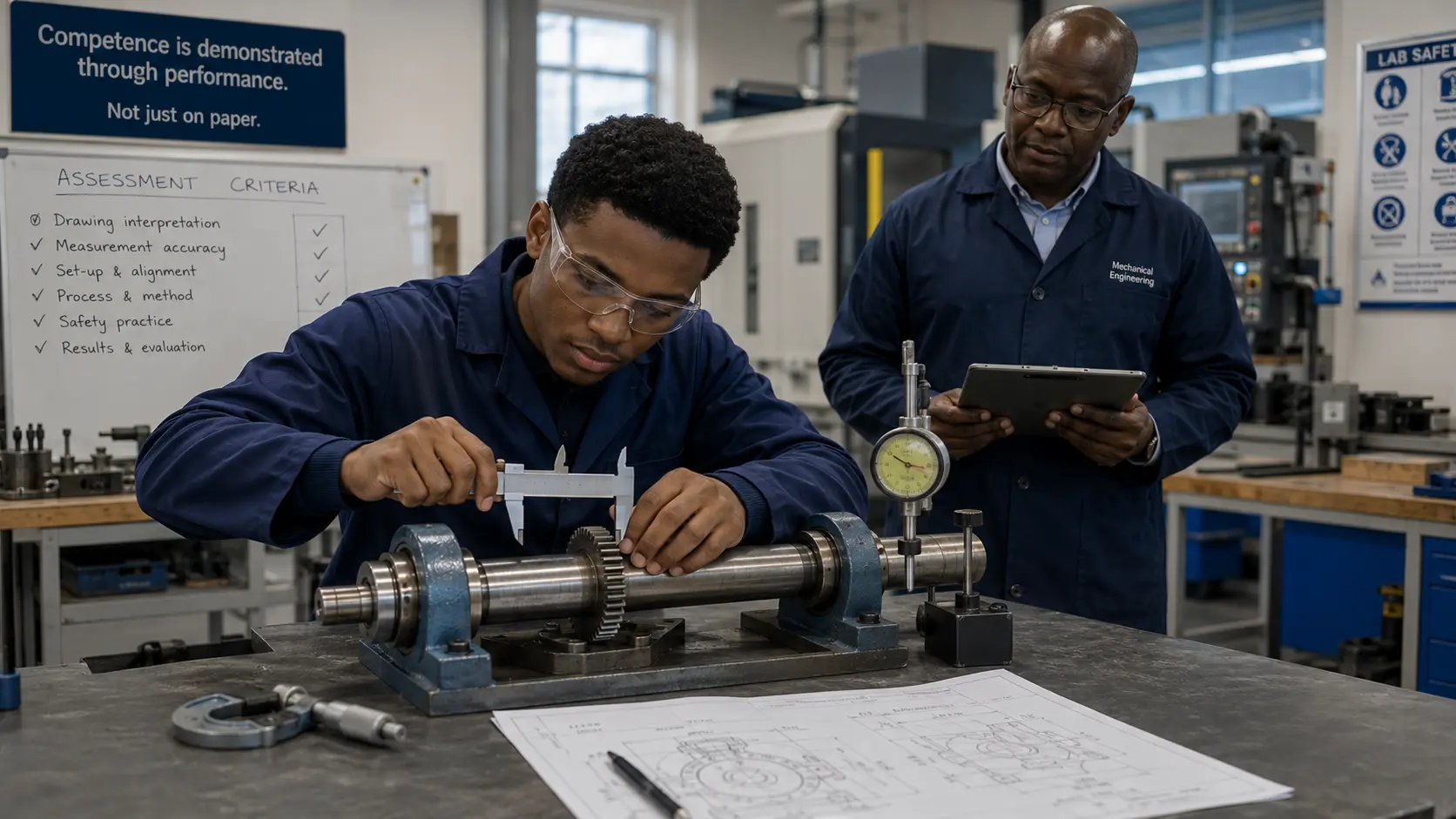
This distinction becomes particularly important in assessment. Suppose the course claims the student can analyze the behaviour of a spring-mass system — a virtual experiment may provide strong evidence. Suppose the claim is that the student can safely install an accelerometer on a rotating-machine test rig and obtain a valid measurement — a virtual laboratory alone provides weaker evidence. The environment limits what the learner can demonstrate.
“Assessment should never claim more competence than the laboratory environment allows the learner to demonstrate.”
| Environment | Evidence it may provide |
|---|---|
| Virtual laboratory | Conceptual prediction, experimental planning, parameter exploration, data interpretation, recognition of relationships. |
| Physical laboratory | Equipment setup, instrument use, measurement technique, safe behaviour, practical adjustment, troubleshooting. |
Neither list means one environment is universally superior. The evidence is different.
Hybrid laboratories offer a stronger alternative
For many mechanical engineering courses, the most useful question may not be virtual or physical — it may be how should virtual and physical experiences be sequenced? A strong design could use three stages. Before the physical laboratory, virtual activities can help students understand the system, identify variables, practise the experimental sequence and predict results.
During the physical laboratory, students set up equipment, operate instruments, collect real measurements and encounter physical imperfections. After the physical laboratory, virtual or computational tools can be used to investigate additional conditions, compare models and test parameters impossible to explore during limited physical time. This uses each environment for what it does well.
The Virtual–Physical Laboratory Learning Cycle
The sequence can be summarized as a cycle — another explanatory framework developed for this article.
- Prepare virtually — understand the system and experimental variables.
- Predict — what should happen?
- Experience physically — set up, operate and measure.
- Compare — how does the real evidence compare with the theoretical or virtual model?
- Explain — why are there differences?
- Extend virtually — explore conditions that would be difficult, expensive or unsafe physically.
- Reflect — what did each environment contribute?
This creates a feedback relationship between model and reality. That relationship is fundamental to engineering.
Cost cannot be ignored
Physical laboratories require investment — potential requirements include equipment, floor space, maintenance, calibration, consumables, technicians and safety systems. This creates genuine challenges, particularly where student numbers are high.
Virtual laboratories can reduce some physical resource constraints, but they are not costless — they may require software, development, computing infrastructure, licenses, technical support and updating.
“Virtual does not mean free, just as physical does not automatically mean educationally superior.”
The decision should consider both learning and resources.
Resource-constrained institutions
Virtual laboratories have particular potential where institutions cannot provide every student with regular access to expensive engineering equipment. Students may still be able to explore system behaviour, experimental relationships and parameter changes. That is a substantial educational opportunity.
But the conclusion should not become institutions therefore no longer need physical laboratories. Where the intended graduate capability includes equipment handling, measurement, setup, safety and physical troubleshooting, some meaningful access to physical systems remains important. The 2024 engineering virtual-laboratory meta-analysis supports this complementary interpretation rather than a complete-substitution model.
Cognitive load matters in virtual laboratory design
Virtual laboratories can simplify complex systems — for example, an interface may highlight only the relevant controls, important variables and essential measurements. That can support learning.
But poorly designed virtual laboratories can also overwhelm students with excessive buttons, animations, graphs, instructions and menus. The learner then spends significant mental effort learning how to operate the simulation, rather than understanding the engineering phenomenon. This is where cognitive-load principles become directly relevant.
Virtual laboratories and Project-Based Learning
Virtual and physical laboratories can both support engineering projects. Imagine students designing a mechanical system — they might model virtually, modify geometry, predict performance, build a prototype, test physically, compare results and revise the model.
This creates a much richer project than treating simulation and physical prototyping as separate educational experiences. The project becomes the environment in which the two forms of evidence meet.
Virtual laboratories and Industry 4.0
Virtual engineering itself is increasingly part of professional practice. Modern engineers work with simulation, digital twins, virtual commissioning, remote monitoring and model-based engineering. Therefore using virtual environments is not merely a substitute created for education — digital experimentation is itself an important engineering capability.
But Industry 4.0 systems remain connected to physical machines, sensors and production processes. Students need to understand that relationship. A digital model represents reality. It does not make physical reality disappear.
Remote laboratories provide a useful third model
Remote laboratories sit between purely virtual and physically attended experiences. Students may control real equipment remotely and obtain real experimental measurements. This can improve access to expensive equipment, geographically distant laboratories and specialized experimental systems.
However, remote access may still provide less evidence of physical setup, tool handling and local safety practice. Therefore remote laboratories should also be evaluated against the intended outcome rather than being treated as automatically equivalent to either virtual or physical attendance.
What lecturers should consider
The laboratory format should begin with the learning outcome. If the goal is conceptual understanding, virtual environments may be particularly useful. If the goal is repeated parameter exploration, virtual may provide greater experimental range. If the goal is real measurement, physical interaction becomes more important. If the goal is equipment operation, physical practice is usually necessary. If the goal is experimental reasoning, either or both may work depending on the task. If laboratory access is extremely limited, virtual or remote access may expand opportunity. If the course needs both understanding and practical competence, a hybrid sequence is likely worth considering.
“The question should never begin with: we have virtual-lab software, where can we use it? It should begin with: what must students be able to understand or do?”
Common mistakes when introducing virtual laboratories
- Replacing physical laboratories purely to reduce cost. Cost is a legitimate constraint, but it should not silently change the competence students are expected to demonstrate.
- Assuming virtual means equivalent. Some learning outcomes transfer well. Others do not.
- Assuming physical automatically means better. Poorly designed physical labs can become recipe-following exercises.
- Assessing physical competence virtually. Conceptual knowledge should not be confused with actual equipment competence.
- Creating unrealistically perfect simulations. Students may fail to appreciate uncertainty and variability.
- Making virtual environments unnecessarily complicated. Interface complexity can distract from engineering learning.
- Using simulation without connecting it to theory. Then students may manipulate parameters without understanding why.
- Using physical laboratories without reflection. Students can collect numbers without learning from them.
- Ignoring accessibility. A digital environment may introduce new barriers even while removing physical ones.
- Treating the choice as binary. Sometimes the strongest approach is virtual plus physical.
Key takeaway
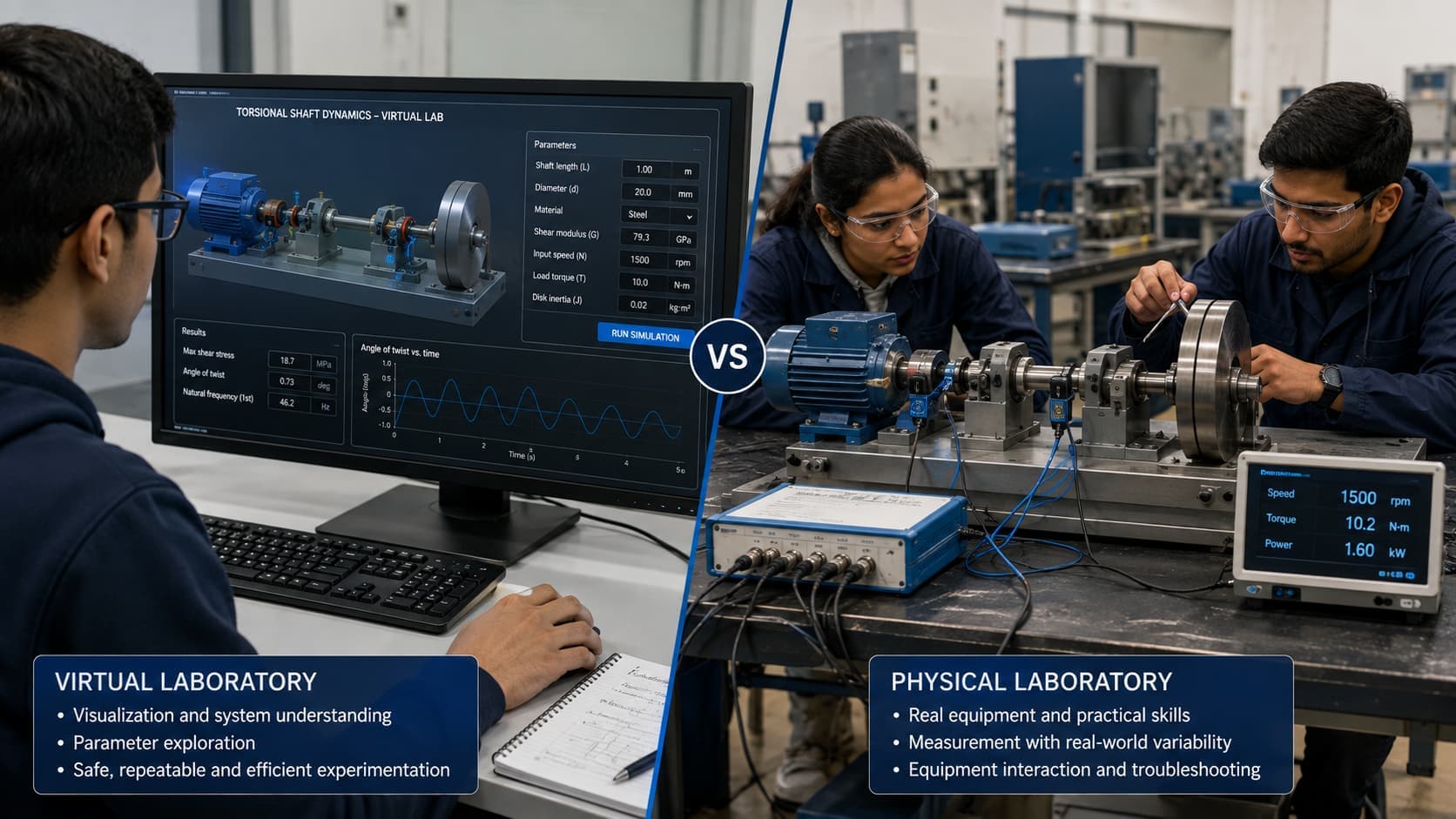
Virtual laboratories and physical laboratories are both valuable, but they are valuable for different reasons. Virtual laboratories can provide visualization, repetition, controlled experimentation, accessibility, preparation and low-risk exploration. Physical laboratories can provide real measurement, physical setup, equipment interaction, safety practice, authentic variability and practical troubleshooting.
The overlap is substantial. The equivalence is not complete. For mechanical engineering education, this leads to a more useful question than which laboratory is better: what competence are we trying to develop, and what evidence would prove that the student has developed it?
Sometimes the answer will be virtual. Sometimes physical. And often the strongest answer will be both, deliberately sequenced.
“For many mechanical engineering courses, the strongest approach is not virtual versus physical, but a deliberately designed virtual–physical sequence.”
Use virtual laboratories to expand what students can explore. Use physical laboratories where students need to encounter, measure and act on engineering reality.
References and further reading
- ABET — Criteria for Accrediting Engineering Programs, 2026–2027. Grounds laboratory design in experimentation, engineering judgement and outcome attainment, and states that for applicable advanced-level program contexts, remote or virtual laboratory access may replace physical access when it enables the intended educational activities.
- ABET — Criteria for Accrediting Engineering Technology Programs, 2026–2027. Reinforces the importance of adequate laboratories, equipment and modern engineering tools in supporting student outcomes.
- Li & Liang (2024) — Effectiveness of Virtual Laboratory in Engineering Education: A Meta-Analysis, PLOS ONE. Synthesized 46 study comparisons from 22 publications and found positive overall educational effects while concluding that virtual laboratories should complement rather than completely replace hands-on engineering laboratories.
- Wahyudi et al. (2024) — Understanding Virtual Laboratories in Engineering Education: A Systematic Literature Review. Review of 29 peer-reviewed articles published from 2018–2023, useful for discussing flexibility, accessibility, safety, motivation and limitations such as interactivity and technical issues.
- Frontiers in Education (2024) — Assessment of Accessibility in Virtual Laboratories: A Systematic Review. Adds nuance to claims about accessibility and demonstrates that digital access alone does not remove all barriers.