It is deciding what deserves to be learned deeply.
Industry 4.0 has created an unusual problem for mechanical engineers.
The problem is not a shortage of things to learn.
A student looking at modern manufacturing can easily come away with a frightening list:
Python. PLC programming. Robotics. Artificial intelligence. Machine learning. IoT. Digital twins. Data science. Cloud computing. Cybersecurity. Additive manufacturing. Computer vision.
Then there are the subjects already expected of a mechanical engineer:
Mechanics, thermodynamics, fluid mechanics, materials, machine design, manufacturing, maintenance and engineering drawing.
Trying to master all of them at specialist level is unrealistic.
And it is unnecessary.
Industry 4.0 readiness is better understood as a layered engineering capability. Mechanical engineers need strong understanding of physical systems, enough digital competence to work intelligently with connected machinery, and deeper expertise in the technologies most relevant to the problems they actually solve.
That distinction has become clearer in my own learning. Working with Python and digital engineering systems has not made mechanical fundamentals feel less useful. It has made them more useful because the software still needs a meaningful physical engineering problem underneath it.
The important question is therefore not:
“Which Industry 4.0 technologies should mechanical engineers collect?”
It is:
“Which capabilities allow a mechanical engineer to understand, improve and make decisions about increasingly connected physical systems?”
Industry 4.0 is more than factory automation
Automation existed long before the term Industry 4.0 became common.
What has changed is the degree to which manufacturing equipment, sensing, computation, communications, models and decision systems can be connected.
Modern smart manufacturing can bring together:
- Physical production equipment
- Sensors
- Controllers
- Industrial communication
- Data management
- Simulation
- Analytics
- AI
- Digital twins
- Human decision-making
International standardization reflects this systems perspective. IEC 63339:2024 establishes a unified smart-manufacturing reference model intended to represent products, production systems, services and their lifecycle relationships. ISO also maintains reference architectures for cyber-physically controlled machine tools and manufacturing digital twins.
This matters for skills.
Industry 4.0 does not create one new profession called "digital mechanical engineer."
It creates more interfaces between mechanical engineering and other technical disciplines.
Mechanical fundamentals remain the foundation
A connected bearing still carries load.
A digitally controlled shaft still transmits torque.
A robotic arm still has inertia.
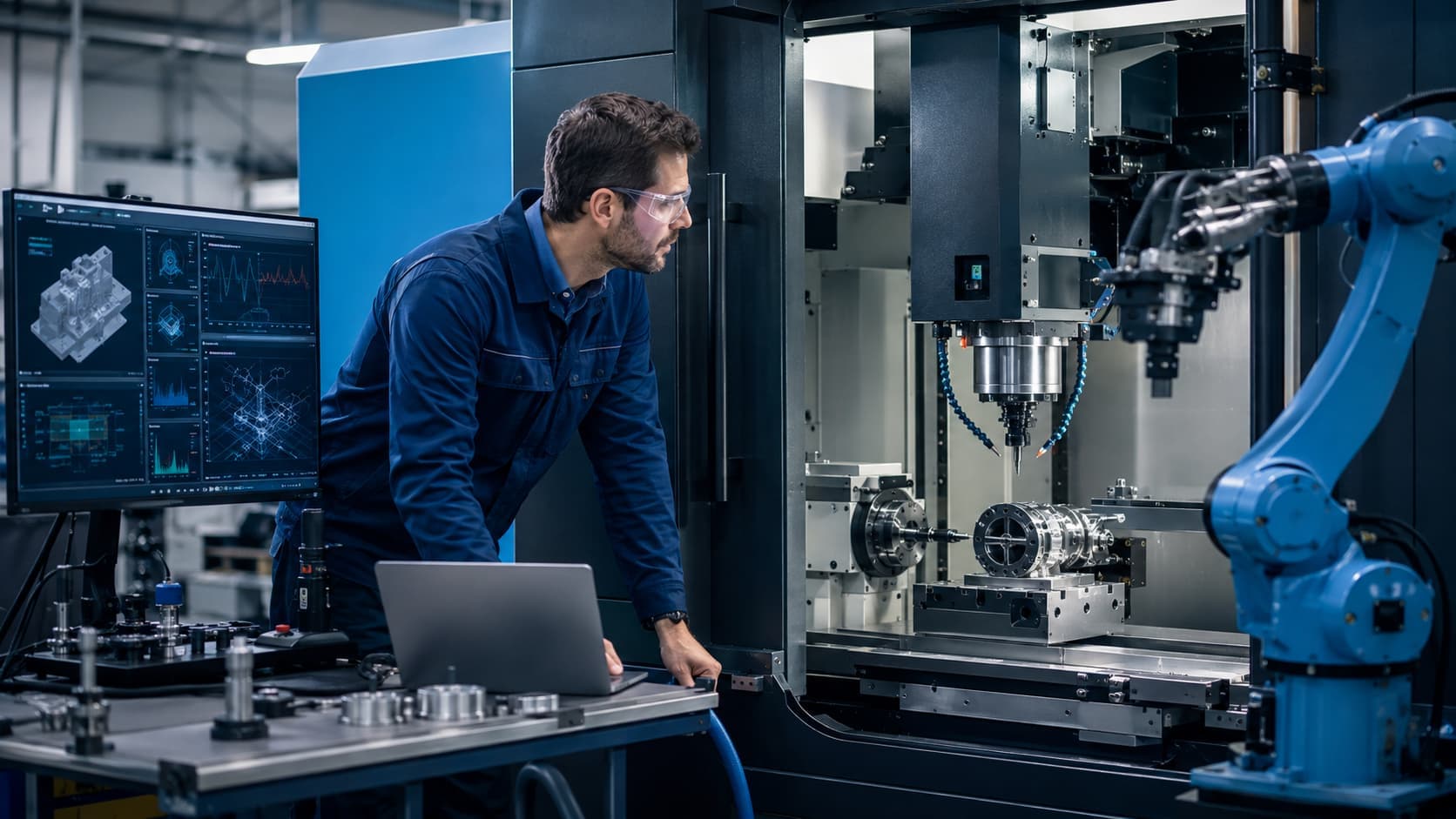
A CNC spindle still generates heat.
A pump connected to an IoT platform still obeys fluid mechanics.
A predictive-maintenance model may identify an abnormal vibration pattern, but the underlying machine still fails through physical mechanisms.
This is why mechanical fundamentals should not be treated as old knowledge that digital tools have replaced.
They provide the physical context required to decide whether digital outputs make sense.
A mechanical engineer working in Industry 4.0 should still be comfortable reasoning about areas such as:
- Forces and motion
- Stress and deformation
- Materials and failure
- Thermodynamics and heat transfer
- Fluids
- Machine elements
- Manufacturing processes
- Tolerances
- Vibration
- Maintenance and reliability
The required depth will differ by role, but abandoning this foundation creates a serious problem: the engineer may become able to process machine information without understanding the machine.
The first digital skill is not AI—it is digital engineering literacy
Before machine learning or digital twins, a mechanical engineer should be comfortable working with digital engineering information.
That includes being able to use and interpret tools such as:
- CAD
- Engineering drawings
- Simulation
- Spreadsheets
- Technical databases
- Plots
- Measurement data
It also means understanding the difference between a software output and an engineering conclusion.
A finite-element package can calculate a stress distribution.
It cannot automatically decide whether the boundary conditions represent reality.
A data-analytics platform can identify a trend.
It cannot automatically establish the physical cause.
Digital literacy therefore includes the ability to question:
- Inputs
- Assumptions
- Units
- Models
- Data quality
- Output plausibility
That habit becomes increasingly important as software becomes easier to use.
Should mechanical engineers learn programming?
For many roles, yes.
But the goal should not necessarily be to become a professional software developer.
Programming is valuable because engineering work contains many repetitive, parametric and data-intensive tasks.
A mechanical engineer might use code to:
- Automate calculations
- Process experimental data
- Analyse sensor signals
- Generate reports
- Explore design parameters
- Communicate with APIs or databases
- Build engineering prototypes
- Test algorithms
Programming also changes how engineers think about processes.
A manual calculation often represents one case.
A program forces you to ask:
- What are the inputs?
- What assumptions apply?
- What should happen when the input is invalid?
- Which steps repeat?
- How can the process be verified?
Those are useful engineering questions.
Why Python is particularly useful
Python is a practical entry point because it supports several engineering activities within one ecosystem:
- Numerical calculations
- Data analysis
- Plotting
- Signal processing
- Automation
- Machine learning
- Engineering-system prototypes
That breadth makes it particularly useful for engineers working across physical systems and data.
But Python should not become another checkbox.
The useful skill is not:
“I know Python syntax.”
It is:
“I can use programming to solve, analyse or automate an engineering problem.”
Depending on the role, another language or platform may matter more.
An automation engineer may spend much more time with PLC environments.
An embedded-systems engineer may need C or C++.
A numerical researcher may use MATLAB or another specialised environment.
“The tool follows the problem.”
Sensors and instrumentation deserve more attention
One of the most important Industry 4.0 skills for mechanical engineers is often less fashionable than AI: measurement.
An intelligent system needs information about the physical system.
That information may come from:
- Vibration sensors
- Temperature sensors
- Pressure sensors
- Current measurements
- Encoders
- Force or strain measurement
- Flow measurement
- Machine-controller data
A mechanical engineer should understand questions such as:
- What physical quantity should be measured?
- Where should the sensor be located?
- What range is appropriate?
- What sampling rate is required?
- What uncertainty or noise exists?
- Does the signal actually represent the phenomenon of interest?
“A weak measurement does not become useful simply because an advanced algorithm is applied afterward.”
This is particularly important in condition monitoring, process control and predictive maintenance.
Learn data acquisition before chasing big data
Between the sensor and an AI model lies an entire engineering chain.
A simplified flow is:
Physical process → sensor → signal conditioning → acquisition → transmission → storage → preprocessing → analysis → engineering decision
Every stage can affect the information.
Understanding this chain helps mechanical engineers avoid thinking of industrial data as numbers that simply appear in a spreadsheet.
It also makes collaboration with instrumentation, electrical, controls and software engineers much easier.
PLC and control-system literacy is highly valuable
Not every mechanical engineer needs to become a PLC programmer.
But engineers working with manufacturing equipment should understand the basic role of:
- PLCs
- Sensors
- Actuators
- Interlocks
- Machine states
- Control loops
- HMI systems
- Alarms
Why?
Because many mechanical problems now appear at the boundary between physical equipment and control logic.
Suppose a pneumatic actuator does not move.
Possible causes include:
- Insufficient pressure
- Mechanical obstruction
- Failed valve
- Sensor condition
- PLC logic
- Safety interlock
Looking only at the mechanical component may miss half of the system.
The Industry 4.0 mechanical engineer should therefore be able to reason across that boundary even if a controls specialist ultimately modifies the PLC program.
Industrial communication and IIoT: understand the architecture
Mechanical engineers do not need to memorize every industrial communication protocol.
They should understand why communication matters.
Connected manufacturing systems need ways to move information between:
- Machines
- Controllers
- Sensors
- Gateways
- Databases
- Analytics platforms
- Supervisory systems
The key concepts include:
- Machine data versus sensor data
- Local versus networked monitoring
- Interoperability
- Latency
- Data context
- Reliability
- Connectivity boundaries
NIST's smart connected manufacturing work focuses heavily on interoperability, heterogeneous data, communications and trusted standards-based digital information flows precisely because smart manufacturing depends on different systems being able to exchange and interpret information.
For mechanical engineers, architectural understanding is normally more valuable initially than becoming a networking specialist.
Data analysis and statistics belong before machine learning
Industrial AI begins with data.
Mechanical engineers working with data should understand basic ideas such as:
- Mean and variation
- Distributions
- Trends
- Correlation
- Outliers
- Sampling
- Uncertainty
- Visualization
They should also understand that correlation does not automatically identify a failure mechanism.
This is where mechanical knowledge remains important.
Suppose bearing temperature increases.
Data analysis may reveal the trend.
Engineering reasoning asks whether it could relate to:
- Load
- Lubrication
- Ambient temperature
- Speed
- Cooling
- Developing damage
“Statistics helps describe the evidence. Mechanical engineering helps interpret it.”
How much AI and machine learning should a mechanical engineer learn?
Enough to understand where it is useful, what information it requires, and what its limitations are.
For many mechanical engineers, the first level should include understanding:
- Supervised versus unsupervised learning
- Features and targets
- Training and testing
- Overfitting
- Classification and regression
- Validation
- False positives and false negatives
That is enough to participate intelligently in many engineering AI projects.
Specialists may go much further into:
- Feature engineering
- Deep learning
- Computer vision
- Time-series modelling
- Uncertainty
- Deployment
- MLOps
Not everyone needs that depth.
NIST's 2026 roadmap for AI and machine learning in smart manufacturing highlights not only industrial analytics but also sensing, heterogeneous control systems, explainability, reliability, digital twins, robotics and trustworthy operation. That breadth is a reminder that industrial AI is a systems problem, not simply a model-training exercise.
Condition monitoring is a natural bridge between mechanical and digital skills
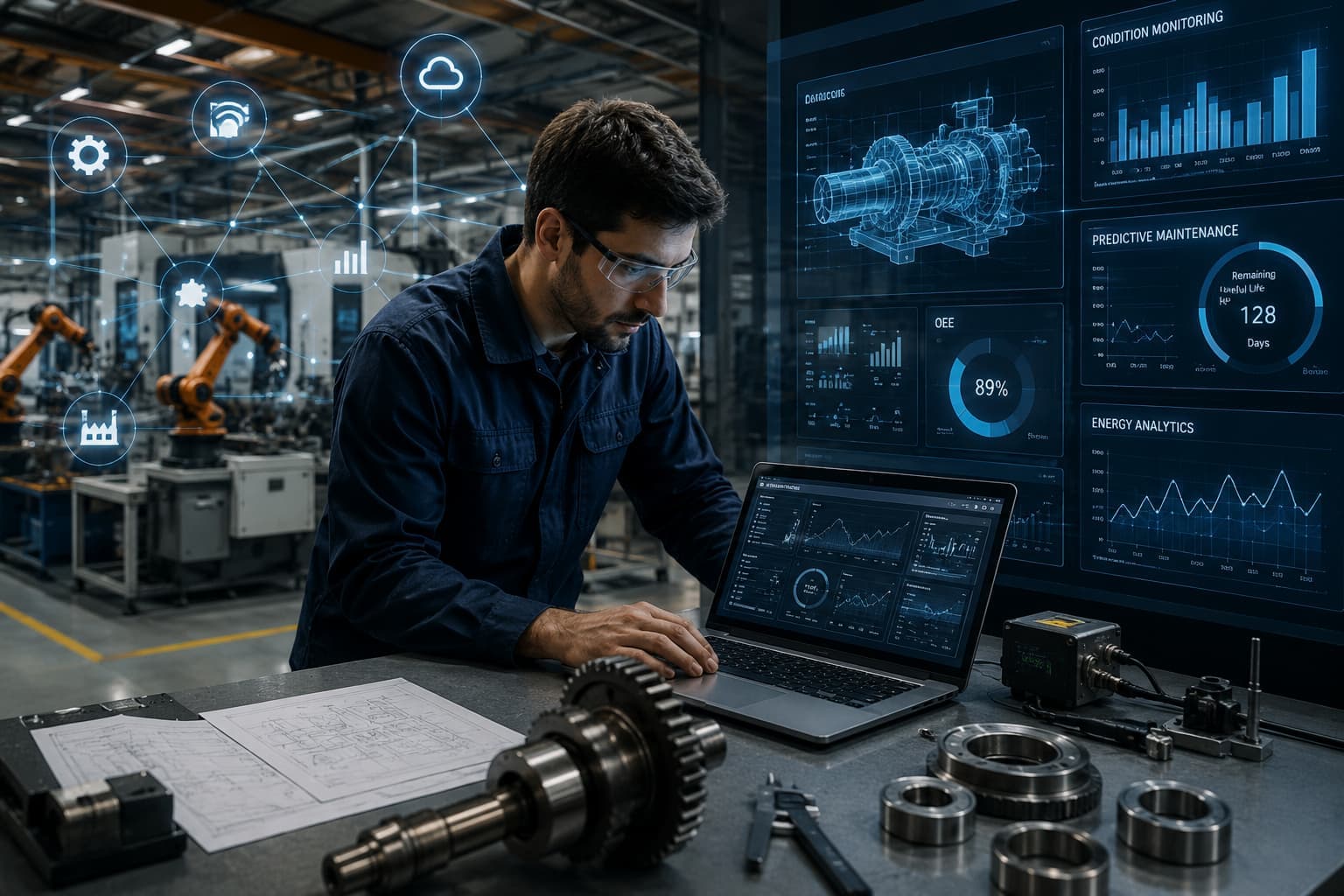
Condition monitoring is a particularly useful Industry 4.0 area for mechanical engineers because it sits directly between machine physics and data.
The engineer needs to understand:
Physical mechanism → measurable signal → data → interpretation → maintenance action
Consider vibration.
Software can process the signal.
But mechanical knowledge helps explain why vibration might change due to:
- Imbalance
- Misalignment
- Bearing behaviour
- Looseness
- Resonance
- Changing machine load
The value lies in connecting the signal back to the machine.
Predictive maintenance extends that connection by using historical and current condition information to support decisions about future maintenance.
Digital twins: learn the concept before the platform
"Digital twin" is another term that can encourage tool-first learning.
A mechanical engineer should first understand the basic concept:
- What physical entity or process is being represented?
- What data connect the physical and digital sides?
- What decision is the model supposed to support?
NIST describes manufacturing digital twins as systems combining models and data to help define, measure, analyse and control manufacturing systems. Its current work focuses heavily on validation, interoperability and trustworthiness—not merely visualization.
A 3D model alone is therefore not enough.
Digital-twin competence requires some combination of:
- Physical modelling
- Data
- Connectivity
- Simulation
- Validation
- Lifecycle information
Again, mechanical understanding remains central.
Cybersecurity awareness is becoming an engineering requirement
A standalone mechanical machine and a network-connected machine have different risk profiles.
When equipment becomes connected, engineering decisions can interact with cybersecurity decisions.
A mechanical engineer does not necessarily need to become a cybersecurity specialist.
But they should understand basic ideas such as:
- Unnecessary connectivity creates exposure
- Access should be controlled
- Engineering networks should not be treated like ordinary office networks
- Software and firmware changes can affect machine operation
- Data integrity matters
- Remote access needs governance
The World Economic Forum's 2025 skills survey places networks and cybersecurity among the fastest-growing skill areas, alongside AI, big data and technological literacy.
For engineers responsible for physical equipment, cybersecurity awareness is increasingly part of responsible systems thinking.
CAD, CAE and simulation remain core digital engineering tools
Industry 4.0 discussions sometimes make established engineering software sound old-fashioned.
It isn't.
Modern digital engineering still relies heavily on:
- CAD
- Finite-element analysis
- CFD
- Dynamic simulation
- Manufacturing simulation
- CAM
These technologies allow engineers to explore physical behaviour before or alongside physical testing.
What matters is learning to use them critically.
A student who knows how to press Solve but cannot identify an unrealistic boundary condition has software familiarity, not engineering simulation competence.
The valuable skill combines:
“Physical model + software + verification + engineering interpretation.”
Additive manufacturing is useful—but role dependent
Mechanical engineers should understand the engineering implications of additive manufacturing because it changes possibilities around:
- Geometry
- Material use
- Prototyping
- Tooling
- Production volume
- Design constraints
But not every mechanical engineer needs advanced additive-manufacturing specialization.
For someone working in conventional process plants, maintenance or rotating equipment, deeper reliability and instrumentation skills may be far more valuable.
For an engineer working in product development or aerospace manufacturing, additive manufacturing may deserve significant depth.
This is why skill selection should follow engineering context.
Systems thinking may be the most important Industry 4.0 skill
Digital technologies increase the number of interfaces inside engineering systems.
Consider a predictive-maintenance system.
It may include:
Machine → sensor → data acquisition → network → database → analytics → model → dashboard → maintenance decision
A technically excellent algorithm can still fail to create value if:
- The sensor measures the wrong phenomenon
- Data acquisition is unreliable
- Operating context is missing
- Alerts reach the wrong person
- Maintenance action is undefined
Systems thinking asks:
“How do the parts interact to produce the required engineering outcome?”
The growing importance of systems thinking is also reflected in employer skill expectations associated with technological change.
For mechanical engineers entering Industry 4.0, this capability often matters more than memorizing another programming framework.
Communication and multidisciplinary collaboration are technical skills too
Industry 4.0 systems rarely belong to one discipline.
A mechanical engineer may need to work with:
- Electrical engineers
- Instrumentation specialists
- Automation engineers
- Software developers
- Data scientists
- Maintenance technicians
- Production personnel
- Cybersecurity teams
The mechanical engineer does not need to perform every person's job.
They need enough shared technical language to work across interfaces.
That means being able to explain:
- What the machine is physically doing
- Which constraint matters
- What measurement is needed
- What failure mode is plausible
- What output would actually support a decision
Strong multidisciplinary collaboration begins with strong domain understanding.
Understand, use or specialize?
Not every skill deserves the same depth.
A practical rule is to classify skills into three levels.
Understand
Know what the technology does, what problem it solves, what information it requires and what its limitations are.
Every modern mechanical engineer should have this level for most common Industry 4.0 technologies.
Use
Be able to apply the technology competently in normal engineering work.
Examples might include:
- Analysing data in Python
- Interpreting PLC states
- Using simulation software
- Working with condition-monitoring signals
The skills required here depend on the role.
Specialize
Be capable of designing, implementing, optimizing or researching the technology itself.
Examples include:
- Industrial robotics
- Advanced controls
- Machine learning
- Digital-twin architecture
- Industrial cybersecurity
Few engineers need specialist depth across all of these.
That is perfectly normal.
The Industry 4.0 Skills Stack for Mechanical Engineers
A useful way to organize the entire learning problem is as a stack.
Layer 1 — Mechanical engineering foundation
Build strong understanding of:
- Mechanics
- Dynamics
- Materials
- Thermodynamics
- Fluid mechanics
- Manufacturing
- Machine design
- Maintenance and reliability
This is what gives digital information physical meaning.
Layer 2 — Digital engineering literacy
Develop practical competence in:
- CAD/CAE
- Simulation
- Spreadsheets
- Engineering data
- Basic programming
- Digital technical documentation
Layer 3 — Connected machine competence
Understand:
- Sensors
- Instrumentation
- Data acquisition
- PLC and control concepts
- Industrial communication
- IIoT architecture
Layer 4 — Data and intelligence
Develop capability in:
- Statistics
- Python/data analysis
- Signal analysis where relevant
- Condition monitoring
- Introductory machine learning
- Predictive maintenance
Layer 5 — Systems integration
Understand how to connect:
- Physical machinery
- Control
- Data
- Software
- Digital models
- Maintenance or production decisions
Include awareness of:
- Interoperability
- Cybersecurity
- Validation
- Lifecycle data
Layer 6 — Specialization
Choose according to career direction.
Possible examples include:
- Industrial AI
- Robotics
- Advanced automation
- Reliability engineering
- Digital twins
- Additive manufacturing
- Advanced controls
- Energy systems
“The most important feature of this stack is the bottom.”
If the higher digital layers cannot be connected back to physical engineering, the engineer risks becoming fluent in tools without being equally strong at engineering decisions.
A practical learning roadmap
For a student or practising engineer, I would not begin by enrolling in five unrelated Industry 4.0 courses.
A more coherent progression is:
First, strengthen the mechanical and manufacturing fundamentals relevant to the type of equipment you want to work with.
Second, become comfortable with digital engineering tools and technical data.
Third, learn basic programming through actual engineering problems rather than isolated syntax exercises.
Fourth, learn how machines are measured and controlled through sensors, instrumentation and PLC/control fundamentals.
Fifth, start analysing real or realistic engineering data.
Sixth, explore AI, predictive maintenance, digital twins or other advanced technologies once you can connect them to a meaningful physical problem.
Finally, choose one or two areas for deeper specialization.
Learning should remain cyclical.
A predictive-maintenance project may send you back to vibration theory.
An automation project may send you back to dynamics.
An energy-monitoring system may require deeper thermodynamics.
“That is not moving backwards. That is engineering learning working properly.”
What should engineering programmes teach?
Mechanical-engineering curricula do not need to transform into compressed degrees in software engineering and data science.
But Industry 4.0 does create a legitimate curriculum question:
“Which digital capabilities now belong to the normal toolkit of a mechanical engineer?”
A strong programme could integrate digital skills into existing mechanical problems.
Teach programming through:
- Numerical engineering calculations
- Machining geometry
- Thermodynamic cycles
- Sensor data
Teach data analysis through:
- Vibration
- Temperature
- Manufacturing measurements
- Energy use
Teach automation through:
- Actuators
- Machine sequences
- Process control
Teach AI through real engineering prediction problems where physical interpretation remains necessary.
This approach keeps the technology connected to engineering rather than creating an unrelated collection of software modules.
Industry 4.0 does not reduce the value of mechanical engineering
The machines may become more connected.
The software may become more capable.
AI may automate parts of analysis.
But industrial systems still contain:
- Structures
- Shafts
- Bearings
- Motors
- Fluids
- Heat
- Tools
- Materials
- Loads
- Wear
What is changing is the amount of information we can collect about those systems and the sophistication with which we can control and analyse them.
That creates an opportunity for mechanical engineers.
A person who understands both what the physical machine is doing and how digital systems can measure, model and improve it can operate across a very valuable boundary.
Key takeaway
Mechanical engineers should not respond to Industry 4.0 by trying to become specialists in every new technology.
Start with the physical engineering. Then build digital capability around it.
Learn enough programming to automate and analyse engineering work.
Understand sensing and data acquisition because intelligent systems begin with measurement.
Learn enough automation and connectivity to understand how modern machines exchange information and respond to commands.
Develop data and AI literacy without treating every engineering problem as a machine-learning problem.
Understand systems integration. Then specialize according to the engineering problems you want to solve.
The goal is not to become:
“Mechanical engineer + software engineer + data scientist + automation engineer + cybersecurity specialist.”
The goal is to become:
“A mechanical engineer who can operate intelligently inside increasingly digital engineering systems.”
Industry 4.0 readiness is not about learning every technology. It is about knowing how physical engineering, data, automation and software fit together well enough to solve real engineering problems.
References and further reading
- NIST — 2026 Roadmap on Artificial Intelligence and Machine Learning for Smart Manufacturing. Current overview of AI/ML foundations, industrial data, sensing, control integration, robotics, digital twins and trustworthy smart manufacturing.
- IEC 63339:2024 — Unified Reference Model for Smart Manufacturing. Standards-level framework for understanding smart manufacturing as interconnected products, production, equipment and lifecycle systems.
- ISO 23704-2:2022 — Cyber-Physically Controlled Smart Machine Tool Systems. Reference architecture for connected subtractive-manufacturing machine-tool systems.
- NIST — Smart Connected Manufacturing Systems. Covers interoperability, industrial communications, heterogeneous data, model-based practices and industrial AI evaluation.
- NIST — Manufacturing Digital Twin Standards / Digital Twins for Advanced Manufacturing. Relevant to digital-twin architecture, interoperability, reliability and validation.
- World Economic Forum — Future of Jobs Report 2025. Employer-based perspective on the growing importance of AI/data, cybersecurity, technological literacy, analytical thinking and systems thinking.