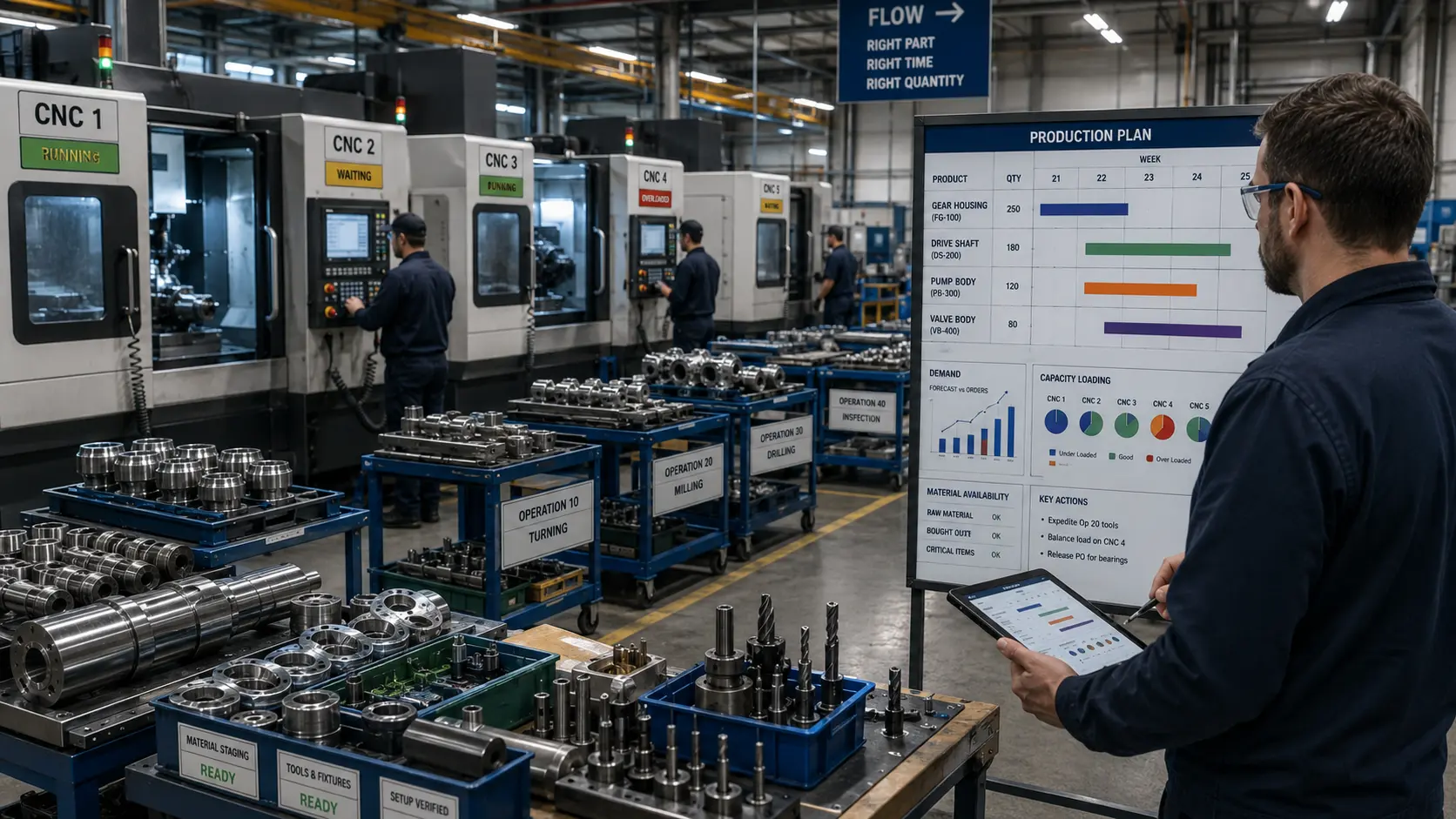
A manufacturing process can be technically capable and still perform poorly. The machine may be available, the operator may understand the task, and the process may be proven — yet production can still lose time to missing material, unavailable tooling, an overloaded machine, or a schedule that changes before the previous version was even executed. Manufacturing efficiency does not begin when the machine starts cutting. It begins earlier, in production planning.
Production can lose time even when the underlying technical process is capable — material is missing, tooling is unavailable, the schedule changes repeatedly, too many jobs are released at once, one machine is overloaded while another sits idle, maintenance conflicts with production, or components spend more time waiting than being processed.
This is why manufacturing efficiency does not begin when the machine starts cutting. It begins earlier, when the production system decides what should be produced, when, with which resources, and in what sequence. That is the role of production planning.
Modern production-planning systems increasingly make this relationship explicit. SAP describes production planning and scheduling as coordinating sales, operations and inventory while considering constraints such as machine capacity, labour and tooling availability, and incorporating feedback from manufacturing execution. The software may be sophisticated, but the engineering principle underneath it is simple: a production plan eventually becomes a physical demand on machines, materials, people and time. If those demands are poorly coordinated, manufacturing pays the price.
What is production planning?
Production planning determines how manufacturing resources should be organized to satisfy expected production requirements. Depending on the organization, planning may consider expected demand, customer orders, inventory, material requirements, machine capacity, labour, tooling, maintenance and lead times.
The output of production planning may then feed more detailed activities such as Master Production Scheduling, Material Requirements Planning, capacity planning and detailed shop scheduling. The precise planning architecture differs between manufacturing environments, but the purpose remains similar: translate demand into an executable production plan.
Production planning and production scheduling are not identical
These terms are often used interchangeably. They are related but operate at different levels.
- Production planning asks: what should we produce, how much, what resources will we need, and is adequate capacity available?
- Production scheduling asks: which order runs first, on which resource, at what time, and in what sequence?
SAP's current production-planning systems reflect this difference by supporting both higher-level planning and detailed resource scheduling, where operation requirements are checked against available resource capacity.
“Planning defines what the manufacturing system should achieve. Scheduling determines how work is positioned in time to achieve it.”
Why production planning is an engineering problem
Planning can appear administrative because much of it happens inside ERP systems, spreadsheets and planning software. But every planning number eventually reaches physical equipment.
Suppose the plan requires 500 components tomorrow. A mechanical or manufacturing engineer should immediately ask which machine will produce them, what the actual cycle time is, how much usable machine time exists, whether fixtures and cutting tools are available, whether raw material is ready, whether maintenance is planned, what the expected good-product yield is, and whether another product is competing for the same machine.
The schedule cannot manufacture anything. The physical system must execute it.
The Production Planning–Efficiency Chain
A practical way to examine this relationship is through eight stages — an explanatory framework for this article, not an official SAP or ASCM model.
- 1. Demand — what does the production system need to supply?
- 2. Materials — are the correct materials and components available when needed?
- 3. Capacity — can machines, labour and tooling support the required output?
- 4. Sequence — in what order should production run?
- 5. Execution — can the shop floor realistically perform that plan?
- 6. Flow — does work move through the system or spend most of its time waiting?
- 7. Output — are good products reaching the required destination at the required rate?
- 8. Feedback — what actually happened, and what should change in the next plan?
Manufacturing efficiency is not simply machine utilization
One of the most damaging misunderstandings in production management is treating an efficient factory as one where every machine runs continuously.
Consider two processes. Machine A can produce 100 units per hour. Machine B can process 60 units per hour. If A runs continuously, the production line does not suddenly deliver 100 finished units per hour — Machine B remains limited to approximately 60. The extra 40 units per hour accumulate between the processes.
Machine A may appear highly utilized. But the system now has more WIP, more handling, more floor-space use and longer queues.
“Efficiency should be evaluated at the level of the production system, not only at the level of individual machines.”
This is one of the strongest connections between production planning and lean thinking.
Capacity planning turns quantity into resource demand
Suppose production planning says produce 240 units, and each unit requires 0.25 machine-hour on a critical machining centre. Required capacity is 240 × 0.25 = 60 machine-hours.
If usable capacity is only 48 hours, the production requirement exceeds capacity by 60 − 48 = 12 hours. The plan cannot be executed as written.
Something must change. Options might include rescheduling, legitimate overtime, another capable resource, subcontracting or revising the commitment. The correct response depends on the situation, but ignoring the capacity problem does not remove it.
Calendar time is not productive capacity
Suppose a machine is scheduled for an eight-hour shift. It is tempting to assume available capacity equals eight hours. But the resource may also require planned maintenance, setup, changeover, cleaning or calibration.
SAP's capacity-planning documentation explicitly distinguishes available capacity using operating-time information and factors such as breaks and utilization. This creates an important planning distinction: calendar time is not necessarily usable production capacity. A plan based entirely on theoretical hours may continuously overestimate what production can actually achieve.
Equipment downtime must be visible to planning
This seems obvious — if the machine is stopped, it cannot simultaneously produce. Yet planning and maintenance are sometimes treated as separate worlds.
SAP's PP/DS documentation makes the logic explicit: where resource downtime is defined, capacity is unavailable in that period. Production plans should therefore reflect predictable losses such as planned maintenance, shutdowns, major servicing and calibration. Otherwise the same machine-hours are effectively promised twice.
Material availability converts capacity into production
Imagine the machine is available, the operator is available and tooling is prepared, but raw material has not arrived. The machine waits, and planned productive capacity becomes idle capacity.
Material planning therefore directly affects manufacturing efficiency. Material that arrives much too late creates waiting; material that arrives far too early can create excess inventory. The objective is coordinated availability.
Tooling can become the hidden constraint
Generic planning discussions often focus on labour, machines and materials. Mechanical manufacturing has another important resource: tooling.
Production may be unable to start because a fixture is being used elsewhere, a cutting insert is unavailable, a special gauge is not ready, or a die or mould is undergoing maintenance. SAP's advanced production-planning platform explicitly includes tool availability among relevant production constraints.
“The production system needs the complete resource combination — not just a free machine.”
Sequence influences setup time
Imagine a machine produces three product families: A, B and C. A poor sequence might be A, then B, then A, then C, then A — every product change requires setup, and the schedule may create several avoidable changeovers.
A more carefully designed sequence might reduce changeover losses. But there is an important trade-off: grouping all Product A work into one large batch may reduce setups but create inventory, waiting and delayed response for B and C.
“The best sequence is not necessarily the one with the fewest setups. It should balance demand, due dates, setup losses, capacity and flow.”
Production planning affects lead time
Processing time is only one part of manufacturing lead time. SAP's current production-planning analytics separates components such as processing time, queue time, setup time, wait time and overall lead time.
Imagine a component requires 20 minutes of actual machining, yet the production order takes two days to move through the factory. The missing time may be queued before the machine, waiting for inspection, waiting for material movement, or waiting for the next operation.
Improving cutting time from 20 minutes to 18 minutes is a real technical improvement, but it may do little for the two-day lead time. Planning therefore needs to consider flow time, not only machine processing time.
Bottlenecks deserve special attention
Manufacturing systems rarely have equal capacity everywhere — one process may constrain the entire production flow.
Suppose Process A can run 80 units per hour, Process B can run 45 units per hour, and Process C can run 70 units per hour. Process B limits throughput. Loading A and C aggressively does not remove that constraint — it may simply create queues around B.
SAP's current capacity-management tools explicitly expose resource overload, backlogs and material shortages so planners can respond to constrained resources.
“System capacity is shaped strongly by its constraints, not merely by the sum of individual machine ratings.”
Releasing more work does not create more capacity
Suppose one machining centre has a long queue. Management responds by releasing even more production orders. The queue becomes larger — nothing about the machine's processing capacity has changed.
Work release and productive capacity are different things. Too much WIP can create longer lead times, prioritization problems, excessive handling and hidden delays. A factory can look extremely busy while customer orders move slowly.
Inventory and planning are closely connected
Production planning influences raw-material inventory, WIP and finished-goods inventory. Planning too little can produce shortages, machine starvation and missed deliveries. Planning too much can create overproduction, storage requirements, tied-up capital and unnecessary handling.
This is why production planning connects so naturally with lean manufacturing. The goal is not maximum stock protection or absolute zero inventory — it is appropriate inventory for the required production system.
Poor planning creates expediting
A common symptom of planning problems is constant expediting. An order becomes late, management changes priority, another job is interrupted, material is rushed, a setup is abandoned, and overtime is added — then another order becomes late.
This cycle can become poor plan, expediting, schedule disruption, new lateness and more expediting. It can consume enormous management attention without increasing actual productive capacity.
Schedule stability improves execution
A production schedule cannot be completely rigid — demand changes, machines fail, and suppliers are late. But constant unnecessary changes also have a cost. Each late priority change may affect material allocation, tooling, labour, setups and work already released.
“Responsiveness is useful. Instability is not.”
A capable planning system should change when genuine new information justifies change, rather than continuously rewriting priorities because the previous plan was unrealistic.
My perspective from practical engineering environments
I have encountered situations in engineering and workshop environments where the technical work itself was achievable, but poor coordination or planning created avoidable waiting, repeated changes, material problems or unnecessary pressure.
This reinforces an important distinction: not every production delay is evidence that the machine is inadequate, the operator is slow, or the engineering method is wrong. Sometimes the process is technically capable, and the surrounding production system has simply coordinated the work poorly. That means manufacturing improvement sometimes needs to investigate the planning system, not only the physical process.
Production planning can influence quality indirectly
Planning should not be blamed automatically for defects — quality problems usually require specific technical investigation. However, poor planning can create conditions where quality becomes more difficult to maintain, such as rushed setup, excessive priority changes, overtime or skipped preparation.
The correct conclusion is not that bad schedules cause every defect. It is that manufacturing conditions created by planning can influence how consistently the technical process is executed — which is where Six Sigma or Root Cause Analysis may become useful.
Production planning and maintenance should share the same reality
Production often wants maximum machine availability. Maintenance needs access to equipment to preserve reliability. If planned maintenance is continually postponed for short-term production, future reliability may deteriorate and failures may become harder to predict.
The opposite problem also exists — maintenance performed without understanding critical production periods can create unnecessary delivery disruption. The better approach is coordination: production requirements and maintenance requirements should enter the same capacity conversation.
Production planning and OEE
Production planning and OEE solve different problems. Production planning asks what work equipment should perform and when. OEE asks how effectively the equipment performed during planned production time.
OEE can therefore provide useful evidence for planning. Suppose the planner assumes 100 units per hour, but historical machine performance consistently shows downtime, reduced speed and quality losses. Planning based entirely on nominal machine capacity may repeatedly fail.
“Theoretical capacity tells us what a machine could produce under assumptions. Operating evidence helps tell us what the production system can realistically expect.”
Production planning and lean manufacturing
Lean manufacturing emphasizes value, flow, pull and reducing unnecessary inventory and waiting. Poor planning can generate the opposite: overproduction, excessive WIP, queueing and repeated changes.
Lean execution still requires planning discipline, but lean also warns against over-planning production detached from actual demand. The useful combination is planning enough to coordinate the system while allowing execution to respond sensibly to real demand and process conditions.
Production planning and the Toyota Production System
The Toyota Production System emphasizes coordinated flow and producing what is required, in the required quantity, at the required time. Production planning works at a broader organizational level but supports similar concerns: quantity, timing, capacity and material coordination.
“A factory cannot create stable flow if upstream plans continuously generate unstable requirements.”
Production planning and Six Sigma
Six Sigma focuses strongly on process variation. That affects planning more than it may first appear.
Suppose the nominal cycle time is 10 minutes, but actual performance varies between 8 and 22 minutes — planning capacity becomes uncertain. Likewise, if product yield varies significantly, a schedule of 100 units may not reliably generate 100 good units.
More stable processes make planning assumptions more dependable. Process stability improves planning reliability.
Finite versus infinite capacity
This distinction helps engineering students understand why some schedules look feasible in software but fail physically.
Infinite-capacity approach
Requirements may initially be placed in time without restricting them to what the resource can physically execute. Overload becomes visible afterward.
Finite-capacity approach
The scheduling process respects available resource capacity and may move work to another available period when the resource is full. SAP's PP/DS documentation provides a concrete example: a bucket-oriented capacity check determines whether sufficient capacity exists before reserving it, and searches for later available capacity if needed.
“A plan should ultimately respect the finite nature of physical resources.”
Industry 4.0 can improve planning feedback
Modern manufacturing can provide planning systems with data from CNC controllers, PLCs, MES, inventory systems and condition-monitoring systems. This can improve visibility into current machine state, production progress, actual cycle time, material status and downtime.
SAP's current planning platform specifically emphasizes feedback between manufacturing execution, ERP and planning systems. But more information does not automatically create better planning — a bad planning rule connected to real-time data can still produce bad decisions faster. Engineering interpretation remains necessary.
Production planning should operate as a feedback system
A weak planning process works like this: plan, send schedule to factory, finished. A stronger process works like plan, execute, measure, compare, learn, update the next plan.
Why? Because planning assumptions may differ from reality. Expected cycle time might be 10 minutes and actual 13 minutes; expected setup might be 30 minutes and actual 55 minutes; expected availability might be 90% and actual performance may differ. Those differences are information.
The Plan–Execute–Learn Loop
This is an explanatory framework for this article, not an official SAP or ASCM model.
| Stage | What happens |
|---|---|
| Plan | Use demand, materials, capacity and timing to set the production plan. |
| Execute | Manufacturing uses machines, people, tooling and production orders to carry it out. |
| Measure | Record meaningful actual information — output, downtime, quality, queues, inventory. |
| Compare | Identify where actual performance differed from the plan. |
| Learn | Determine whether the difference was caused by inaccurate planning assumptions, equipment loss, process variation, material shortage or unexpected demand. |
| Update | Improve the next planning cycle, then repeat. |
This makes production planning an engineering feedback system rather than a static administrative exercise.
Common production-planning mistakes
- Planning from theoretical machine capacity. Calendar availability is not always productive capacity.
- Loading every machine as heavily as possible. Maximum utilization can create WIP rather than throughput.
- Ignoring bottlenecks. Improving non-constrained resources may not improve the production system.
- Releasing too much WIP. More work in the queue does not create more capacity.
- Ignoring tooling. An available machine without the necessary fixture or tool is not fully available production capacity.
- Ignoring maintenance. Planned production and planned downtime cannot occupy the same resource at the same time.
- Changing priorities constantly. Repeated rescheduling can create additional setup, material and execution losses.
- Producing early just to keep machines busy. This may create overproduction.
- Ignoring execution feedback. Plans based on incorrect cycle-time or availability assumptions will continue failing.
- Treating every missed schedule as a shop-floor problem. Sometimes the execution system did not fail — the original plan was unrealistic.
What mechanical engineers should understand
A mechanical engineer may not be responsible for creating the entire production schedule. But engineering decisions strongly influence planning.
- Machine capability determines possible production rates.
- Reliability influences available capacity.
- Setup design influences changeover time.
- Tooling determines whether a process can actually run.
- Layout influences movement and flow.
- Quality performance determines good output.
- Maintenance consumes capacity but protects future availability.
- Process variation influences predictability.
These are engineering variables. Production planning converts them into operational consequences.
Key takeaway
Manufacturing efficiency does not start at the spindle, assembly station or production line. It starts earlier — the production system must coordinate demand, materials, capacity, tooling, maintenance, sequence and time.
When that coordination is poor, the factory can experience waiting, excess WIP, overloaded resources, idle equipment, schedule instability and expediting. When it is stronger, production has a more realistic path from demand to completed product.
“Do not ask only whether the manufacturing process is technically capable. Ask whether the production plan allows that capability to be used effectively.”
And when actual production differs from the plan, treat the difference as engineering information. The next plan should be better because the factory has learned something.
References and further reading
- SAP — Production Planning and Scheduling. Overview of coordinating sales, operations and inventory while considering machine capacity, labour and tooling constraints, with feedback from manufacturing execution.
- SAP Help Portal — Capacity Planning and Available Capacity. Explains how available capacity is calculated from operating time, breaks and utilization rather than raw calendar time.
- SAP Help Portal — PP/DS Capacity Check and Resource Downtime. Describes how defined resource downtime removes capacity from a period and how finite scheduling searches for later available capacity.
- SAP Help Portal — Production Planning Analytics. Breaks manufacturing lead time into processing time, queue time, setup time and wait time.
- SAP — Industrial AI and Manufacturing Execution Feedback. Discusses feedback between manufacturing execution, ERP and planning systems in connected production environments.