Industrial AI is not a better version of automation — it is a different tool for a different class of problem, and manufacturers who reach for it before checking whether a deterministic rule would already solve the problem are usually adding risk, not capability.
A control cabinet full of interlocks, sequencing logic and PID loops has been reliably running manufacturing equipment for decades.
That equipment is not obsolete. Most of it is still exactly the right tool for the job it does.
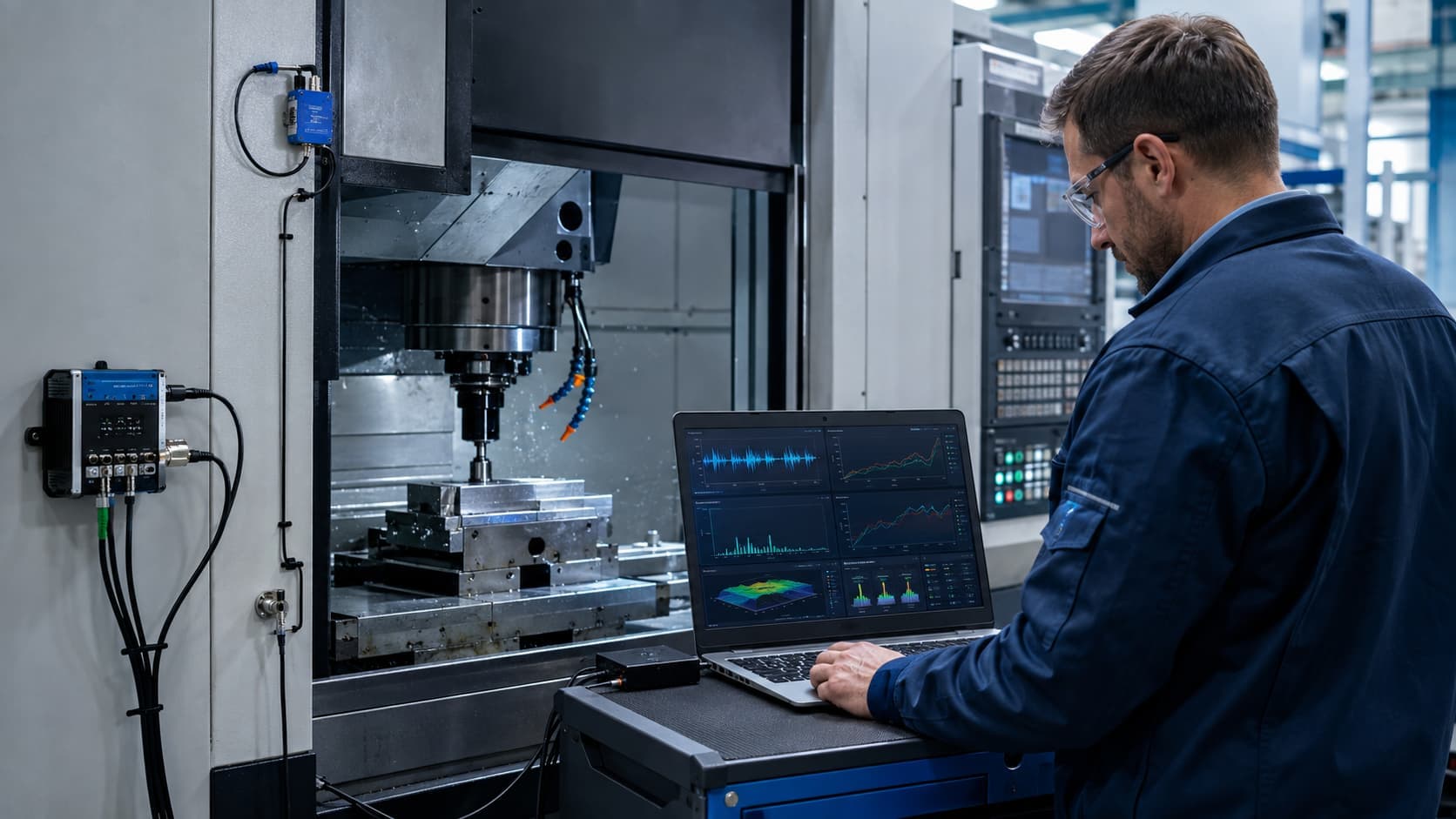
At the same time, manufacturers are increasingly surrounded by cameras, vibration sensors, process historians and enough compute to train models on all of it.
The question this raises is not "should we use AI" or "should we keep using automation."
“The question is: for this specific problem, is the behaviour known well enough to engineer it directly, or does it need to be learned from data?”
Get that question wrong in one direction and a manufacturer spends money training a model to approximate a rule an engineer could have written in an afternoon. Get it wrong in the other direction and a manufacturer keeps trying to hand-code a pattern that is genuinely too complex, high-dimensional or context-dependent to specify explicitly — and the logic never quite works.
Traditional automation still solves most manufacturing problems
Deterministic automation means the behaviour is engineered in advance: given the same input, it produces the same output, every time.
That determinism is not a limitation to be engineered away. It is the entire point.
A PLC running an interlock, a sequencer stepping through a machining cycle, and a PID loop holding a temperature setpoint all share the same property: the rule was known, so the rule was written down.
That is not a weaker or older way of solving the problem. For anything where the correct behaviour can be fully specified in advance, it is the correct way to solve the problem.
Where deterministic automation is the right tool
Deterministic logic is the right choice whenever the relationship between input and required action is already understood well enough to write it down explicitly. Typical examples include:
- Interlocks — preventing a hazardous condition through hard, engineered logic
- Sequencing — executing an ordered set of operations and managing machine state
- Threshold alarms — flagging a value once it crosses a known, defined limit
- PID and closed-loop control — holding a process variable at a setpoint using feedback
These are consistent, repeatable and verifiable. A reviewer can read the logic and know exactly what the system will do in every state it can reach. That is a genuine engineering advantage — not something to trade away for a learned model unless there is a real reason to.
Where Industrial AI becomes genuinely useful
Industrial AI earns its place where an important pattern exists in the process, but that pattern is difficult or impractical to encode as an explicit rule — while still being learnable from representative historical or real-time data.
That description points toward a specific family of tasks, not manufacturing in general:
- Defect recognition — classifying visual or dimensional variation that is too subtle or too varied to describe as a fixed rule set
- Anomaly detection — flagging process behaviour that deviates from a learned normal, when "normal" is too high-dimensional to threshold directly
- Degradation prediction — estimating how a component's condition is likely to evolve from patterns in historical condition data
- Process optimization — searching a large, interacting parameter space for better setpoints or schedules than a fixed rule can reach
Notice what these have in common: prediction, classification, anomaly detection and complex optimization. That is where the learned-model approach in AI for CNC Predictive Maintenance tends to add real value — not because AI is more advanced than automation, but because the pattern genuinely resists being written down as a rule.
AI is not a substitute for missing sensors or missing engineering understanding
A model can only learn a pattern that is actually present in the data it is given.
If the sensor that would reveal a failure mechanism was never installed, no amount of modelling recovers that missing signal. If the historical data does not cover the operating conditions the model will later see in production, the model has nothing to generalize from.
This is a common failure mode in industrial-AI projects: treating a data-science technique as a substitute for instrumentation, sensing or basic process understanding that was never engineered into the system in the first place.
AI does not remove the engineering work of understanding the physical system. It depends on it.
Safety and protective control must remain deterministic
This point deserves to be stated without qualification.
Appropriately engineered safety interlocks, emergency-stop systems and deterministic protective control should not be replaced by general-purpose AI.
Safety-rated logic exists because its behaviour must be fully specifiable, verifiable and certifiable — the same input must always produce the same protective action, and that behaviour must be demonstrable in advance, not inferred statistically after the fact.
A learned model, by its nature, characterizes behaviour probabilistically from data. That is exactly the property that makes it useful for prediction and classification — and exactly the property that disqualifies it from being the safety authority in a protective function.
Industrial AI can inform a safety-related decision. It can raise an early warning, flag an anomaly, or support an engineer's judgment. It should not be the deterministic mechanism that a hard interlock or an emergency stop depends on.
The Industrial AI Necessity Test
Before adding AI to a manufacturing problem, it helps to work through a deliberately conservative sequence of questions — one that defaults toward conventional automation and only advances toward AI when the answer genuinely requires it.
1. Can reliable rules solve the problem?
If explicit logic, calculations or deterministic algorithms can solve it reliably, prefer them.
2. Is existing control already adequate?
If current control, logic or supervision already meets requirements, do not add AI.
3. Is there a hard-to-encode pattern?
Look for complex, high-dimensional, nonlinear or context-dependent relationships.
4. Is representative data available?
This means sufficient quantity, quality, coverage of operating conditions, and proper labeling.
5. Does the task require prediction, classification or optimization?
AI is most applicable to predictive, classificatory or optimization tasks.
6. What happens if the model is wrong?
Assess the risk to safety, quality, cost, delivery, equipment and compliance.
7. Can its output be verified or bounded?
Consider whether results can be checked, cross-validated, constrained, or provided with confidence limits.
8. Will it improve a real manufacturing decision?
It must lead to better decisions, performance, yield, quality, OEE, cost or responsiveness — not simply exist as a model.
9. Can the system be maintained over time?
Consider data drift, retraining needs, monitoring, governance, documentation and ownership.
10. Is AI actually better than the simpler alternative?
The benefit over a simpler, lower-risk, lower-cost alternative should be demonstrable, not assumed.
The outcome of that sequence sorts into three categories:
Use conventional automation. Rules, logic or existing control are sufficient; lower complexity, risk and cost; easier to verify, validate and maintain.
Use AI as support. AI augments human or rule-based decisions, providing insights, recommendations or monitoring rather than sole authority — kept human-in-the-loop with clear oversight.
Consider AI-enabled automation. AI is needed to drive or optimize decisions, with managed risk through verification and safeguards, integrated, maintained and governed as part of the automation system.
This framework does not replace engineering judgment. Assumptions, evidence and decision rationale still need to be documented at each step.
A three-layer architecture for industrial AI
Once AI is justified for a specific problem, the question shifts from whether to use it to where it sits relative to existing control. A useful architecture separates the system into three layers:
Layer 1 — deterministic automation + Layer 2 — industrial intelligence + Layer 3 — engineering / operational decision
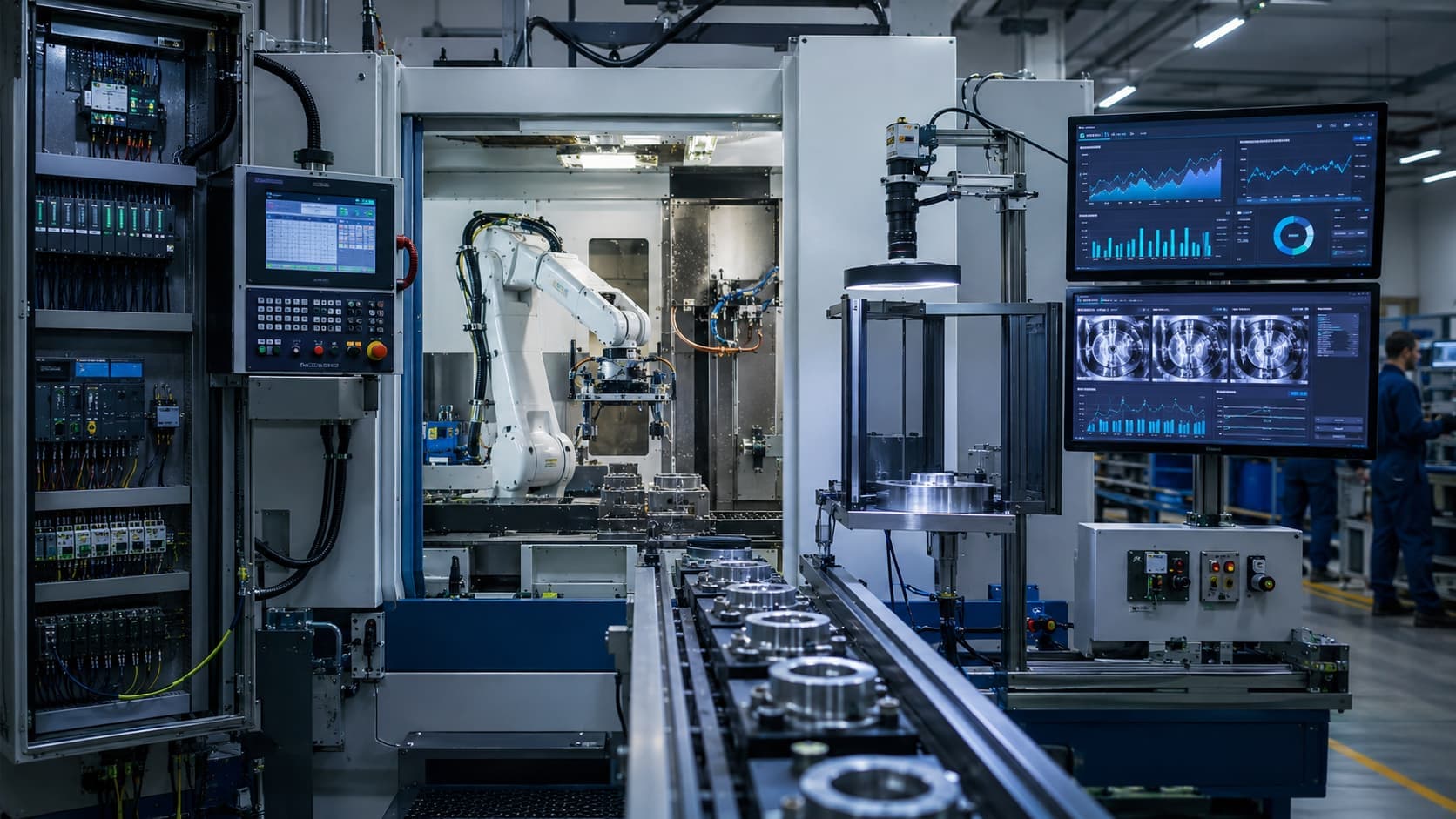
Layer 1 — deterministic automation handles real-time, deterministic control of machines and processes: safety, interlocks, sequencing, motion control and feedback control, executed on PLCs, DCS and motion controllers at millisecond or faster update rates. Reliable, predictable, safe.
Layer 2 — industrial intelligence analyzes data and context to generate insights, predictions and recommendations: anomaly detection, prediction, computer vision, optimization and pattern recognition. It receives selected data and context from Layer 1 — process values, events, alarms, state, diagnostics, setpoints and historical data — through controlled, secure, filtered and rate-limited interfaces, and returns intelligence outputs: anomaly alerts, predictions, recommendations, models and insights.
Layer 3 — engineering / operational decision is where humans and organizations use those insights to make and execute informed decisions: maintenance planning, production adjustment, quality decisions and process improvement. It receives intelligence results — insights, predictions, recommendations and confidence levels — alongside operating context and constraints, and its decisions are implemented through change management and, once approved, applied back to the automation layer.
Notice what does not change in this architecture: Layer 1 keeps its deterministic character throughout. Industrial intelligence reads from it and offers insight to it, but does not become the thing executing the interlock.
Predictive maintenance does not automatically require AI
It is tempting to treat "predictive maintenance" and "AI" as synonyms. They are not.
A great deal of useful condition-based maintenance runs on straightforward threshold logic: alarm when vibration amplitude exceeds a defined limit, alarm when bearing temperature exceeds a defined limit. That is deterministic automation applied to a maintenance decision, and for many failure modes it works well, as covered in condition monitoring for rotating machinery.
AI becomes justified in this space specifically when the relationship between raw condition data and remaining useful life or failure likelihood is too complex, nonlinear or context-dependent for a fixed threshold to capture reliably — the same trustworthiness question addressed in AI for CNC Predictive Maintenance.
Running the Necessity Test against a maintenance problem, rather than assuming AI by default, is what keeps that distinction honest.
A practical decision matrix for common manufacturing tasks
Applying the Necessity Test to familiar manufacturing tasks produces a pattern worth making explicit:
| Manufacturing task | Typical recommendation | Why |
|---|---|---|
| Emergency stop / safety interlock | Deterministic automation | Must be fully specifiable, verifiable and certifiable |
| Machine sequencing / conveyor logic | Deterministic automation | Behaviour is known in advance and rarely changes |
| Temperature / pressure setpoint control | Deterministic automation | PID and closed-loop control already solve this reliably |
| Threshold-based vibration or temperature alarm | Deterministic automation | A known limit is sufficient; no pattern needs to be learned |
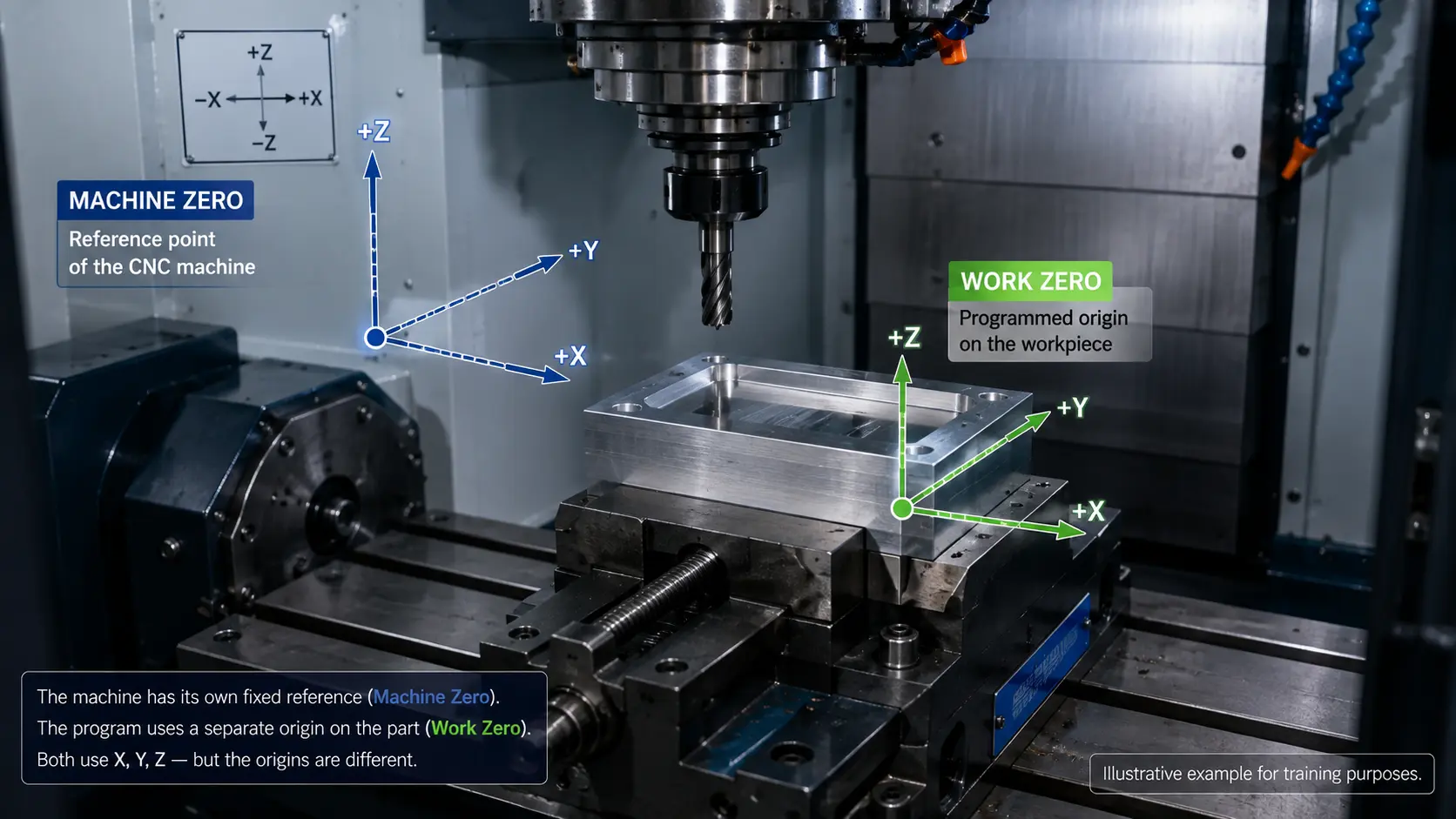
| CNC toolpath execution from G-code | Deterministic automation | The path is calculated and specified, not inferred |
| Visual defect classification on variable surfaces | AI as support | The visual pattern is difficult to encode as fixed rules |
| Bearing/gearbox degradation prediction from trends | AI as support | Useful where the failure pattern is nonlinear and data-rich |
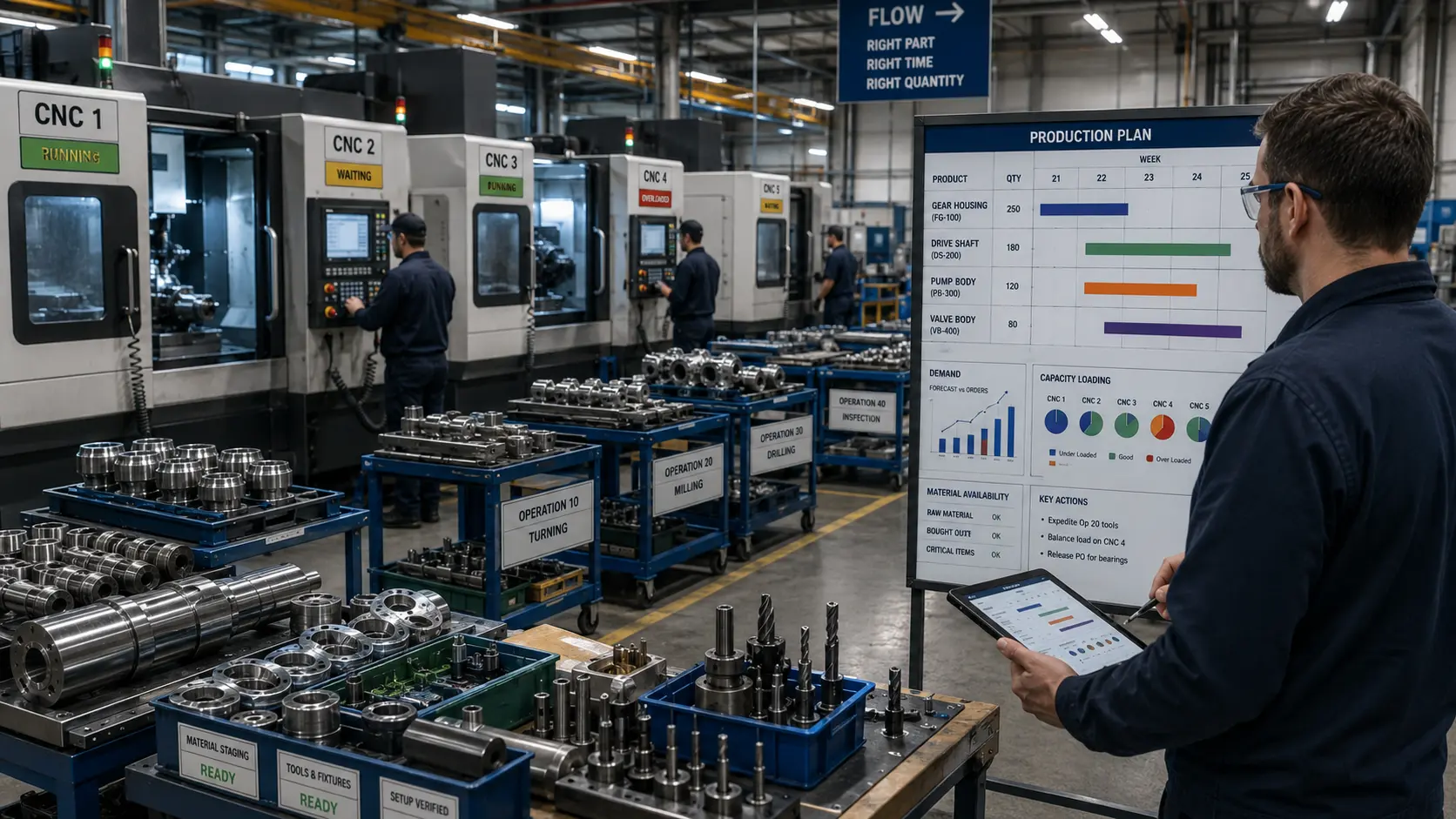
| Dynamic production scheduling under many constraints | AI-enabled automation | A large, interacting search space suits optimization models |
This is illustrative, not exhaustive — the right column for any real task still depends on running the full Necessity Test against the specific problem, the available data and the consequence of getting it wrong.
Where this shows up across the modern factory
The same deterministic-plus-intelligence pattern repeats across several areas of modern manufacturing.
A digital twin, as discussed in Digital Twins in Manufacturing, is only as useful as the real-time data feeding it — the same Layer 1 discipline about instrumentation and data quality applies before any model built on top of it can be trusted.
Retrofitting older equipment with IIoT sensors, covered in Modernizing Legacy Manufacturing Equipment with IIoT, is frequently the actual bottleneck behind an industrial-AI project — without that instrumentation layer, there is no representative data for a model to learn from in the first place.
And the skills this requires from engineers are exactly the connective ones described in Industry 4.0 Skills for Mechanical Engineers: enough control-systems fluency to know what Layer 1 already handles well, and enough data literacy to recognize where Layer 2 genuinely adds value.
Even the manufacturing metric used to judge whether any of this mattered — covered in Overall Equipment Effectiveness (OEE) — is itself just Availability, Performance and Quality calculated from deterministic definitions. AI can help explain why a loss occurred; it does not replace the measurement discipline underneath the score.
My position: digital tools work best connected to physical understanding
My own work has moved across mechanical problems, software and data systems, and predictive-maintenance concepts specifically.
That combination is what shapes the view in this article: digital tools, including industrial AI, are most useful when they stay connected to physical engineering understanding — what the machine is actually doing, what the sensor is actually measuring, and what the failure mechanism actually is — rather than being applied as a general-purpose upgrade layered on top of a system nobody has fully understood.
A model trained without that physical grounding can still produce numbers. Whether those numbers mean anything is a separate question, and it is an engineering question before it is a data-science one.
Key takeaway
Manufacturers should not use AI where reliable deterministic logic already solves the engineering problem adequately.
Industrial AI becomes valuable where important patterns are difficult to encode explicitly but can be learned from representative data — especially for prediction, classification, anomaly detection and complex optimization.
The architecture that keeps both true at once is straightforward:
“Deterministic automation, plus Industrial AI where justified, plus engineering constraints and human decision where the consequence requires it.”
Safety interlocks, emergency stops and protective control stay deterministic, regardless of how capable general-purpose AI becomes. That is not a temporary limitation of current AI systems. It is what a protective function is required to be.
Used this way, industrial AI does not compete with automation. It extends what the automation stack can see and predict, while leaving the automation stack doing exactly what it has always done well.
References and further reading
- NIST — 2026 Roadmap on AI/ML for Smart Manufacturing. Strategic guidance on where artificial intelligence and machine learning fit within smart-manufacturing priorities and how adoption can be approached responsibly.
- NIST MEP — AI in Manufacturing guidance. Practical guidance aimed at manufacturers, including small and mid-sized ones, on evaluating where AI genuinely fits their operations.
- NIST AIMS. NIST's applied initiative connecting AI methods and evaluation practices to real manufacturing use cases.
- NIST — 2026 AI for Manufacturing workshop. A venue where NIST and manufacturers examined practical questions around adopting AI on the factory floor, alongside existing automation and control systems.