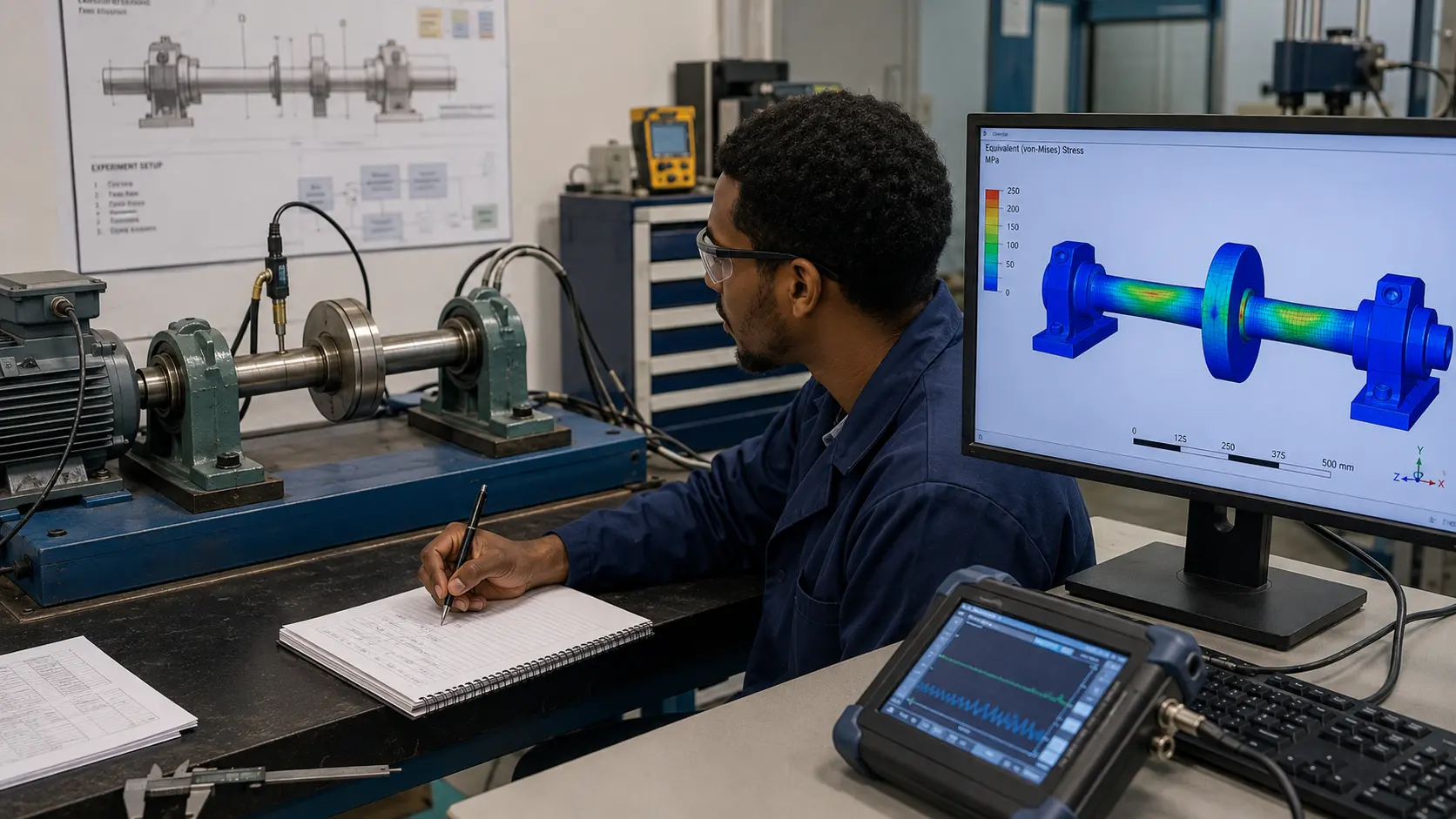
A simulation can show a student something the real engineering system may never show directly.
A beam can display its stress distribution.
A pipe can reveal its internal velocity field.
A machine structure can display its vibration mode.
A CNC simulation can show the toolpath created by a program before the machine moves.
These visualizations are valuable because much of engineering deals with physical behaviour that is either invisible, difficult to observe, expensive to reproduce or unsafe to investigate directly.
But there is an important distinction.
The coloured stress contour is not stress itself.
The simulated fluid streamlines are not the actual moving fluid.
The virtual CNC tool is not cutting material.
They are representations produced by models.
That does not reduce their educational value.
It defines how they should be used.
I have found simulation useful in my own engineering learning because it can make relationships easier to see and explore. At the same time, simulation has not removed the need to reason about the physical system itself. Seeing or working with the real system can reveal constraints and behaviour that a model does not automatically provide.
This creates a useful question for engineering education:
“What should students learn through simulation, and what still requires experience with physical engineering systems?”
Simulation is a model, not the physical system
Every engineering simulation begins by deciding what parts of reality will be represented.
Consider a structural simulation.
The engineer defines:
- Geometry
- Material properties
- Loads
- Constraints
- Contacts
- Mathematical relationships
The software then solves the resulting model.
That is fundamentally different from physically loading a component.
The real component also contains things such as:
- Manufacturing tolerances
- Surface imperfections
- Material variability
- Residual stresses
- Uncertain loading
- Friction
- Wear
Some of those effects may be included in the model.
Others may not.
A simulation therefore answers a specific question:
“How does this model behave under these assumptions?”
Engineering judgement is required before translating that answer into “this is exactly how the physical system will behave.”
Why simulation is important in engineering education
Many engineering problems are difficult to explore fully through equations or physical laboratories alone.
A traditional calculation may allow students to solve several cases.
Simulation can allow dozens of controlled variations.
A physical experiment may provide measurements at selected locations.
Simulation may reveal behaviour throughout the model.
Some physical experiments involve:
- Expensive equipment
- Safety risks
- Substantial setup time
- Material consumption
- Limited laboratory access
Simulation can make exploration much easier.
The educational value therefore comes partly from the ability to ask:
“What happens if I change this?”
and obtain rapid feedback.
There are two different ways to teach simulation
One of the most useful distinctions in engineering education is between learning through simulation and learning engineering simulation.
A 2025 ASEE review of simulation across the mechanical-engineering curriculum makes exactly this distinction and argues that the two uses are complementary.
Learning through simulation
Here, simulation is mainly a learning aid.
Suppose students are learning beam deflection.
The objective is not necessarily to produce expert finite-element analysts.
Instead, a simplified model may allow them to explore load, beam length, section geometry and material stiffness, and see how predicted deformation responds.
The simulation exists to make the mechanical relationship clearer.
Learning engineering simulation
This is different.
Now the simulation process itself is part of professional engineering competence.
Students need to understand:
- How to formulate a model
- How to simplify geometry
- How to define boundary conditions
- Selecting elements or numerical methods
- Convergence
- Verification
- Validation
- Interpretation
The interface may therefore need to become progressively more complex.
These are both legitimate educational goals.
Confusing them can create poor instruction.
If the objective is teaching basic mechanics, forcing a beginner to master a complicated professional solver interface may distract from the mechanics. If the objective is teaching professional FEA competence, hiding all modelling decisions behind an easy interface is equally inappropriate.
Simulation makes invisible engineering behaviour visible
This may be simulation's greatest educational strength.
Stress
Stress exists inside a loaded component but cannot normally be seen directly.
Simulation can show a stress field.
Heat transfer
Internal temperature gradients may be difficult to observe physically.
A thermal model can make them visible.
Fluid mechanics
Velocity and pressure fields inside a pipe, duct or machine can be difficult to inspect.
Simulation provides a representation of those fields.
Vibration
Mode shapes can be difficult for beginners to imagine from equations alone.
Simulation can animate them.
CNC machining
Students can read a line of G-code but struggle to mentally convert coordinates into tool movement.
A toolpath simulation connects program, motion and machining geometry.
This does not eliminate the need to understand equations.
It gives the equations a visual and physical reference.
Simulation can reveal cause and effect
One reason classroom calculations are useful is that variables can be controlled.
Simulation extends that capability.
Suppose students investigate beam deflection.
They can keep material, load and length constant and change section depth. Then observe what happens.
Now change the load. Then the material.
The learner can begin asking:
“Which variables have the strongest effect?”
This supports engineering intuition.
But the educational design matters.
Randomly changing twenty parameters teaches much less than asking a focused question, predicting the effect and testing it systematically.
Prediction should come before the Run button
Simulation becomes much more educational when students are required to think before using it.
Instead of: enter parameters, click Run, record answer — use: predict what should happen, explain why, run the simulation, compare, explain any difference.
A 2026 process-engineering study used a similar hybrid structure: students first made theory-based predictions, then used simulation to test and refine their explanations. The hybrid format was associated with higher marks in that classroom sequence, although the authors appropriately caution that the design cannot establish a causal advantage because the assessments occurred in a fixed order without randomization.
The useful principle is therefore not that “hybrid is always better.”
It is that simulation can become more intellectually productive when learners must commit to engineering reasoning before seeing the output.
Simulation allows safe failure
Real engineering failure can be expensive. Or dangerous.
Simulation creates an environment where students can investigate excessive structural loads, poor controller settings, incorrect process conditions, toolpath collisions or unstable behaviour, without necessarily damaging physical equipment.
This gives students freedom to ask:
“What happens if we push the system outside the normal operating region?”
That is valuable.
Failure can become a learning event.
But the instructor should still ask:
“Why did the system fail?”
Otherwise the exercise becomes entertainment rather than engineering.
Simulation allows rapid repetition
Physical laboratory activities can take time.
Equipment must be prepared, configured, measured and reset.
Simulation can repeat the same experiment quickly.
This makes parameter exploration particularly powerful.
Students can investigate five geometries, several materials or multiple operating points within one learning session.
That makes simulation useful for discovering patterns.
But repetition becomes educational only when students compare and interpret the cases rather than producing more output.
Simulation can support learning where laboratory access is limited
Physical engineering laboratories require resources.
They need equipment, maintenance, space, supervision and consumables.
Simulation can increase the number of engineering situations students can encounter without requiring a separate physical rig for every scenario.
This can broaden access.
But increased access should not be confused with educational equivalence.
A large randomized engineering study involving 458 students compared hands-on, remotely operated and simulation-based cantilever-beam laboratories. The results varied with both laboratory format and the organization of the activity, illustrating that learning outcomes depend on more than simply whether an experiment is physical or simulated.
The stronger lesson is:
“The learning objective and activity design matter at least as much as the technology used to deliver the experience.”
Simulation cannot fully teach physical measurement
This is one of the clearest limitations.
In simulation, the software can provide displacement, temperature, stress, velocity or pressure wherever the model allows.
Physical engineering is different.
The student must ask:
“How do I actually measure this?”
That introduces another set of skills:
- Instrument selection
- Sensor placement
- Calibration
- Resolution
- Repeatability
- Uncertainty
- Noise
- Data acquisition
Consider vibration.
A simulation may provide the model's displacement at any node.
A real machine requires decisions about accelerometer location, mounting, orientation, sampling and frequency range.
Those measurement decisions are part of engineering competence.
Simulation cannot fully reproduce them because the simulated data have already been generated by the model.
Real equipment contains imperfections
Physical engineering systems are rarely as clean as introductory models.
A real machine may have:
- Backlash
- Friction
- Looseness
- Wear
- Contamination
- Manufacturing tolerances
- Alignment errors
- Environmental variation
A simulation only contains these effects if they have been represented.
This leads to one of the most important principles students should learn:
“A simulation cannot reveal a physical phenomenon that the model does not contain.”
If bearing clearance has not been modelled, the simulation will not spontaneously discover it.
If thermal expansion is excluded, the model cannot reveal its effect.
If friction is assumed away, the result reflects that assumption.
Simulation is therefore powerful partly because it simplifies reality.
The same simplification is also its limitation.
Models depend on assumptions
Every model makes assumptions.
Consider finite-element analysis.
The user may assume linear elastic material behaviour, fixed boundary conditions, perfectly applied loads and ideal contact.
The solver may then produce a detailed colour plot.
That graphical detail can make the result feel authoritative.
But the solution is authoritative only within the assumptions of the model.
The 2025 ASEE review of mechanical-engineering simulation education specifically emphasizes the importance of teaching students problem formulation, interpretation and validation, not merely software procedures.
Students should therefore learn to ask:
- What did we assume?
- Why was that assumption reasonable?
- Which behaviour was excluded?
- How sensitive is the result to the assumption?
Those questions are often more important than learning another software command.
Verification and validation should accompany simulation
Simulation education becomes stronger when students learn two related questions.
Verification
“Did we solve the mathematical/computational model correctly?”
Depending on the simulation, this may involve mesh refinement, time-step sensitivity, convergence, numerical checks and comparison with analytical solutions.
Validation
“Does the model adequately represent the relevant physical behaviour for its intended use?”
Validation may involve comparison with physical experiments, known benchmark data, manufacturer information or established engineering behaviour.
These are not identical questions.
A numerical model can be solved perfectly and still represent the physical problem poorly.
Why precise numbers can create false confidence
Simulation software often produces many decimal places.
For example: 147.382 MPa.
That appears precise.
But perhaps load is only approximately known, material properties vary, boundary conditions are simplified, or contact is idealized.
The number of displayed digits does not tell us the uncertainty of the engineering model.
This is an important educational issue because polished visual output can make inexperienced learners trust simulation results too easily.
Students should therefore learn to distinguish numerical precision from engineering confidence.
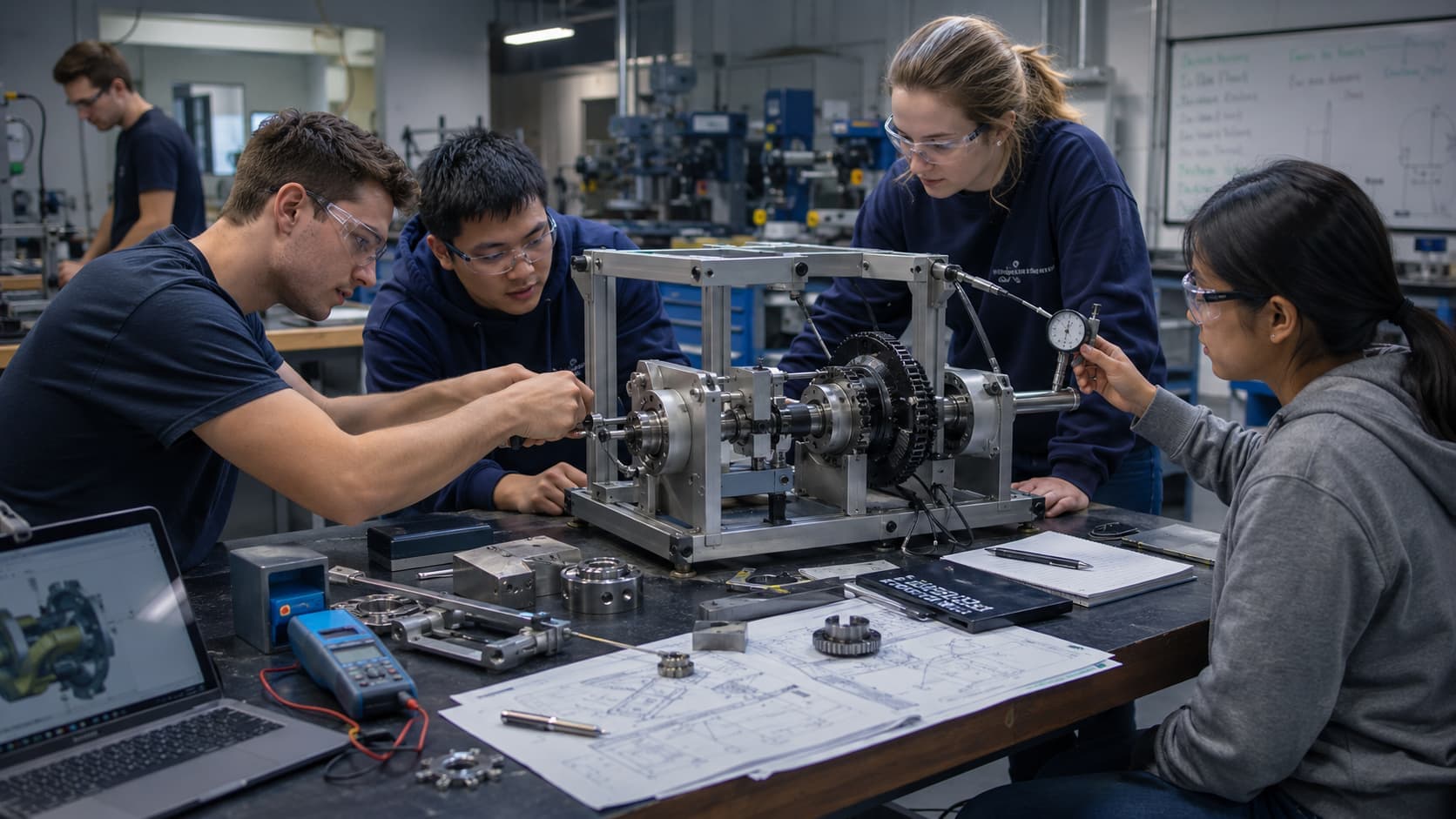
Hands-on laboratories teach different things
A physical laboratory may not show an entire stress field.
But it teaches other lessons.
Students may encounter imperfect equipment, calibration, noise, setup, sensor placement, unexpected results, loose connections and physical constraints.
These are not simply inconveniences.
They are part of engineering.
The randomized comparison of simulated, remote and hands-on laboratories mentioned earlier is useful precisely because it showed that the learning process differs across formats rather than supporting a simple hierarchy of one laboratory type over another.
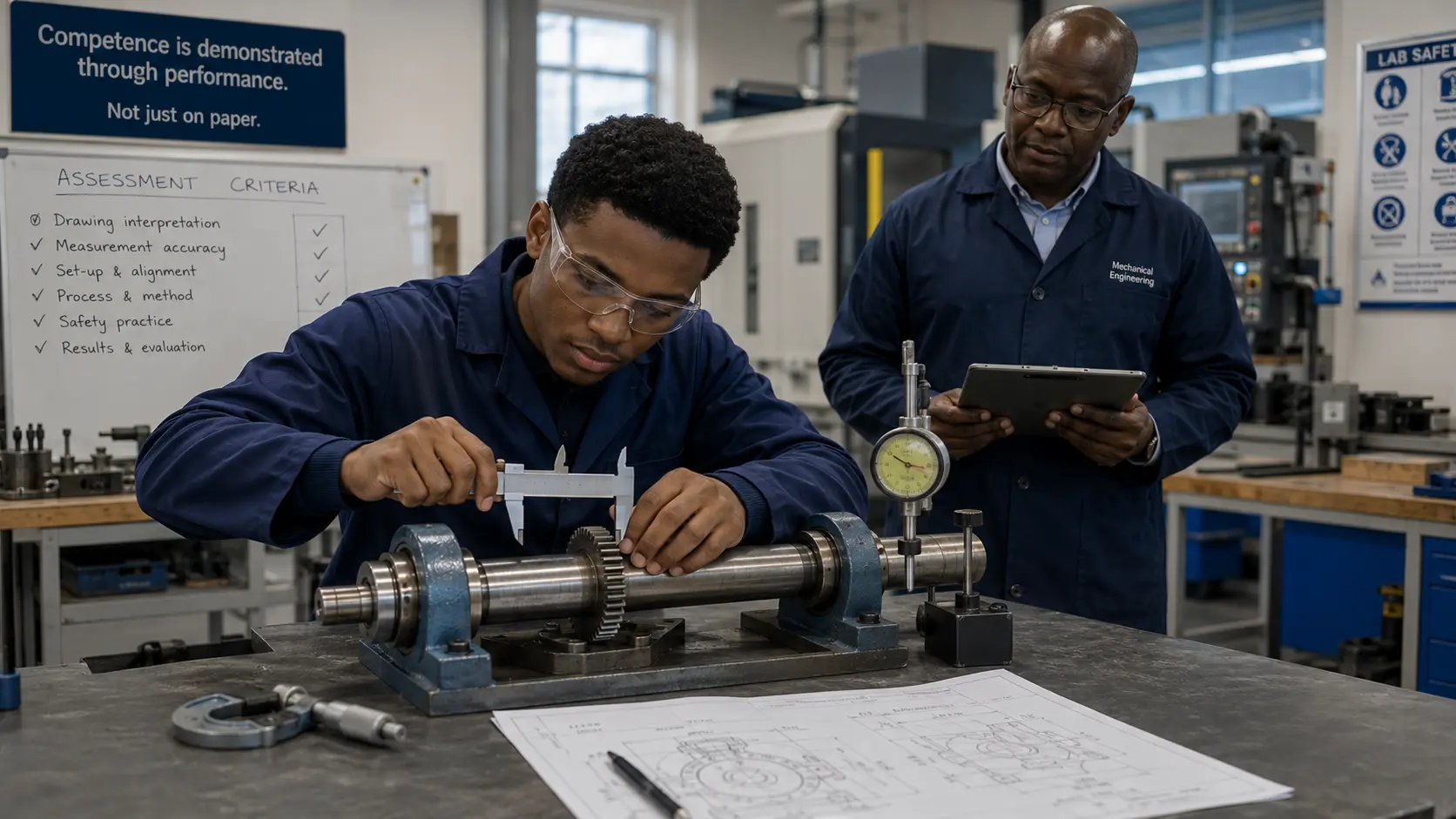
Workshops teach embodied engineering knowledge
There are also skills that simulation is poorly suited to reproduce.
Consider:
- Using a micrometer
- Aligning a component
- Positioning a workpiece
- Tightening a fastener
- Feeling tool resistance
- Hearing abnormal machine behaviour
- Judging physical access
- Maintaining safe body position near equipment
Some engineering knowledge is acquired through interaction with physical objects and environments.
Simulation can prepare students for those experiences.
It cannot fully substitute for them.
Simulation does not reproduce real safety responsibility
A simulated CNC collision may produce a message: “Collision detected.”
A real collision can damage a tool, damage a workpiece, damage equipment or injure someone.
The physical consequences change decision-making.
Learners need environments where safety becomes an authentic engineering constraint rather than merely a software notification.
Simulation can help students practise hazardous scenarios safely.
But safety competence ultimately includes understanding real equipment, procedures and consequences.
Simulation can reduce cognitive load
Simulation can simplify a difficult engineering relationship.
For example, instead of mentally imagining how a structural mode shape develops, students can observe it.
That can reduce unnecessary cognitive demands.
This connects directly to cognitive-load principles in engineering education.
But the benefit depends on design.
If the simulator contains dozens of controls, unfamiliar menus, multiple plots and confusing settings, then students may use much of their working memory learning the interface rather than the engineering.
This creates an important principle:
“If the purpose is learning an engineering concept, the simulation interface should not be substantially harder to understand than the concept itself.”
Simulation can increase cognitive load
Consider a first-year learner opening a professional FEA package.
They encounter geometry tools, materials, coordinate systems, contacts, meshing, solver configuration and result controls.
At the same time they are still learning stress, strain and boundary conditions.
Now there are two difficult problems: learn mechanics, and learn simulation software.
If software competence is not the objective yet, scaffolding may be necessary.
The 2025 mechanical-engineering curriculum review recommends narrowing modelling goals and providing templates or detailed guidance when simulation is introduced early, precisely so learners can concentrate on the intended engineering concepts.
Simplified simulations have a legitimate place
A simplified learning simulation is not automatically inferior to professional engineering software.
It may be better suited to the educational objective.
Suppose the goal is understanding how cutting parameters influence a CNC process.
A learning tool may expose only speed, feed, geometry and the resulting toolpath.
That allows the learner to focus on the engineering relationship.
Later, professional CAM or CNC environments can introduce tooling databases, controller specifics, post-processing and machine configuration — the same progression this site covers in more depth when discussing why CNC theory needs hands-on practice, and in programmatic G-code generation and verification.
The level of software complexity should match the learning objective.
But simplification should eventually give way to authentic complexity
Simplified environments also have a limitation.
Students eventually need to understand that real engineering work involves incomplete information, model choices, uncertainty, conflicting constraints and imperfect data.
The learning progression might therefore be:
- Simplified model
- Guided professional model
- Independent simulation
- Physical comparison
- Open engineering problem
This connects directly to scaffolding and transfer.
Simulation and transfer of learning
Simulation can form a useful bridge between theory and practice.
For example: beam equation → FEA model → physical beam.
Or: G-code → toolpath simulation → machine operation.
The same concept is encountered in different representations.
That can support transfer.
But transfer is not guaranteed.
If students become good only at one simulation interface, they may simply have learned another context-specific procedure — the same gap this site explores in why engineering students struggle to transfer classroom knowledge into practical work.
They should therefore be asked to explain:
- Which engineering principle is represented here?
- Where would the same principle appear in a different system?
This is how simulation becomes part of broader engineering understanding rather than an isolated software skill.
My own experience with simulation
In my own engineering work and learning, simulation has helped make relationships clearer by allowing physical or system behaviour to be represented computationally.
That has been useful in areas involving modelling, CNC-related systems and other engineering analysis.
At the same time, I would not treat simulation as a complete substitute for the physical engineering system.
The model can help answer:
“What should happen under these assumptions?”
Physical observation helps answer another question:
“What actually happens when the assumptions meet reality?”
The difference between those questions is where a great deal of engineering judgement develops.
The Simulation–Reality Learning Cycle
A useful engineering-learning sequence can be organized into seven stages.
| Stage | Key question |
|---|---|
| 1. Predict | What should happen physically, using physics, equations and engineering intuition — before touching the simulation? |
| 2. Model | What aspects of the physical system are represented? Identify assumptions, simplifications, variables and boundary conditions. |
| 3. Simulate | Run the model systematically, changing parameters only for a reason. |
| 4. Interpret | Why did the response change? Which physical relationship explains it? Does the trend make sense? |
| 5. Validate | Does the result agree with analytical results, known behaviour or experimental evidence, where appropriate? |
| 6. Experience | Encounter the physical system where feasible — observe measurement, imperfections, constraints and equipment behaviour. |
| 7. Reflect | Which predictions were correct? Which assumptions were weak? What did simulation reveal well, and what did the physical system reveal that the model did not? |
Then return to the model with improved understanding.
That makes simulation part of an engineering reasoning cycle rather than simply software use.
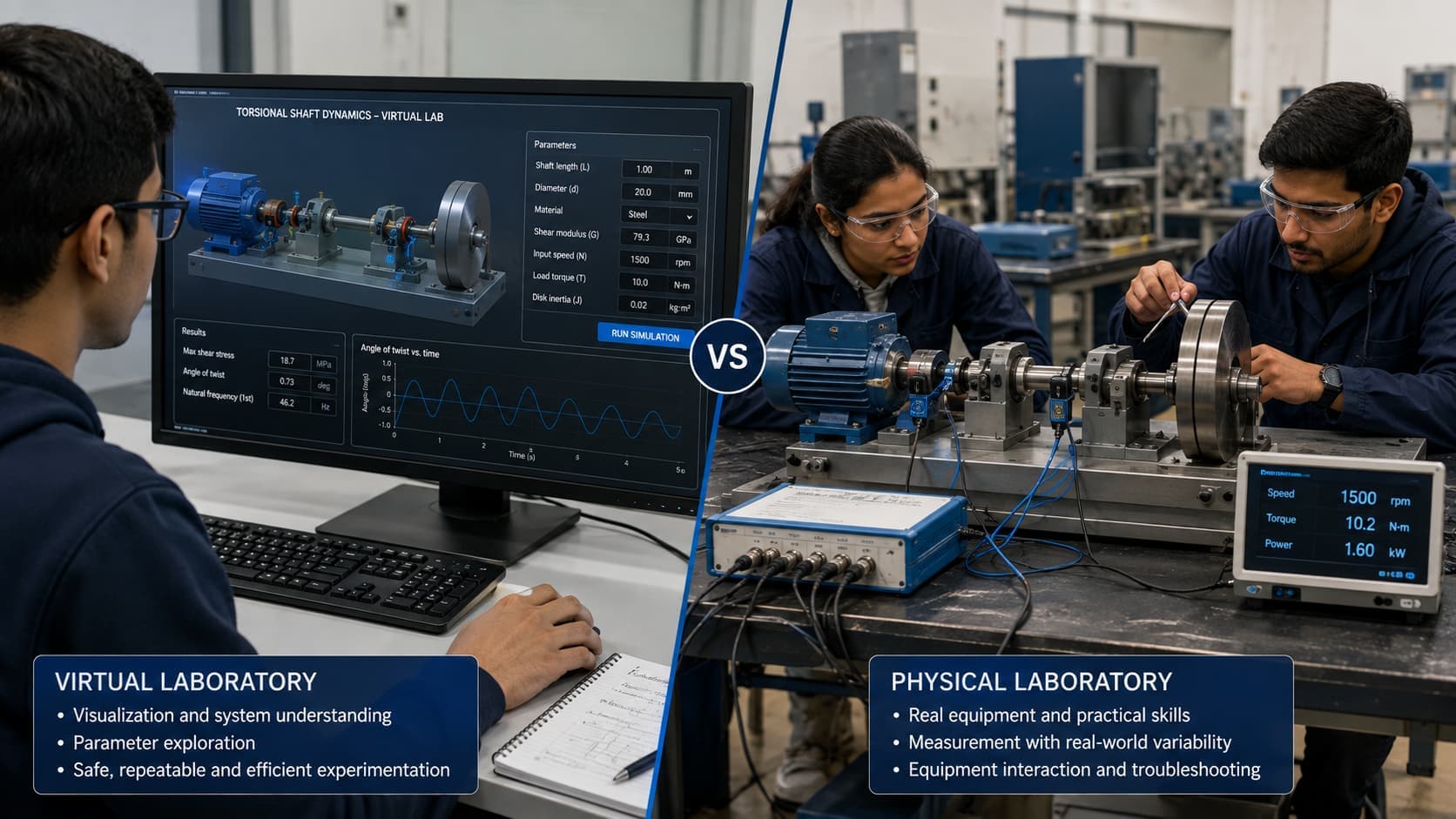
Which environment should educators choose?
A useful decision starts with the learning objective.
Use simulation when the objective is primarily:
- Visualizing invisible phenomena
- Testing parameter relationships
- Exploring many scenarios
- Practising model-based reasoning
- Safely exploring extreme conditions
- Comparing design alternatives
Use physical laboratories or workshops when the objective includes:
- Instrumentation
- Measurement
- Physical setup
- Uncertainty
- Tool handling
- Equipment operation
- Practical troubleshooting
- Safety behaviour
Combine them when the objective includes:
- Model validation
- Comparison of predicted and observed behaviour
- Developing engineering judgement
- Transfer between abstract and physical representations
The question is therefore not: “Simulation or hands-on?”
The better question is:
“What learning outcome requires which combination?”
What this means for mechanical-engineering curricula
Simulation should not necessarily exist only inside one advanced software course.
The 2025 ASEE review shows examples of simulation being integrated across introductory design, statics, solid mechanics, machine design, vibration and vehicle design, with different levels of complexity depending on the learning objective.
That suggests a useful curriculum progression.
- Early years — use simplified simulation to reveal concepts.
- Middle years — connect analytical calculation with simulation.
- Laboratories — compare model predictions with measurements.
- Advanced courses — teach model formulation, numerical methods, verification and validation.
- Capstone/projects — use simulation as one engineering tool among analysis, prototyping, experimentation, design and testing.
This progression develops both learning through simulation and learning how to simulate.
Key takeaway
Simulation is one of the most powerful tools available to modern engineering education.
It can make hidden behaviour visible.
It can allow rapid experimentation.
It can expose cause-and-effect relationships.
It can make dangerous or expensive experiments accessible.
But simulation cannot fully teach:
- Measurement
- Physical uncertainty
- Equipment setup
- Manufacturing imperfections
- Practical troubleshooting
- Embodied interaction with machinery
Nor should students assume a polished simulation output is automatically correct.
The strongest educational approach therefore does not place simulation and physical practice in competition.
It connects them.
- Predict with theory.
- Explore with simulation.
- Test against evidence.
- Experience the physical system.
- Reflect on the difference.
That is where simulation becomes more than a digital demonstration.
It becomes a tool for developing engineering judgement.
References and further reading
- Magallanes et al. — Simulation across the Mechanical Engineering Curriculum, ASEE Annual Conference, 2025. A particularly useful recent review distinguishing learning through simulation from learning to perform simulation, and discussing simulation across mechanical-engineering courses.
- Corter et al. — Process and Learning Outcomes from Remotely-Operated, Simulated, and Hands-On Student Laboratories, Computers & Education, 2011. Large randomized undergraduate engineering study involving 458 students, useful for showing that laboratory format and learning-process design interact rather than one format being universally superior.
- Jafary et al. — Comparing Predictive, Simulation-Based and Hybrid Assessments in Undergraduate Process Engineering, Discover Education, 2026. Recent classroom study examining theory-based prediction, simulator-supported analysis and an integrated hybrid approach, with careful acknowledgement of limitations in causal interpretation.