Mechanical engineering students can learn the equation for bending stress. They can calculate shaft diameter. They can study thermodynamics, manufacturing processes, materials, CAD and programming. But engineering practice rarely presents these areas as separate examination questions — a real engineering problem may require several of them at once.
Consider a relatively simple task: design and build a small mechanical lifting system capable of carrying a specified load. Suddenly, the student may need to think about forces, stress, material properties, dimensions, bearings, fabrication, tolerances, safety, cost and testing.
The value of the project is not merely that students eventually produce a mechanism. Its educational value comes from having to decide which engineering knowledge applies, how it should be used, and how to determine whether the solution actually works. That is where Project-Based Learning becomes particularly relevant to mechanical engineering education.
Current ABET engineering criteria emphasize abilities such as complex problem solving, engineering design, experimentation, teamwork, communication and independent acquisition of knowledge. These are capabilities that well-designed engineering projects can bring together within a single learning experience.
“Giving students a project does not automatically create Project-Based Learning. The project must be designed around learning.”
What is Project-Based Learning?
Project-Based Learning, often abbreviated PBL or PjBL, is an educational approach in which learners develop knowledge and skills through sustained engagement with a meaningful problem, challenge, design or investigation that typically leads to a substantial outcome.
In engineering, that outcome might be a mechanical design, prototype, test rig, manufacturing solution, simulation, automated system or experimental investigation. The project provides a context in which students need to apply engineering knowledge rather than only reproduce it.
Recent mechanical-engineering examples include project-based approaches in mechanisms education, laboratories, interdisciplinary undergraduate activities, thermal-system design and Industry 4.0 learning.
A project is not automatically Project-Based Learning
Imagine two assignments. Project A: students receive complete drawings, material specifications, manufacturing instructions and a testing procedure. They follow the instructions and manufacture the product. This may be an excellent practical exercise, but much of the engineering thinking has already been done for them.
Now consider Project B: students receive a required function, load requirement, dimensional envelope, available materials and manufacturing constraints. They must determine geometry, material, component sizing, manufacturing method and testing procedure.
Both activities involve making something. But Project B requires much more engineering decision-making. That distinction matters — hands-on activity and Project-Based Learning are related, but they are not automatically the same thing.
Why mechanical engineering is well suited to project learning
Mechanical engineering is inherently integrative. A mechanical system rarely belongs to only one textbook chapter. Consider designing an electrically driven pump system.
- Fluid mechanics — what flow and pressure are required?
- Mechanical design — how should the shaft and coupling be sized?
- Materials — which material is suitable?
- Manufacturing — how will the components be produced?
- Instrumentation — how will flow or pressure be measured?
- Electrical/control systems — how will the motor or control system operate?
- Testing — how will actual performance be compared with predicted performance?
A project provides a place where these separate areas of the curriculum can meet.
Projects create knowledge-integration environments
Traditional curricula are usually divided into subjects — mechanics, thermodynamics, materials, manufacturing, design. This organization is necessary because complex knowledge needs to be taught systematically. But students must eventually learn to recombine that knowledge, and projects can provide that opportunity.
In my own engineering learning and project work, I have found that working through a complete project can make areas that previously felt separate start to connect. Theory, calculations, design, programming, manufacturing, testing and troubleshooting become easier to understand when they are contributing to the same engineering problem.
That experience reflects one of the main educational strengths of projects: the student begins to see engineering as a connected system rather than a collection of subjects.
The Engineering Project Learning Loop
A useful project-learning process can be represented as a cycle — an explanatory framework developed for this article.
- Define — what engineering problem are we solving?
- Connect — which theory and prior knowledge could help?
- Design — what solution should we propose?
- Build or model — how can the idea become testable?
- Test — what evidence shows how the solution performs?
- Interpret — why did the system behave as observed?
- Improve — what should change?
- Reflect — what engineering understanding did the process develop?
Then the learner may return to design, or even theory, with new questions. That circular process is important. Real engineering rarely follows: calculate once, build once, success.
From knowing equations to making engineering decisions
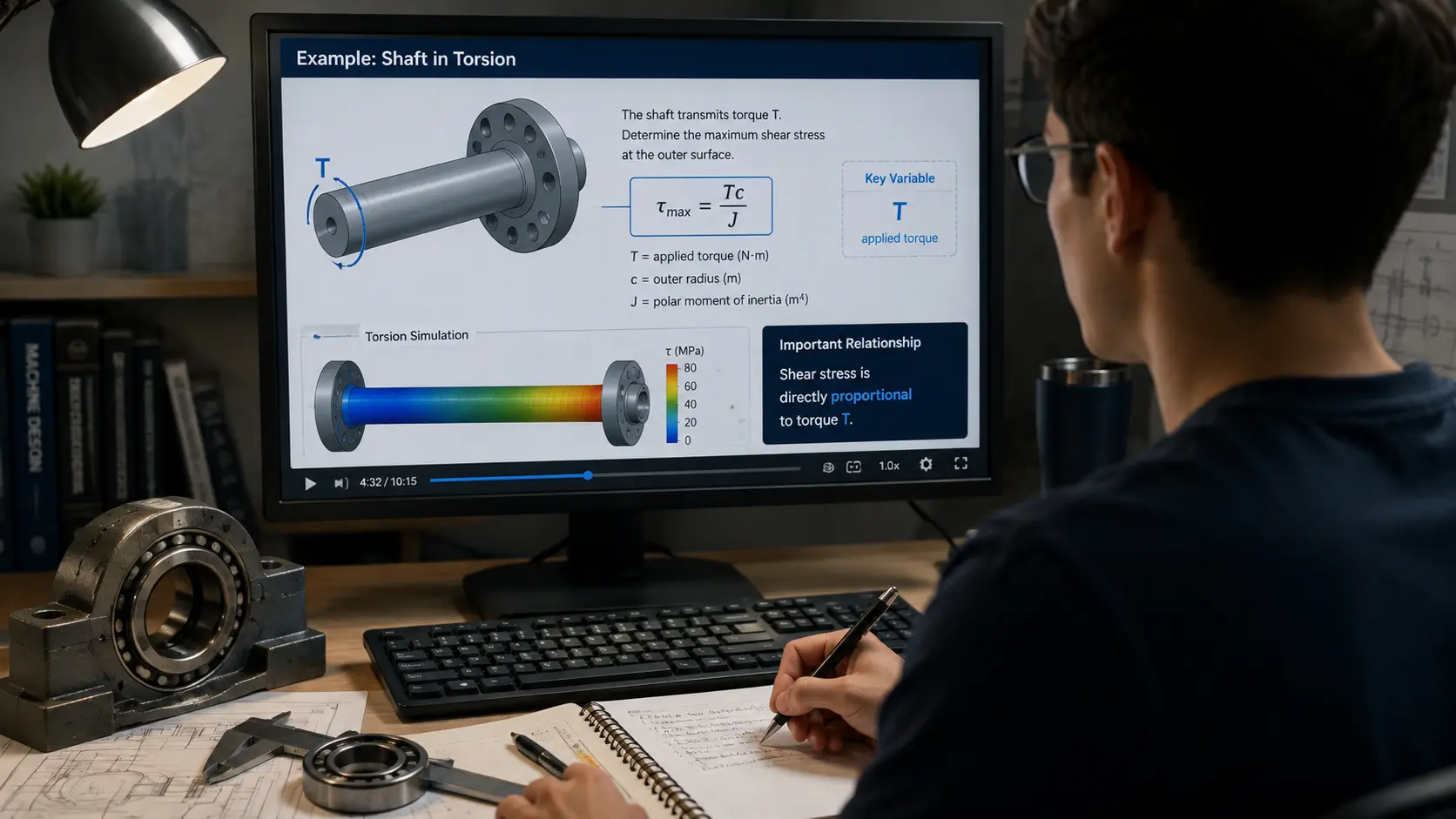
Consider the familiar stress equation, stress equals force divided by area. A student may solve many examination questions using this relationship correctly. A project creates additional questions: what load should be used? Is it purely axial? Could dynamic loading matter? What section area is relevant? What material should be selected? What factor of safety is appropriate? Could stiffness or fatigue control the design instead of strength? Can the component actually be manufactured at that geometry?
The equation remains essential. But now it exists inside a much larger reasoning process. This is the difference between knowing a principle and knowing when and how to use it.
Projects can expose hidden misunderstandings
A written solution may appear correct because the variables have been simplified carefully. A real or simulated system can expose assumptions that the student did not realize they were making — perhaps a shaft deflects excessively, a mechanism jams, a bearing arrangement creates unexpected resistance, the assembly cannot be manufactured as drawn, a sensor gives unstable data, or the calculated performance does not match the experiment.
Now the learner has a discrepancy. That discrepancy can become educational. The question becomes: why did the system behave differently from what I expected? This can produce deeper reasoning than simply being told that an answer is wrong.
Hands-on work alone does not guarantee deep learning
It is tempting to assume that if students build something, they are learning practically. Not necessarily. Students can copy an existing design, follow a tutorial, assemble components according to instructions, and produce a working artifact. The final product may look impressive, but the learner may struggle to explain why a material was chosen, why a dimension matters, why one design was preferred, or why the system behaves as it does.
“The educational question should be: what engineering decisions did students actually have to make? That is more useful than: did they build something?”
Meaningful decisions are central to project learning
Mechanical engineering projects can require decisions about geometry, materials, dimensions, manufacturing process, tolerances, sensors, algorithms, test procedures and operating parameters. Not every project needs all of these, but students need some genuine ownership over the engineering solution.
If every significant technical decision has already been made by the instructor, students are primarily executing a procedure. Again, this can still be useful — it simply develops different competencies.
Open-ended does not mean unstructured
One solution might therefore appear obvious: give students complete freedom. That can create another problem. A learner with limited knowledge may face unfamiliar theory, new software, unfamiliar equipment, teamwork, documentation and open-ended design all at once.
The project becomes difficult not because the engineering concept itself is advanced, but because too many uncertainties are being handled simultaneously. This is where scaffolding becomes important.
Scaffolding mechanical engineering projects
Scaffolding means giving students enough structure to work productively while preserving meaningful responsibility. For an introductory project, the lecturer might provide approved materials, a design envelope, key equations and a basic testing procedure, while students choose dimensions, geometry and final configuration.
At a later level, students may independently select material, modelling method, manufacturing process and test strategy. Eventually, advanced students may work on highly open-ended projects. This creates progression: highly guided, then partially open, then increasingly independent. The project should develop with student competence.
Project complexity should match student readiness
This is particularly important in mechanical engineering because project work is cognitively demanding. A student may simultaneously need to understand engineering theory, CAD, simulation, manufacturing, instrumentation, teamwork and report writing. If every element is new, the student may spend more effort managing the learning environment than reasoning about engineering.
A good project therefore distinguishes between productive complexity and unnecessary complexity. Students should be challenged to integrate knowledge — they should not be buried beneath unrelated difficulties.
Theory and projects should interact
A weak curriculum may separate them entirely: semester begins with all theory, then final weeks bring the project. Another extreme is giving students an open project before they possess enough conceptual knowledge to reason about it.
A stronger relationship can be iterative: learn a relevant concept, apply it to the project, observe a limitation or new question, learn additional theory, and return to the project. This creates a Theory–Application Feedback Cycle — theory, then application, then observation, then question, then deeper understanding, then application again. Instead of theory and practice competing for curriculum time, each supports the other.
Failure can be educational
Suppose students design a mechanism, calculate the required dimensions, manufacture a prototype, and it fails the test. Has the project failed educationally? Not necessarily. Failure may reveal an incorrect assumption, inadequate stiffness, poor tolerance selection, insufficient strength, measurement error or control instability.
Professional engineering itself relies heavily on testing, diagnosis and redesign. Students should therefore experience some form of iteration. The important question is not simply did the first prototype work — it is can the student explain what happened and improve the design using evidence?
Failure alone does not create learning
There is another danger. A project fails, students become frustrated, the deadline arrives, they submit, and nothing has been learned from the failure. For failure to become educational, students need to move through something like observe, measure, interpret, connect to theory, modify and retest.
“Iteration becomes educational when students convert failure into evidence.”
Testing turns a project into an engineering investigation
Imagine students design a small heat exchanger. Producing the CAD model is one level of learning. Manufacturing it adds another. But testing introduces a deeper question: does actual performance agree with predicted performance? Students can compare predicted versus measured temperature change, and expected versus measured pressure drop.
Now discrepancies require explanation. Engineering judgement begins to develop because students must decide whether the model is wrong, the measurement is questionable, or the manufactured geometry differs from the ideal. Testing therefore connects calculation with evidence. ABET's current student outcomes explicitly include the ability to develop and conduct appropriate experimentation, analyze and interpret data, and use engineering judgement to draw conclusions.
Teamwork is a major strength of PBL
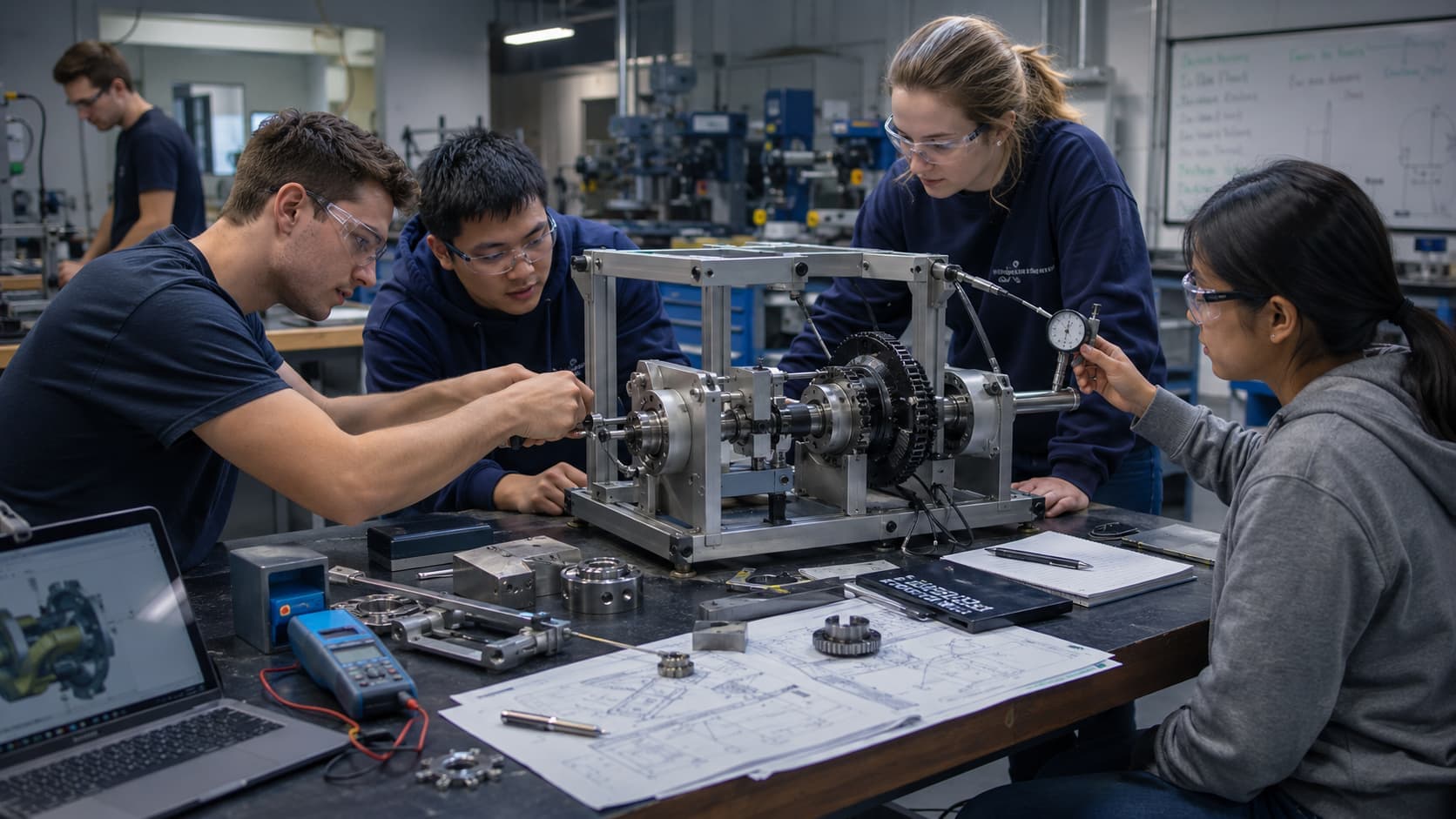
Most significant engineering projects involve more than one person. Teams must distribute tasks, coordinate interfaces, resolve technical disagreements, manage deadlines and communicate decisions. ABET's 2026–2027 criteria expect engineering graduates to function effectively in teams that create collaborative environments, establish goals, plan tasks and meet objectives.
Projects provide a natural environment for developing these capabilities. But teamwork introduces an important assessment problem.
A successful team does not prove equal individual competence
Consider four students. Student A develops the CAD model. Student B performs calculations. Student C manufactures the prototype. Student D prepares documentation. The final project works. Does that prove all four students can calculate, design, manufacture and troubleshoot? No.
This creates one of the most important challenges in project assessment. The group produces one artifact, but the course awards competence to individuals. The assessment system has to distinguish the two.
Group product + individual evidence
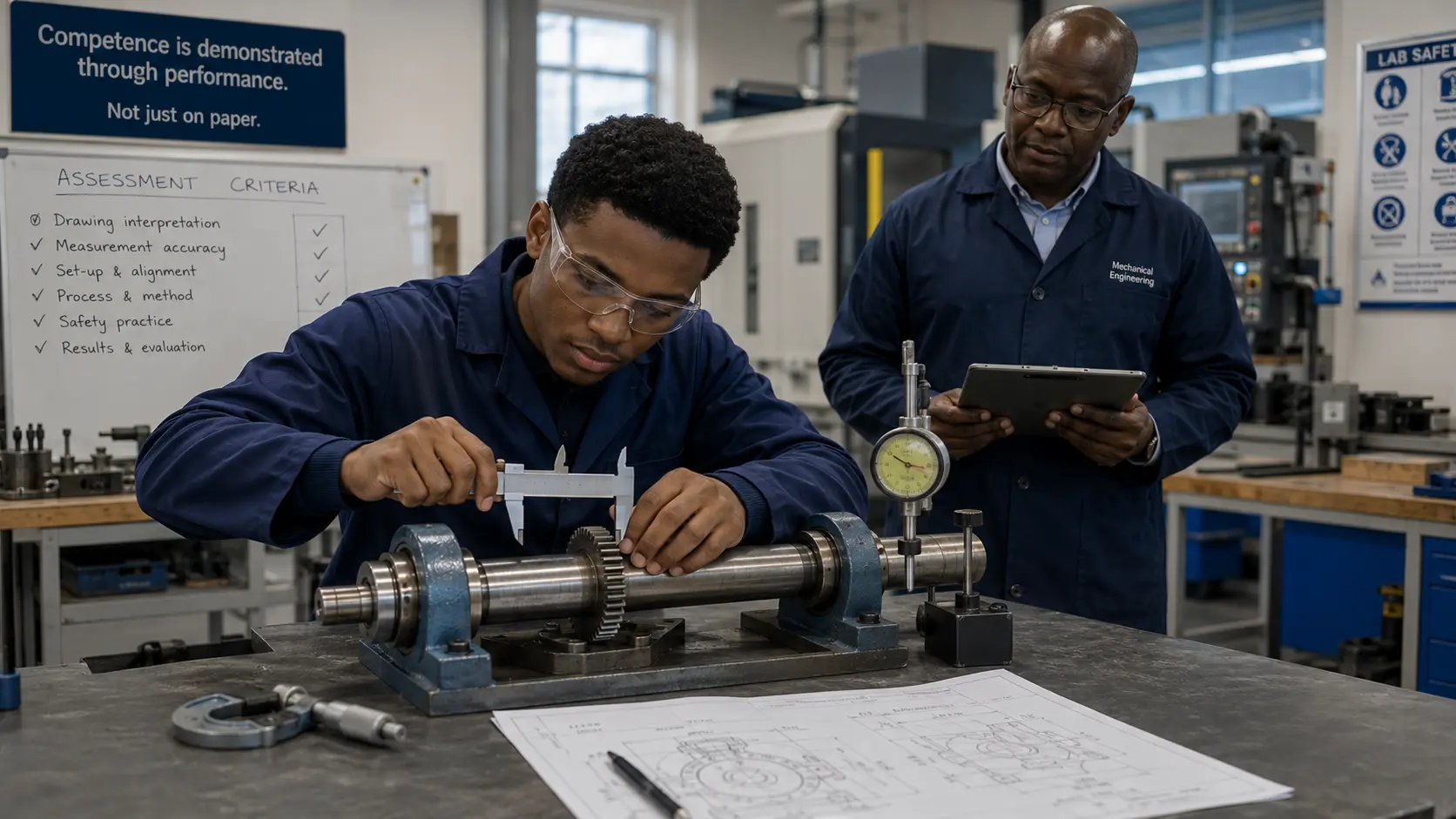
A stronger assessment model combines both. Group evidence may include the final design, prototype, test results and technical presentation. Individual evidence may include technical questioning, individual design justification, practical demonstration, reflective analysis and individual calculations.
Together they provide stronger evidence. A polished final product should not allow an individual student's lack of understanding to disappear behind the team.
What should the lecturer do during Project-Based Learning?
The lecturer's role changes, but does not disappear. The lecturer still needs deep technical and pedagogical expertise. Rather than providing every answer, the lecturer may ask questions such as why a material was selected, what assumption supports a calculation, how the student will know whether the prototype meets the requirement, what evidence suggests the cause of a failure, or how the design would change if the load increased.
These questions move students beyond task completion toward engineering reasoning.
Good project facilitation is not passive teaching
A lecturer who says "work on the project and ask me if you need anything" has not necessarily implemented strong PBL. Students may need technical milestones, targeted feedback, access to resources, demonstrations, safety guidance and conceptual interventions. The challenge is to support students without taking ownership of the engineering decisions away from them.
Assessment should reward the engineering process
Imagine two teams. Team A's first design works, and they perform little investigation. Team B's initial design performs poorly — they test it, identify a design weakness, modify it, retest it, and produce a much stronger explanation.
If assessment rewards only "final device works," Team A may receive the stronger mark despite demonstrating less engineering learning. That would be questionable. A PBL assessment should consider evidence such as problem interpretation, theoretical reasoning, design justification, testing, analysis, iteration, communication and final performance. The final product matters, but the engineering journey also matters.
Documentation should show reasoning
Poor project documentation often reads: "First we designed the shaft. Then we manufactured it. Then we tested it." That describes activity. Engineering documentation should explain decisions — for example: "The initial shaft diameter was selected from the calculated bending requirement and then revised after deflection analysis showed that stiffness, rather than yield strength, governed the design."
The difference is substantial. One records what students did. The other shows how they thought.
Reflection should reconnect experience with theory
Reflection is sometimes dismissed as "write what you learned." It can be much more technical. Good engineering reflection asks which assumption proved inaccurate, which calculation became important later, which result surprised the student, which design decision they would change, what theory explains the observed failure, and which skill they still lack.
Reflection helps convert experience into generalizable engineering understanding. Without that step, students may remember only the specific project rather than the underlying principle.
Simulation can strengthen project learning
Mechanical engineering projects increasingly involve simulation. Students may use it to visualize stress, investigate fluid flow, compare geometries, test parameters and predict performance. This is valuable, but simulation should be aligned with the learning outcome.
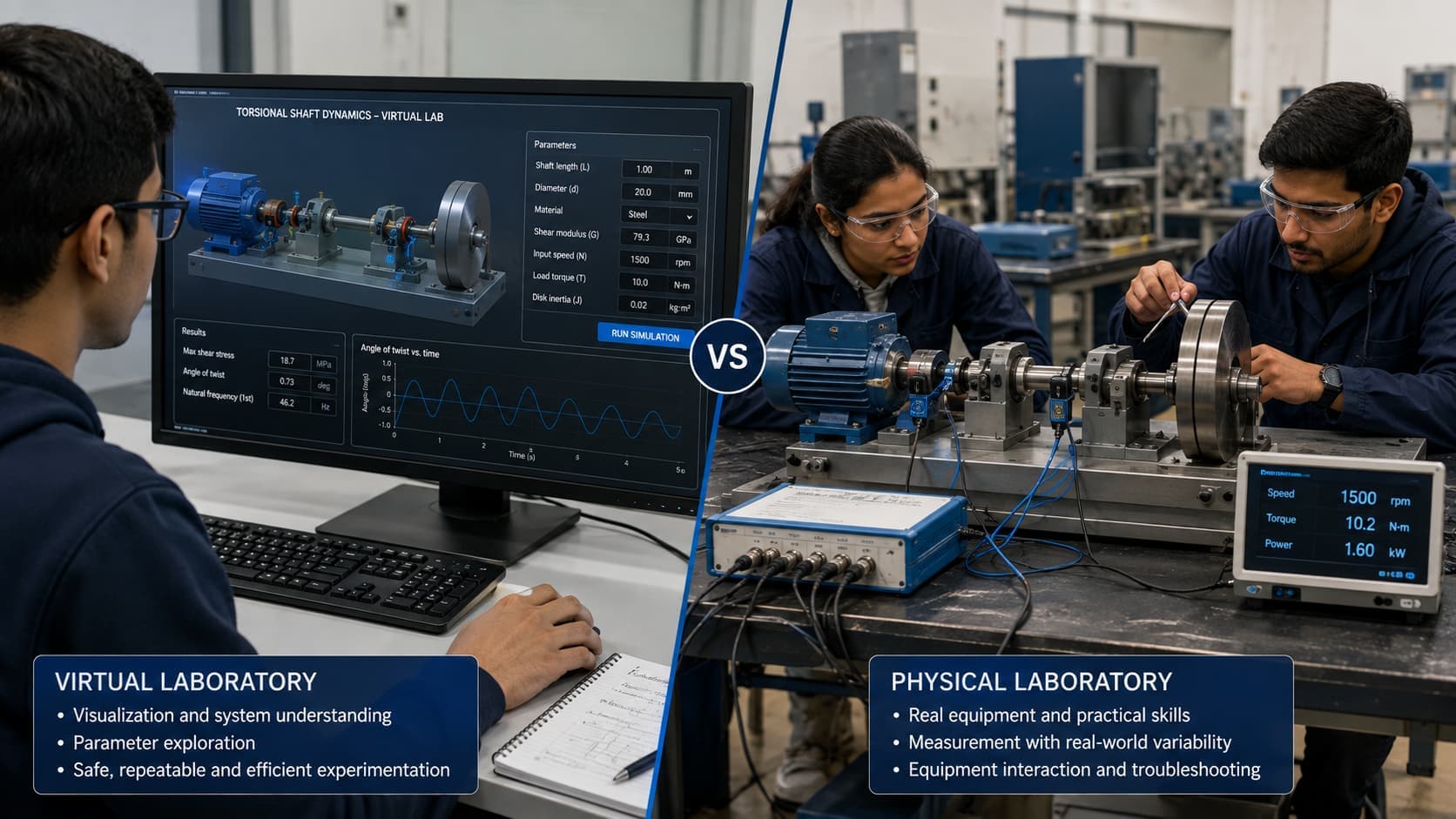
If students are supposed to learn instrumentation, manufacturing, setup or real measurement, a simulation-only project cannot provide all of that evidence. The stronger model may combine theory, simulation and physical observation or testing where appropriate.
Physical prototypes are not always required
The reverse is also important. Project-Based Learning should not be defined as "students must manufacture a physical product." A legitimate mechanical engineering project might involve computational modelling, thermal-system optimization, engineering software, data analysis or machine-condition investigation.
What matters is that learners engage meaningfully in engineering decisions, investigation, evidence and iteration. A physical prototype is one possible format.
Programming is increasingly part of mechanical project work
Mechanical engineering is becoming increasingly connected to digital systems. Projects may now involve Python, sensors, data acquisition, CNC, automation, condition monitoring and machine learning. This creates an opportunity for PBL — instead of learning programming as something separate from mechanical engineering, students can use it to solve mechanical problems. That helps create interdisciplinary competence.
Project-Based Learning and Industry 4.0
Current engineering practice increasingly combines physical systems with digital technologies. Mechanical engineers may need to understand connected machinery, automation, data, simulation and intelligent systems. Recent ASEE work has specifically explored combining project-based learning with modern digital and Industry 4.0-oriented methods in mechanical-engineering education.
Projects can provide a useful learning environment because students need to integrate these technologies around one system rather than learn every technology in isolation.
PBL and mechanical engineering laboratories
Traditional laboratory exercises often use predetermined procedures: configure equipment, collect specified measurements, calculate required results, write report. These laboratories can be very useful for developing measurement skills and reinforcing theory, but they provide limited design ownership when every decision has already been prescribed.
Recent ASEE work in mechanical engineering has explored restructuring laboratory experiences through PBL specifically to increase student engagement with real-world application and more comprehensive investigation. The goal should not be to eliminate traditional labs — guided laboratory work and project learning develop overlapping but different capabilities.
Project-Based Learning and capstone design
Capstone projects are probably the most familiar form of extended project experience in engineering. Current ABET engineering criteria require a culminating major engineering design experience that incorporates engineering standards, multiple constraints and knowledge acquired through earlier coursework.
This illustrates an important educational principle: integration becomes especially important near the end of engineering education. But projects should not necessarily be reserved for the final year — smaller, carefully scaffolded projects can progressively prepare students for more independent capstone work.
Project-Based Learning vs Problem-Based Learning
The terminology can become confusing. Both approaches typically involve students learning through engagement with problems. A simplified distinction is that Problem-Based Learning often uses a problem as the central trigger for inquiry and knowledge development, while Project-Based Learning typically extends toward developing a substantial product, design, model, investigation or engineering outcome over a longer process.
However, research literature and institutions do not always use the terms identically. Therefore, the distinction should not be treated as absolute. For this article, the important emphasis is that students learn through sustained ownership of an engineering task that requires application, decision-making and evidence.
PBL is not automatically superior to every other teaching method
This is important. Engineering students still need direct explanations, demonstrations, worked examples, tutorials, laboratories and independent study. A differential-equations technique may initially be taught much more efficiently through direct instruction and structured practice. A project then provides a place to use that knowledge.
Recent research reinforces the broader point that instructional design matters: PBL is one approach within a larger set of active and design-oriented pedagogies, and its effects depend on context and implementation rather than the label alone.
“The question should not be: should all engineering teaching become project-based? A better question is: which learning outcomes are especially well served by project work?”
Where PBL is particularly valuable
PBL becomes especially useful when students need to demonstrate several capabilities that are difficult to develop using written examinations alone.
- Integration — combining several engineering concepts.
- Design — creating a solution under constraints.
- Investigation — collecting and interpreting evidence.
- Judgement — choosing between alternatives.
- Troubleshooting — explaining unexpected behaviour.
- Communication — defending engineering decisions.
- Teamwork — coordinating technical work with others.
The Mechanical Engineering PBL Design Check
Before giving students a project, lecturers can ask eight questions — an explanatory framework developed for this article, not an official ABET or ASEE model.
| # | Check | The question |
|---|---|---|
| 1 | Outcome | What engineering competence should this project develop? |
| 2 | Theory | Which engineering principles must students actually apply? |
| 3 | Decision | Which meaningful engineering choices belong to the students? |
| 4 | Constraint | What realistic constraints make the problem authentic? |
| 5 | Evidence | How will students determine whether their proposed solution works? |
| 6 | Iteration | Will students have a realistic opportunity to revise the solution after obtaining evidence? |
| 7 | Individual learning | How will the lecturer determine what each student understands? |
| 8 | Reflection | How will students connect the experience back to transferable engineering concepts? |
“Design the learning before designing the project.”
Common mistakes when implementing PBL
- Treating a large assignment as PBL. Duration alone does not make an activity project-based learning.
- Making every decision for students. Then students execute rather than engineer.
- Making the problem completely unstructured. Too little guidance can create confusion rather than independence.
- Introducing too many new skills simultaneously. This can overload learners.
- Grading only the finished prototype. Reasoning and iteration disappear.
- Assuming group success proves individual competence. Contribution and learning may be highly unequal.
- Rescuing students immediately when something fails. Students lose opportunities for diagnosis.
- Allowing failure without structured investigation. Frustration alone is not learning.
- Designing projects around resources the institution does not have. Authenticity must remain feasible.
- Forgetting reflection. Students may complete the project without extracting transferable principles.
What lecturers should take away
A good mechanical engineering project does not need to be enormous. It needs to be intentional. Students should encounter a challenge that requires them to understand, choose, apply, test, interpret and improve. The lecturer's role is to structure the environment so that these actions serve specific educational outcomes.
Projects should therefore not be judged mainly by how impressive the final prototype looks. A simple mechanism that forces students to justify loading, material, dimensions, manufacturing and testing may produce more learning than an elaborate system assembled mainly from instructions.
Key takeaway
Project-Based Learning has strong potential in mechanical engineering because engineering itself involves integration. Students eventually need to move from "what equation should I use?" toward "what engineering problem am I solving, what information do I need, what assumptions are justified, what design should I select, and what evidence will tell me whether it works?"
Projects provide one environment in which that transition can occur. But they need careful design. A project should not merely keep students busy — it should require them to connect theory, make engineering decisions, produce something testable, collect evidence, interpret results, improve their solution and explain what they learned. That is where project work becomes engineering education.
“The purpose of Project-Based Learning is not simply to produce a project. It is to develop an engineer through the process of producing it.”
References and further reading
- ABET — Criteria for Accrediting Engineering Programs, 2026–2027. Grounds the article in current engineering graduate outcomes including design, complex problem solving, experimentation, teamwork, communication and knowledge acquisition.
- ABET — Criteria for Accrediting Engineering Technology Programs, 2026–2027. Emphasizes practical application, technical tools, testing, measurements, design and teamwork.
- Kaipa & Bawab — Transforming Engineering Education: Project-Based Learning and Technology Integration in a Senior-Level Mechanisms Course, ASEE 2025. Recent mechanical-engineering example of PBL integrated with mechanisms analysis and design.
- Haghbin — Revolutionizing Mechanical Engineering One-Credit Laboratory Courses: A Project-Based Learning Approach, ASEE 2024. Recent example of restructuring traditional mechanical-engineering laboratory activity toward more project-oriented investigation.
- Zhao, Gurocak & Lesseig — Agile Methods Coupled with Project-Based Learning to Train Mechanical Engineers in the Era of Industry 4.0, ASEE 2025. Connects mechanical engineering PBL with modern digital/Industry 4.0 capability development.
- Fleming — Enhancing Thermal Design Education through Project-Based Learning: An HVAC Project with Real-World Data, ASEE 2025. Example demonstrating project-based application in thermal/mechanical engineering.
- Wijnia et al. — Effects of Problem-Based, Project-Based, and Case-Based Learning on Students' Motivation: A Meta-Analysis, 2024. Broader evidence showing that the effectiveness of active problem/project approaches should be understood through research rather than assuming every implementation produces identical outcomes.