Knowing what a CNC command means is not the same as knowing what the machine will do.
A learner may correctly define an absolute coordinate system, explain a work offset, identify a feed-rate command or describe the purpose of G-code.
But place that learner in front of a machine, change one coordinate or offset, and a much harder question appears:
“What motion should I expect—and why?”
That gap between knowing and doing is central to technical education.
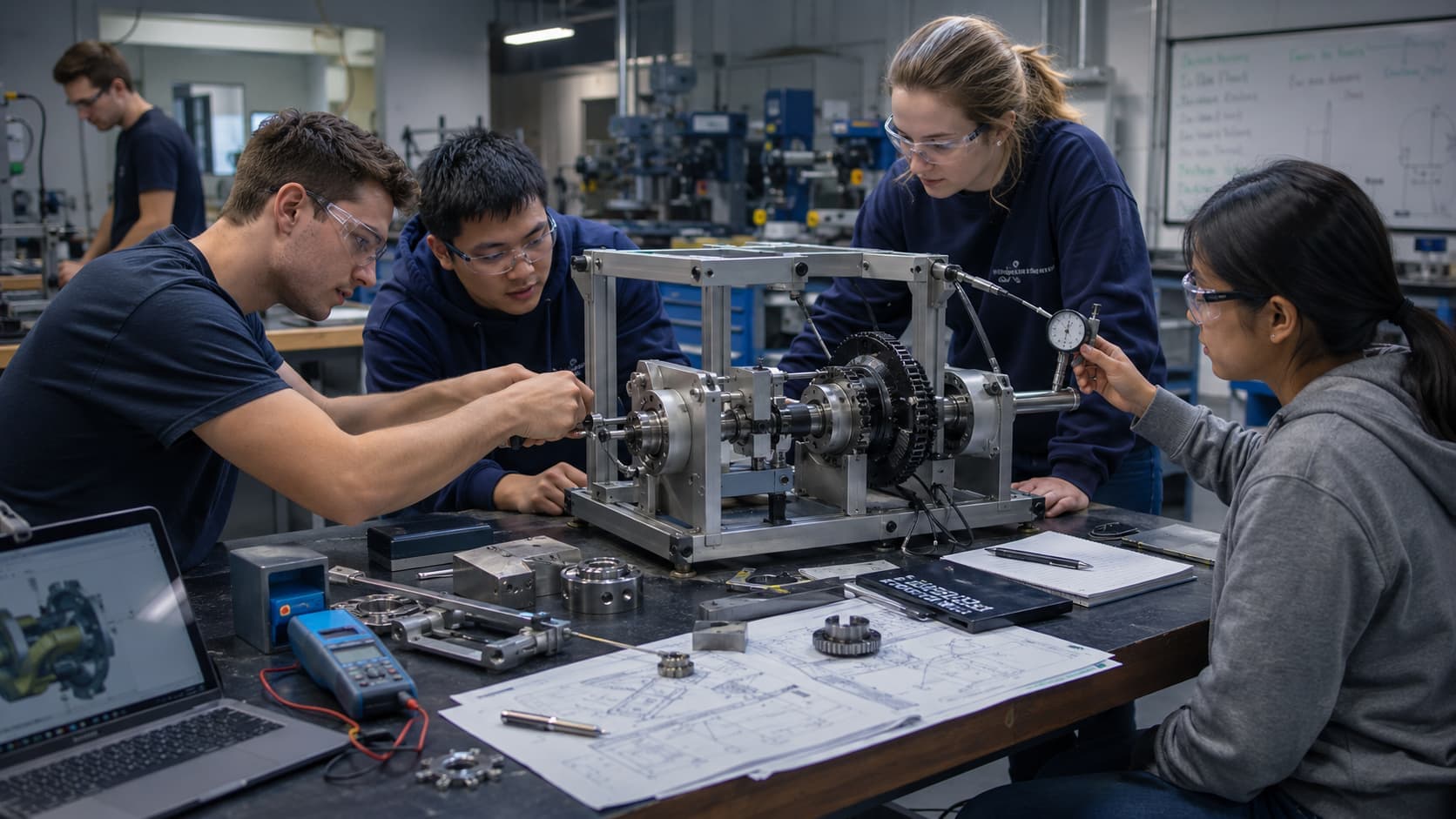
I have experienced it myself. Some mechanical and CNC-related concepts became much easier to understand once I could see or apply them practically instead of treating them only as abstract theory.
That does not make theory less important. It makes the role of theory clearer.
“Theory gives us a model of how the machine should behave. Practice gives us a way to test that model.”
The strongest CNC education therefore does not choose between theory and practice. It connects them.
CNC knowledge and CNC competence are not the same thing
Technical competence includes more than remembering information.
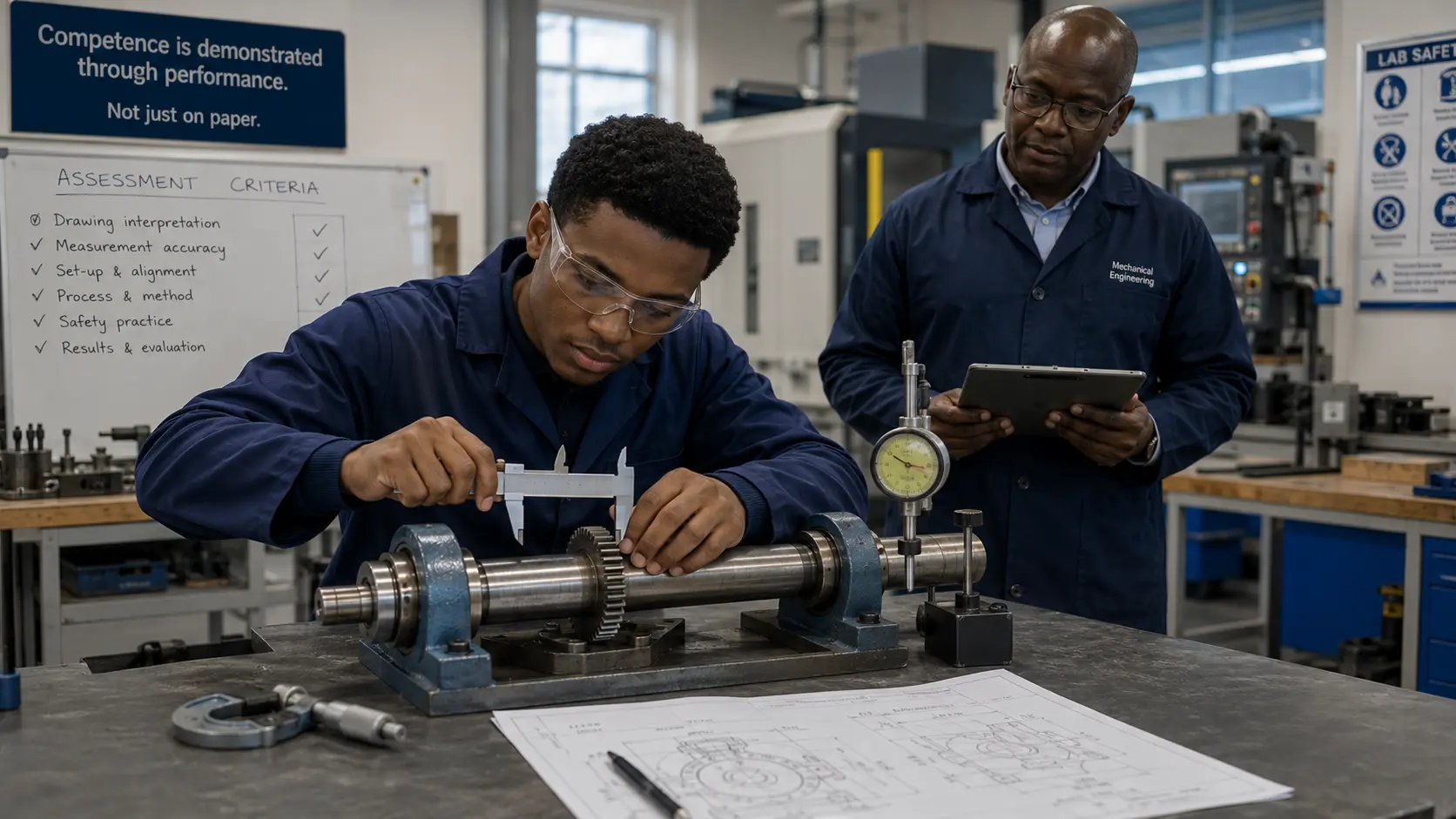
UNESCO-UNEVOC's competency-based training framework describes competence as involving the knowledge, skills and attitudes needed to perform work to an appropriate standard.
That distinction matters in CNC.
A learner might know that a work coordinate system establishes the program reference relative to the workpiece.
But competence involves being able to:
- Identify the intended reference
- Set or verify it correctly
- Understand how the program coordinates depend on it
- Recognize an incorrect setup
- Respond appropriately when the machine position does not match expectations
Knowledge matters. But practical competence asks whether the learner can use that knowledge reliably in a real technical situation.
Why CNC concepts can remain abstract
CNC combines several layers of abstraction.
The learner has to connect:
- Geometry
- Coordinate systems
- Numerical commands
- Machining parameters
- Machine state
- Tooling
- Physical motion
Consider the difference between learning:
G01 performs a coordinated feed move
and observing a programmed feed move happen on an actual or simulated machine.
The definition explains the command. The observation provides a physical reference.
Now ask the learner:
- Where will the tool move?
- At what feed?
- Relative to which coordinate system?
- What would change if the machine were in incremental mode?
- What happens if the target coordinate changes?
The concept becomes more than something to memorize. It becomes a prediction about machine behaviour.
Experience alone is not enough
Hands-on learning is often summarized as:
“Students learn by doing.”
That is only partly correct.
Experiential-learning theory emphasizes a cycle involving experience, reflection, conceptual understanding and further experimentation rather than activity alone.
A learner can perform a CNC operation repeatedly without fully understanding why it works.
For example:
- Press the button
- Select the offset
- Enter the value
- Start the program
If the learner is simply copying a demonstrated sequence, the practical activity may produce task completion without deeper understanding.
The better question is:
“Can the learner explain what each action changed in the machine system?”
Practical work becomes educationally powerful when it is connected to:
- Prediction
- Observation
- Feedback
- Explanation
- Another attempt
The CNC Learning Loop
A useful way to structure CNC education is:
Explain → Predict → Simulate → Practice → Observe → Reflect → Modify → Repeat
This is not intended as a universal educational theory. It is a practical CNC teaching framework built around the broader principle of experiential learning.
Explain
Introduce the concept.
For example:
- Absolute positioning
- Work offsets
- Feed rate
- Tool path
Predict
Before running anything, ask the learner:
“What should happen?”
Prediction matters because it exposes the learner's mental model.
Simulate
Run the program or operation in a safe digital environment. Now the learner sees whether the prediction was correct.
Practice
Move to guided physical application when appropriate.
Observe
- What did the machine actually do?
- What changed?
Reflect
Why did it behave that way?
Modify
Change one parameter, command or assumption.
Repeat
Run the cycle again with improved understanding.
That repetition gradually converts isolated facts into usable engineering reasoning.
Simulation belongs between theory and the machine
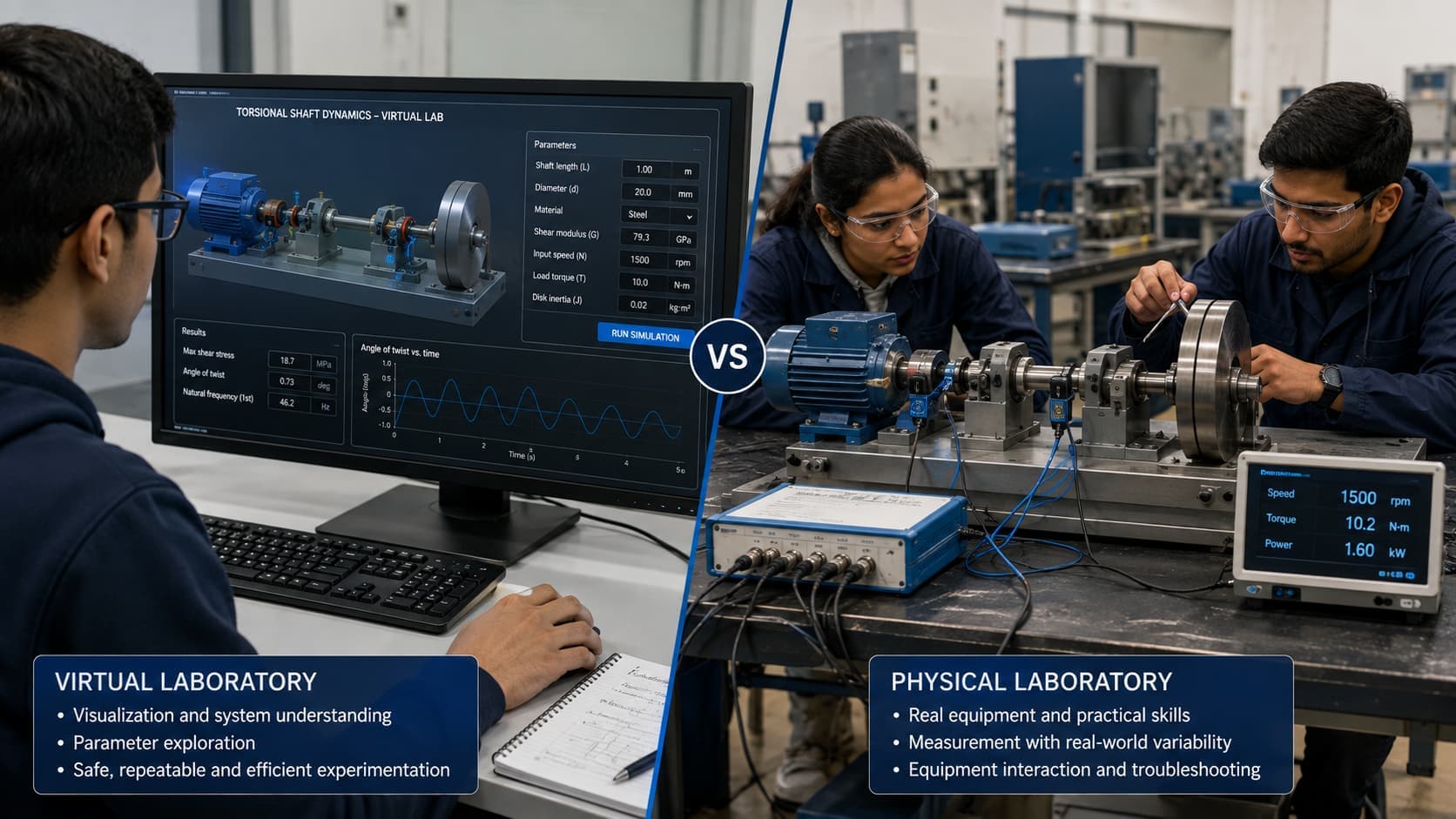
CNC simulation has an important educational role.
It can provide:
- Repeatable practice
- Lower-risk experimentation
- Visualization of tool motion
- Rapid parameter changes
- Opportunities to review mistakes
- Access when machine availability is limited
Research into virtual manufacturing, extended-reality environments and digital-twin-supported education continues to explore how realistic simulations can expand manufacturing training.
More recent work has also examined cyber-physical machine tools and digital twins for education and workforce development.
Simulation is particularly useful because it allows mistakes to become learning opportunities without immediately creating physical consequences.
But simulation should be understood as a bridge. Not necessarily the destination.
What physical CNC practice adds
Simulation can represent toolpaths extremely well. It cannot reproduce every feature of a real workshop environment.
Physical CNC practice introduces:
- Tooling setup
- Fixture constraints
- Actual work offsets
- Machine startup and shutdown procedures
- Real controller interaction
- Tool handling
- Material
- Chip formation
- Machine sound
- Vibration
- Safety procedures
- The consequences of setup decisions
There is also something educationally important about recognizing that a command is no longer just a line on a screen. It is about to move real hardware.
That changes the learner's relationship with the program. The consequences become concrete.
Safety means practical learning must be scaffolded
“Learning from mistakes” needs careful interpretation in CNC education.
A mistake in a spreadsheet may be easy to reverse.
A CNC mistake can involve:
- Collision
- Broken tooling
- Fixture damage
- Incorrect workpiece machining
- Machine damage
- Potentially unsafe conditions
Therefore hands-on education should not mean unrestricted trial and error.
A better progression is:
Theory → prediction → simulation → guided practice → supervised independent practice → demonstrated competence
This allows learners to experiment where the risk is low and gradually increase responsibility.
Simulation becomes particularly valuable because it gives learners space to make conceptual mistakes before those mistakes become machine motion.
G-code becomes clearer when learners can see the motion
Consider:
G01 X50 Y20A learner can memorize the syntax.
A better lesson asks:
- What coordinate mode is active?
- Where is the current tool position?
- What point does X50 Y20 represent?
- What path do you expect the tool to follow?
- At what feed should it move?
- What does the simulation show?
- What does the physical machine show?
- If the path differs from your prediction, why?
Now the command is no longer merely a code statement.
It connects:
symbol → geometry → machine state → motion
That connection is one reason CNC is an excellent context for teaching programming and engineering together.
Feeds and speeds need physical context too
Theoretical treatment of machining parameters is essential.
Students need to understand relationships involving:
- Cutting speed
- Spindle speed
- Feed
- Tool diameter
- Material
- Depth of cut
But physical or realistic practical application gives those quantities consequences.
A change in machining parameters may affect:
- Cycle time
- Cutting behaviour
- Surface condition
- Tool loading
- Machine sound
- Chip formation
The educational goal is not to encourage learners to experiment outside safe machining limits. It is to help them connect parameter changes with observable process behaviour.
Theory predicts the relationship. Practice provides evidence.
Feedback turns activity into learning
Imagine two students performing the same CNC exercise.
Student A completes the required steps.
Student B completes the steps but is also asked:
- What did you expect?
- What did you observe?
- Why did it happen?
- What would happen if this value changed?
- How could you verify your answer?
The second student is doing more than operating the machine. They are building an explanatory model of the process.
That difference matters.
Experience becomes more useful when learners are required to reflect on it and then use their new understanding in another attempt.
Digital tools should reveal engineering relationships
Modern CNC learning increasingly involves:
- CAM
- Simulation
- Python
- Automated G-code generation
- AI tools
- Digital twins
These tools can improve learning substantially. But they also create a potential problem.
Automation can hide the engineering.
Suppose a learner enters:
- Workpiece dimensions
- Number of holes
- Feed
- Depth
and receives a complete CNC program. That may be convenient.
But if the student cannot see how the input values became coordinates and machine commands, an educational opportunity has been lost.
The better learning system exposes the chain:
input → calculation → G-code → predicted toolpath → simulated behaviour → machine behaviour
This principle is central to my own Python CNC Automation work.
Part of my intention is to help learners see the relationship between the parameters they enter, the generated G-code, and the resulting CNC or toolpath behaviour.
The software should therefore not merely provide an answer. It should make the engineering relationship visible.
Example: using Python-generated G-code as a learning system
Consider a learner generating a bolt-hole pattern.
The student enters:
- Centre coordinate
- Radius
- Number of holes
- Drilling depth
- Feed
The system calculates the positions. Then it generates the G-code.
But instead of stopping there, the learning activity continues.
Step 1 — Predict
Where should each hole appear?
Step 2 — Inspect the coordinates
Do the calculated values make sense?
Step 3 — Inspect the G-code
How are those coordinates represented?
Step 4 — Simulate
Does the toolpath match the prediction?
Step 5 — Modify
Change the radius.
Step 6 — Observe
What changed in:
- Coordinates?
- G-code?
- Toolpath?
Step 7 — Explain
Why did it change?
This single task integrates:
- Mathematics
- Machining
- Programming
- G-code
- Verification
- Reflection
That is one reason software can be particularly useful in Technology Education when it is designed around learning rather than only automation.
Hands-on learning should not become procedure memorization
There is another danger. Practical training itself can become overly procedural.
Students may memorize:
“first press this, then enter this, then move this.”
That can produce short-term task performance without strong transfer.
If the machine, controller or task changes, the memorized procedure may no longer work.
A stronger approach emphasizes principles:
- What system state are you changing?
- Why is the offset necessary?
- What reference does it establish?
- What safety check should happen first?
- What information would tell you that the setup is wrong?
Teaching principles alongside procedures makes knowledge more transferable.
From demonstration to independent competence
A useful progression is:
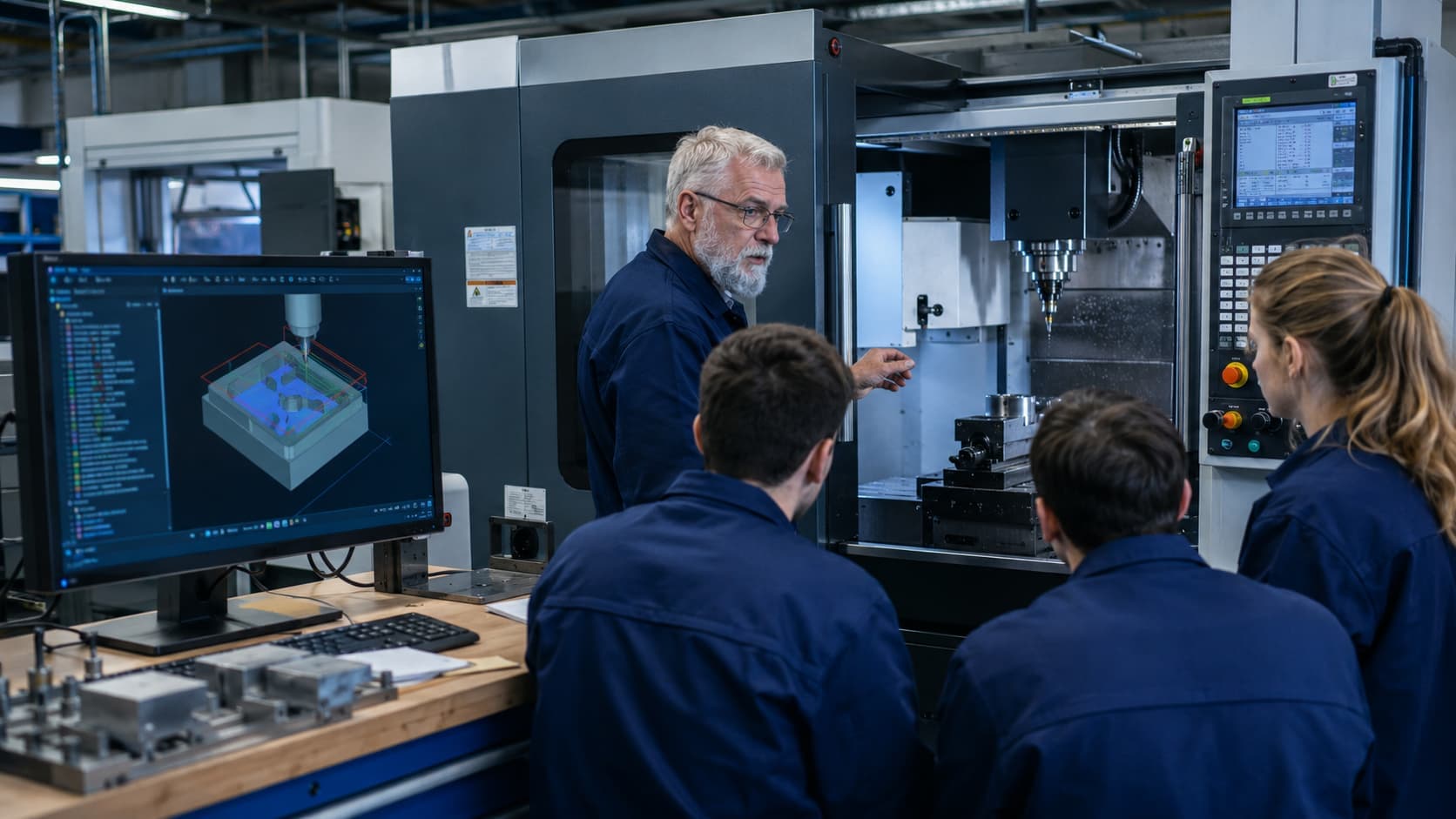
Instructor demonstration
Learners first see the complete operation.
Guided questioning
Students explain what they think is happening.
Simulation
Learners test understanding in a lower-risk environment.
Guided machine practice
Students perform the operation with immediate feedback.
Reduced guidance
The instructor provides less step-by-step support.
Independent task
Learners plan and execute an appropriate task within their demonstrated competence.
Reflection and assessment
The learner explains not only what was done but why.
This gradually shifts responsibility from instructor to learner. That is more useful than moving directly from lecture to unsupervised machine operation.
Implications for Technology Education
CNC education should be designed around learning outcomes that include both explanation and performance.
Students should not only be assessed on whether they can:
- Define a coordinate system
- Identify a G-code
- Calculate spindle speed
- Describe an offset
They should also demonstrate that they can:
- Apply the concept
- Predict the machine consequence
- Verify the result
- Identify incorrect behaviour
- Explain why the result occurred
That requires learning environments where theory, digital tools and practical facilities are connected.
It also means laboratories should not be treated merely as supplementary demonstrations after the “real teaching” has occurred in class.
The laboratory is part of the learning process. So is the simulator. So is the explanation afterward.
Key takeaway
Effective CNC learning is not:
theory versus practice.
It is:
theory → prediction → simulation → practice → observation → reflection → improved theory
Theory gives learners the language and models needed to reason about machining. Simulation allows them to test those models safely. Hands-on practice introduces real equipment, procedures and constraints. Reflection connects the experience back to understanding.
Together, those stages help turn:
information into engineering competence.
For me, the key lesson is simple:
“Theory explains the machine. Practice makes the explanation usable.”
References and further reading
- UNESCO-UNEVOC — TVETipedia: Competency-Based Training. Relevant to the development of knowledge, skills and attitudes required for competent occupational performance.
- UNESCO-UNEVOC — TVETipedia: Work-Based Learning. Defines learning undertaken through authentic work environments and occupational practice.
- Kolb & Kolb — Experiential Learning Cycle resources. Useful for understanding learning through experience, reflection, conceptualization and experimentation.
- OECD — Vocational Education and Training Systems. Provides contemporary examples of vocational systems combining theoretical instruction, practical workshops, simulations and workplace learning.
- Engineering laboratory education research. Literature emphasizes laboratory work as a means of developing practical, analytical, experimental and professional engineering competencies rather than simply demonstrating classroom theory.
- Recent manufacturing education research involving simulation, XR and cyber-physical machine tools. Relevant to the growing use of digital environments and digital twins in manufacturing education and workforce development.