A low boiling point does not make a fluid automatically suitable for a geothermal Organic Rankine Cycle.
That is one of the first lessons that becomes apparent when working-fluid selection moves from a textbook comparison into an actual thermodynamic design problem.
An ORC working fluid has to do far more than boil at a convenient temperature. It needs to match the geothermal heat source, operate within practical pressure limits, transfer heat effectively, expand appropriately through the turbine or expander, condense under the available cooling conditions, remain chemically stable, satisfy safety and environmental constraints, and produce a system that can realistically be built and operated.
I have already explored working-fluid selection through thermodynamic calculations and literature comparison as part of my wider interest in low-enthalpy geothermal utilization and binary ORC systems.
That process reinforces an important conclusion:
“There is no universally best ORC working fluid.”
The better question is:
“Which working fluid best matches this geothermal resource and this particular cycle objective?”
Recent research continues to demonstrate that fluid ranking changes with source temperature, cycle configuration and optimization criterion.
Why use an Organic Rankine Cycle for lower-temperature geothermal heat?
The conventional Rankine cycle commonly uses water as the working fluid.
Organic Rankine Cycles instead use fluids whose thermophysical behaviour can make them more suitable for converting lower-temperature heat sources into useful power.
NIST specifically identifies organic working fluids as enabling Rankine-cycle operation with lower-temperature heat sources including geothermal and solar heat.
The geothermal fluid does not normally pass through the turbine in a binary ORC.
Instead:
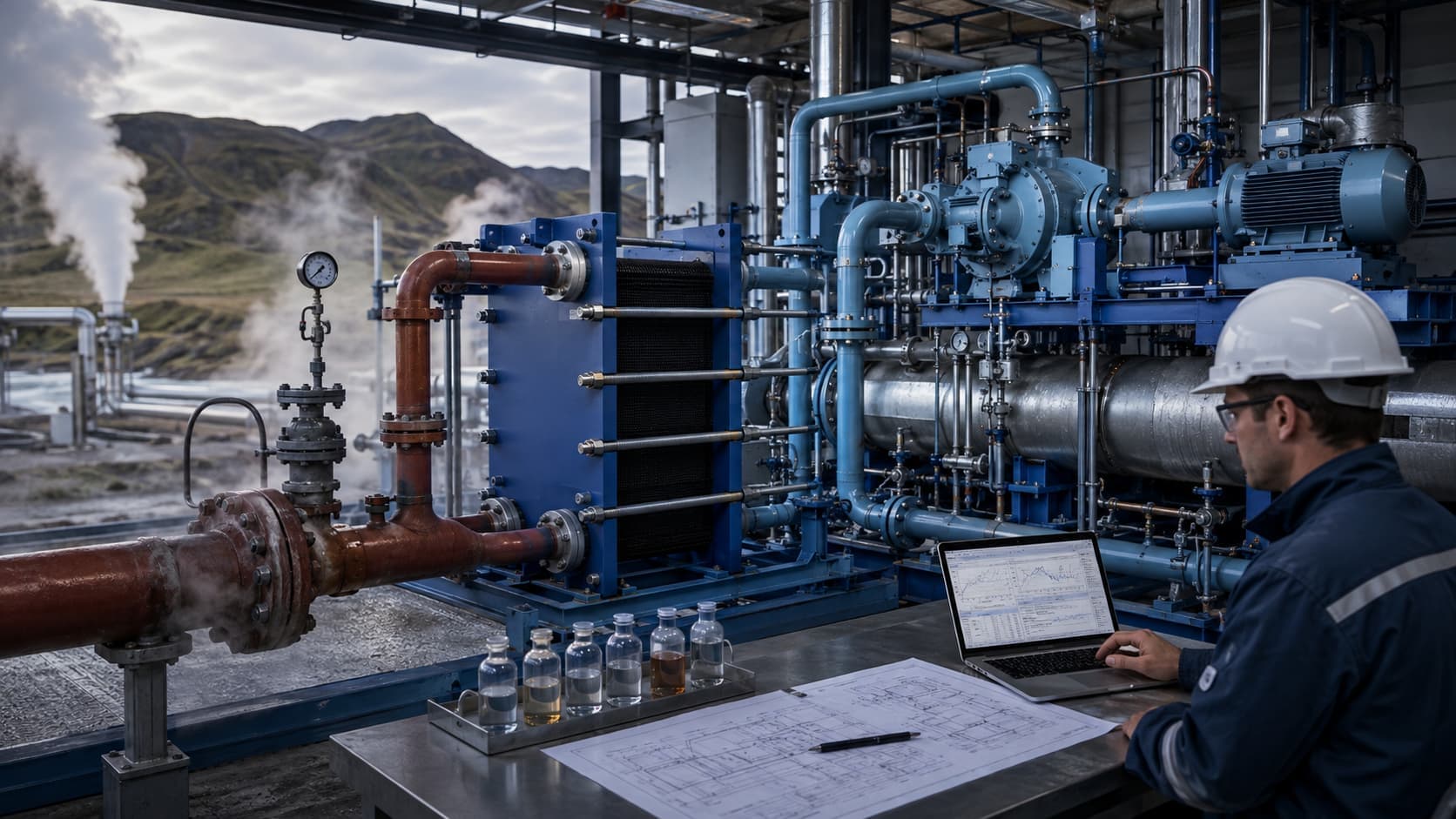
Geothermal fluid transfers heat through a heat exchanger to a closed organic working-fluid loop.
The organic fluid then:
- Receives heat
- Evaporates
- Expands through a turbine or expander
- Condenses
- Is pumped back to high pressure
- Repeats the cycle
That separation allows geothermal heat to be used even when the resource is unsuitable for direct steam generation.
But as source temperature falls, the thermodynamic margin becomes smaller. Temperature matching therefore matters increasingly.
Start with the geothermal resource
Fluid screening should begin with the heat source. Not with a refrigerant table.
Important questions include:
- What is the geothermal-fluid inlet temperature?
- What mass flow is available?
- What minimum outlet or reinjection temperature is required?
- How stable is the source temperature?
- Are there scaling or chemistry constraints?
- What cooling conditions are available at the site?
The cold side is equally important.
An air-cooled condenser in a hot climate operates under different conditions from a water-cooled condenser supplied by relatively cool water.
The same working fluid can therefore perform differently at different sites.
This is why fluid selection cannot be separated from system boundary conditions.
There is no universally best working fluid
Suppose two candidate fluids are compared.
Fluid A gives the highest calculated thermal efficiency. Fluid B produces more net electrical power. Fluid C gives lower environmental impact but requires a larger heat exchanger.
Which one is best?
The answer depends on the project objective.
Published geothermal ORC studies repeatedly show that different fluids can become preferred depending on whether the optimization target is:
- Thermal efficiency
- Exergy efficiency
- Power output
- Cost
- Environmental impact
- Equipment size
Working-fluid selection is therefore a multi-objective engineering problem.
The working fluid has to match the geothermal source
Heat does not transfer only at the working fluid's boiling point. The full temperature profiles matter.
Inside an ORC evaporator, the geothermal fluid cools progressively while the working fluid:
- Warms as a liquid
- Approaches saturation
- Undergoes evaporation
- May become superheated depending on the cycle
The temperature difference between those streams drives heat transfer.
At one location, that difference reaches a minimum.
This is commonly referred to as the pinch point or minimum temperature approach.
The pinch has important consequences.
If the streams are forced unrealistically close together, the required heat-exchanger area can become excessive.
If there is an unnecessarily large temperature difference, the system destroys more of the limited work potential of the low-temperature heat source.
Recent low-enthalpy ORC research still identifies thermal mismatch in the evaporator as a major source of performance limitation.
This leads to a better design question than simply asking whether the fluid boils.
Ask:
“How well does its heating and phase-change behaviour match the cooling geothermal stream?”
Critical temperature matters
Every pure fluid has a critical point.
Above the critical temperature, the conventional distinction between saturated liquid and saturated vapour disappears.
For a subcritical ORC, the evaporation temperature remains below the fluid's critical temperature.
Critical temperature therefore influences the useful operating range available for a given geothermal source.
Recent working-fluid studies continue to find a relationship between source temperature, working-fluid critical properties and achievable ORC output.
But there is no simple rule such as:
“Choose the highest critical temperature.”
Changing the fluid changes:
- Operating pressure
- Heat-transfer behaviour
- Turbine expansion
- Mass flow
- Condenser conditions
- Equipment design
Critical temperature is therefore a screening parameter, not a complete selection criterion.
Wet, dry and isentropic fluids
ORC working fluids are often classified according to the slope of the saturated-vapour line on a temperature-entropy diagram.
They are commonly described as:
- Wet
- Isentropic
- Dry
The distinction matters because the working fluid's state changes during turbine expansion.
Wet fluids
A wet fluid can move toward or into the two-phase region during an approximately isentropic expansion. That may produce liquid droplets unless the turbine inlet is sufficiently superheated or another design approach is used.
Dry fluids
Dry fluids tend to leave the expander in a superheated condition. That can reduce the risk of liquid formation during expansion.
But a highly superheated turbine exhaust can also mean useful heat remains in the fluid. A recuperator may then become attractive in some cycle configurations.
Isentropic fluids
These exhibit saturation behaviour between those two extremes.
The important conclusion is:
“Dry does not automatically mean superior.”
Fluid type influences cycle architecture and turbine-exit condition, but performance still depends on the overall heat-source and cycle combination.
Thermal efficiency is not enough
Consider the familiar thermal-efficiency idea:
net useful cycle work divided by heat supplied to the cycle.
It is an important performance measure. But for geothermal ORCs, it should not be the only measure.
A fluid might achieve high cycle efficiency while recovering relatively little energy from the geothermal stream.
Another fluid may operate at slightly lower efficiency but extract more useful heat before the geothermal fluid reaches its allowable reinjection temperature.
The second case could produce greater net power.
Therefore an ORC comparison should consider quantities such as:
- Turbine power
- Pump power
- Net cycle power
- Geothermal heat extracted
- Source utilization
- Thermal efficiency
Research comparisons indeed show that the fluid maximizing one metric need not maximize another.
Why exergy matters
Energy is conserved. But the ability of energy to produce useful work is not.
A geothermal stream at a modest temperature contains energy, but its potential to become mechanical or electrical work is limited by how close its temperature is to the surrounding environment.
That work potential is described through exergy.
Low-temperature geothermal resources contain relatively limited exergy compared with very high-temperature heat sources.
This is why large temperature differences and other irreversible processes matter so much.
Exergy analysis can help identify where useful work potential is being destroyed, including within:
- Evaporators
- Condensers
- Expanders
- Pumps
This does not mean the fluid with the highest exergy efficiency will automatically be the final design choice. It adds another useful perspective to the selection process.
The working fluid also designs the expander
Working-fluid selection changes more than the thermodynamic diagram. It changes the machine.
Different fluids can require different:
- Mass flow rates
- Inlet pressures
- Outlet pressures
- Pressure ratios
- Vapour densities
- Volumetric flow rates
Those properties influence turbine or expander design.
Recent ORC research explicitly combines working-fluid selection with turboexpander design because the thermodynamic optimum and the practical machine optimum are connected.
A cycle model might report attractive performance.
But if the selected fluid creates an impractical:
- Pressure ratio
- Volumetric flow
- Rotational speed
- Machine size
the design problem has not been solved.
The fluid therefore needs to be evaluated as part of an energy-conversion system, not in isolation.
Heat exchangers can reshape the decision
Low-temperature ORC systems depend heavily on their heat exchangers.
The fluid influences:
- Heat-transfer behaviour
- Pressure drop
- Required mass flow
- Phase-change characteristics
- Required surface area
A very small assumed pinch-point temperature difference can increase theoretical heat recovery. But achieving that small approach may require substantially more heat-transfer area.
This introduces a classic engineering trade-off:
“thermodynamic performance versus capital equipment requirement.”
A thermodynamically attractive fluid may not produce the most economical plant.
That is why thermo-economic optimization appears so frequently in modern ORC research.
Match the cold side as well as the hot side
The geothermal resource receives most of the attention. But the condenser also influences fluid selection.
A working fluid must condense at conditions compatible with the actual heat sink.
Possible cooling approaches include:
- Air cooling
- Cooling water
- Cooling tower systems
Ambient conditions influence condensing temperature and pressure.
Depending on the fluid, a low condensing temperature may also require very low system pressures.
That can influence:
- Equipment design
- Air ingress
- Sealing
- Condenser size
Working-fluid selection should therefore match hot source + cycle + cold sink, not just hot source + fluid.
Environmental performance belongs in the engineering decision
Working-fluid research has changed considerably as environmental regulation has evolved.
Historically attractive fluids may have:
- Ozone-depletion concerns
- High global-warming potential
- Regulatory limitations
Today, candidate screening should include:
- Ozone depletion potential
- Global warming potential
- Atmospheric/environmental considerations
- Regulatory status
The U.S. EPA, for example, evaluates refrigerant substitutes using factors including GWP, ozone depletion, toxicity and flammability, illustrating the broader environmental-and-safety screening now applied to working fluids.
High-GWP HFCs are also facing increasingly restrictive transitions in multiple applications.
A fluid that performs well in an old paper should therefore not automatically be assumed to be the best fluid for a new installation.
Lower environmental impact can introduce other trade-offs
Environmental improvement does not eliminate engineering trade-offs.
For example, some lower-GWP fluids may introduce:
- Flammability
- Different pressure requirements
- New material-compatibility questions
- Different costs
Hydrocarbons may have attractive thermodynamic properties but require careful management of flammability.
Other candidates may reduce flammability while introducing environmental, pressure or economic compromises.
Therefore:
“Low GWP does not automatically mean low engineering risk.”
Safety screening should include:
- Toxicity
- Flammability
- Chemical stability
- Material compatibility
- Expected operating pressure
Accurate fluid properties matter
ORC calculations depend on thermophysical properties.
These include:
- Enthalpy
- Entropy
- Density
- Heat capacity
- Viscosity
- Thermal conductivity
- Saturation properties
NIST's REFPROP database provides high-accuracy thermophysical-property models for many industrially important pure fluids and mixtures and is widely used in research and engineering calculations.
Property quality matters because errors propagate through:
- Pump calculations
- Heat-exchanger calculations
- Turbine expansion
- Mass-flow prediction
- Cycle efficiency
A detailed cycle model is only as trustworthy as the property information behind it.
Pure fluids versus zeotropic mixtures
Pure fluids generally undergo phase change at approximately constant temperature when pressure remains fixed.
Zeotropic mixtures behave differently.
Their composition allows evaporation and condensation to occur across a temperature glide.
That glide can potentially match a geothermal stream more closely as the source temperature decreases through the heat exchanger.
The conceptual advantage is better temperature matching → potentially lower irreversibility.
Recent research continues to explore working-fluid mixtures and optimized fluid formulation for low-temperature ORC systems.
But mixtures also create additional complexity:
- Composition selection
- Property modelling
- Charging
- Leakage effects
- Heat exchanger design
So:
“A mixture may improve the thermal match, but it does not automatically simplify the plant.”
The ORC Working-Fluid Selection Funnel
Instead of choosing a fluid from a single property, I find it more useful to think of selection as progressive screening.
Stage 1 — Define resource constraints
Establish:
- Geothermal inlet temperature
- Geothermal mass flow
- Allowable reinjection temperature
- Cooling conditions
Without these, fluid optimization lacks a meaningful boundary.
Stage 2 — Thermodynamic screening
Eliminate candidates with unsuitable:
- Critical temperature
- Freezing behaviour
- Stability
- Saturation behaviour
- Pressure requirements
Stage 3 — Model cycle performance
Compare:
- Expander work
- Pump work
- Net power
- Thermal efficiency
- Geothermal-resource utilization
- Exergy performance
Avoid selecting from one metric alone.
Stage 4 — Evaluate equipment implications
Ask:
- What pressure ratio does the expander need?
- What volumetric flow results?
- How large might the evaporator and condenser become?
- What are the pump requirements?
Stage 5 — Safety and environmental screening
Assess:
- Flammability
- Toxicity
- GWP
- ODP
- Chemical stability
- Relevant regulations
Stage 6 — Practical and economic screening
Consider:
- Availability
- Cost
- Component compatibility
- Fluid handling
- Maintenance requirements
- Likely long-term availability
Stage 7 — Multi-objective selection
Only now should the remaining candidates be ranked. The result may depend on the actual goal.
A research system maximizing net power may choose differently from a commercial plant minimizing levelized cost or prioritizing environmental impact.
An illustrative low-temperature geothermal scenario
Consider a geothermal source in roughly the 100–130 °C range.
This is only an illustrative design scenario—not a result from a specific plant.
Fluid A may allow good heat-source utilization but operate at relatively high pressure. Fluid B may provide a convenient pressure level but leave more geothermal heat unused. Fluid C may have a lower environmental impact but require different safety provisions.
The engineer should not simply ask:
“Which fluid gives the highest efficiency?”
The complete comparison should ask:
- How much net power is produced?
- What geothermal outlet temperature results?
- What is the pinch point?
- What pressure ratio does the expander experience?
- What condenser pressure is required?
- What heat-exchanger size is implied?
- What safety classification applies?
- What environmental restrictions apply?
- What does the plant cost?
That is what turns fluid ranking into system design.
Where my geothermal ORC research fits
My own research interest in this area considers how low-enthalpy geothermal resources might be used more effectively through binary Organic Rankine Cycle systems, including useful power generation and industrial co-generation.
I have already worked through thermodynamic calculations and literature comparisons involving ORC working fluids.
One of the clearest conclusions from that process is that choosing a fluid cannot be separated from choosing:
- Operating conditions
- Heat-exchanger conditions
- Expander requirements
- And the final use of the recovered energy
For a co-generation system, the optimization may become even more interesting.
Maximizing electricity production may not necessarily maximize the value of the entire geothermal resource if useful thermal energy is also required downstream.
That creates a future research question beyond simple working-fluid selection:
“How should the ORC be optimized when electricity and useful process heat are both valuable outputs?”
That is the direction in which the broader thermodynamic problem becomes an integrated energy-system problem.
Key takeaway
Selecting an ORC working fluid should not begin with:
“Which fluid has the lowest boiling point?”
or:
“Which fluid produced the highest efficiency in another study?”
Begin with:
- What geothermal resource is available?
- What cooling conditions exist?
- What fluid properties match those temperature levels?
- How much useful power and resource utilization result?
- What equipment does that fluid require?
- What safety and environmental constraints apply?
- Is the resulting system economically and practically credible?
Only then does working-fluid ranking become meaningful.
The central principle is:
“Choose the fluid for the system—not the system for the fluid.”
References and further reading
- NIST — Refrigerants and Working Fluids. NIST research on candidate working fluids and mixtures for Organic Rankine Cycles, including lower-temperature geothermal applications.
- NIST — REFPROP. Reference database for thermodynamic and transport properties of pure fluids and mixtures used in engineering modelling.
- Guzović et al. (2025), Energies — Effect of Working Fluid on Characteristics of Organic Rankine Cycle for Geothermal Applications. Recent comparative work demonstrating how strongly fluid properties influence geothermal ORC performance.
- 2025 thermo-economic geothermal ORC working-fluid screening research. Relevant to the interaction among temperature matching, thermodynamic performance and economic criteria.
- 2025 ORC working-fluid design and selection research. Relevant to the relationship between working-fluid critical properties, geothermal source temperature and output performance.
- U.S. EPA — Refrigerant substitute and GWP guidance. Useful for environmental, flammability, toxicity and regulatory screening rather than relying solely on historical thermodynamic studies.