A student can explain how a machine should be set up, describe how a measurement instrument works and calculate machining parameters accurately — and still struggle when actually asked to set up the machine, use the instrument or make the call, because knowing something and being able to perform with that knowledge are not identical outcomes.
This does not make theory unimportant. Engineering practice depends on theoretical understanding. But it shows that knowing something and being able to perform with that knowledge are not identical outcomes.
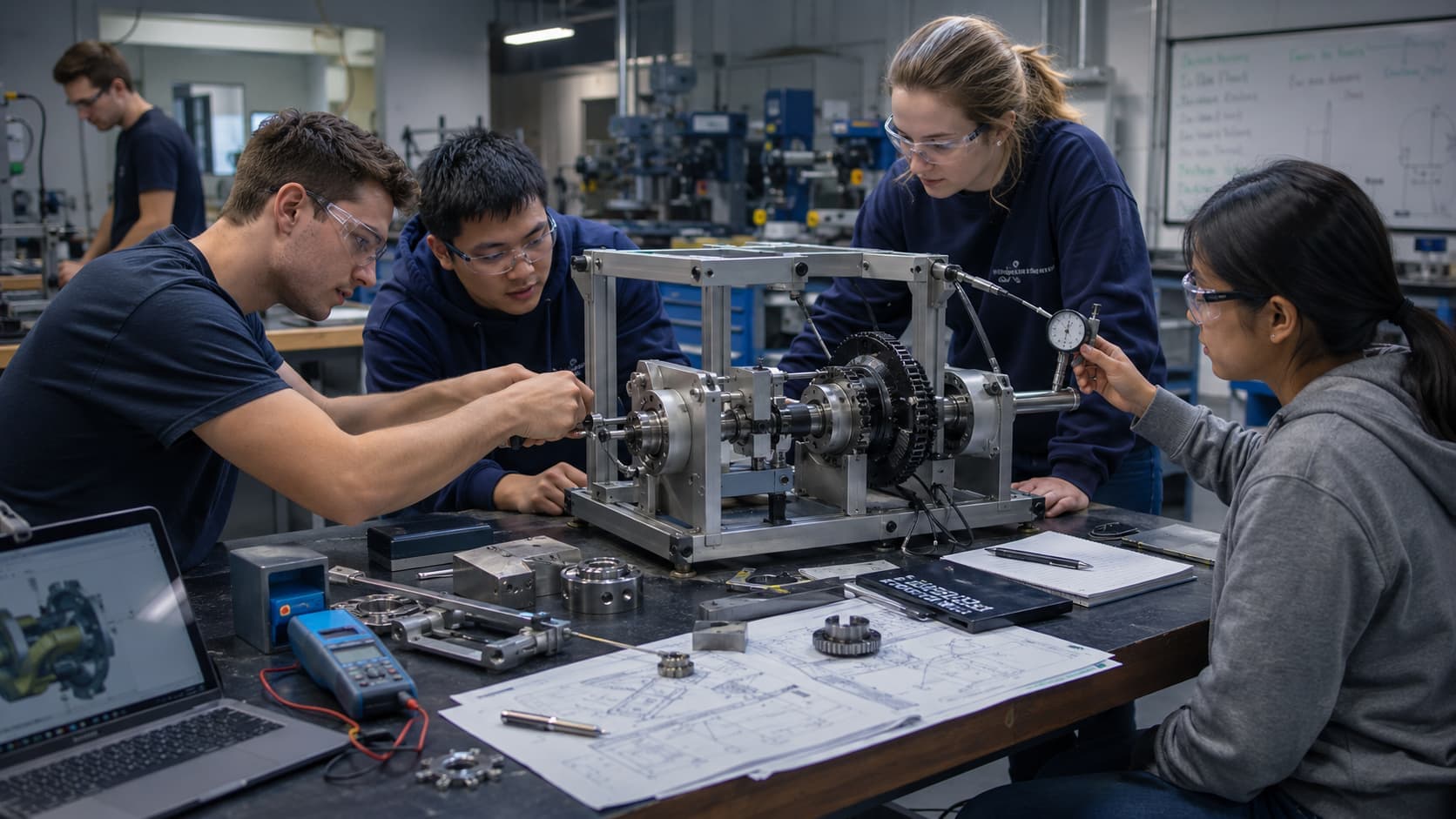
I have encountered this distinction in engineering learning and practical situations myself. A concept can make sense theoretically, yet carrying out the actual task introduces another level of difficulty: equipment, measurements, sequence, safety, judgement and unexpected behaviour all become part of the problem.
This creates an important assessment question:
“If an engineering course claims that students have developed practical competence, what evidence should demonstrate that competence?”
A written examination can provide strong evidence that a learner understands theory or can perform calculations. It cannot, by itself, provide equally strong evidence that the learner can:
- Use an instrument correctly
- Set up equipment
- Conduct an experiment
- Diagnose an unexpected problem
- Behave safely
- Make a practical engineering decision
The assessment should therefore match the capability being claimed.
Current ABET engineering criteria reflect this principle. Student outcomes are defined in terms of what graduates are expected to know and be able to do, including solving complex engineering problems, designing solutions, conducting experiments, interpreting data and using engineering judgement. ABET also states that effective assessment should use measures appropriate to the outcome being assessed.
The implication is straightforward: practical competence needs practical evidence.
Knowledge is part of competence, not the whole of it
Consider a student learning measurement. At one level, the student may know that a micrometer measures dimensional features with greater resolution than a basic steel rule. That is useful knowledge. At another level, they may be able to explain the main parts of the instrument, how to read it, and why measurement force matters.
But practical competence introduces additional questions. Can the learner:
- Select the appropriate instrument?
- Check its condition?
- Position it correctly?
- Take a repeatable measurement?
- Identify an unrealistic reading?
- Interpret the result against a requirement?
Knowing the instrument supports performance. It does not automatically guarantee performance.
The Engineering Competence Evidence Ladder
A useful way to think about assessment is as a progression.
- Level 1 — Explain. Can the student explain the engineering concept? For example: why is shaft alignment important? This primarily tests conceptual knowledge.
- Level 2 — Calculate. Can the student use the relevant principles quantitatively? For example: calculate the required shaft speed or machining feed.
- Level 3 — Interpret. Can the student make sense of engineering information — an engineering drawing, a vibration spectrum, a measurement result, pressure-temperature data, a toolpath?
- Level 4 — Execute. Can the student perform the task correctly and safely — take a measurement, set up an experiment, configure a machine, perform an inspection?
- Level 5 — Diagnose. Can the learner respond when reality does not match expectation? For example: why is this measurement unstable, or why is the machine producing an abnormal result?
- Level 6 — Decide. Can the learner choose and justify a suitable engineering action under realistic constraints?
These levels are not separate subjects. Higher levels integrate the lower ones. A student diagnosing a machine still needs theory, calculation and interpretation. The difference is that the knowledge must now operate inside a practical situation.
Assess the capability in the form in which it will be used
Suppose a course outcome says: students will be able to conduct an engineering experiment and interpret the resulting data.
If the final assessment consists only of explain the steps involved in conducting an experiment, then the assessment captures only part of the stated outcome.
A more aligned assessment would require students to plan or understand the setup, use the equipment, obtain data, evaluate data quality, interpret the results, and draw an engineering conclusion.
ABET's 2026–2027 criteria specifically include the ability to develop and conduct appropriate experimentation, analyze and interpret data, and use engineering judgement to draw conclusions. The assessment evidence should therefore contain those behaviours somewhere in the course.
Written exams remain valuable
There is no need to reject traditional examinations. They can be excellent for assessing theory, calculations, conceptual relationships, analytical reasoning and design principles.
The mistake occurs when written performance is used as the only evidence for outcomes that are fundamentally practical.
For example, a written question can ask: describe the correct procedure for aligning two shafts. That tests whether the learner knows the procedure. It does not directly test whether they can align the shafts.
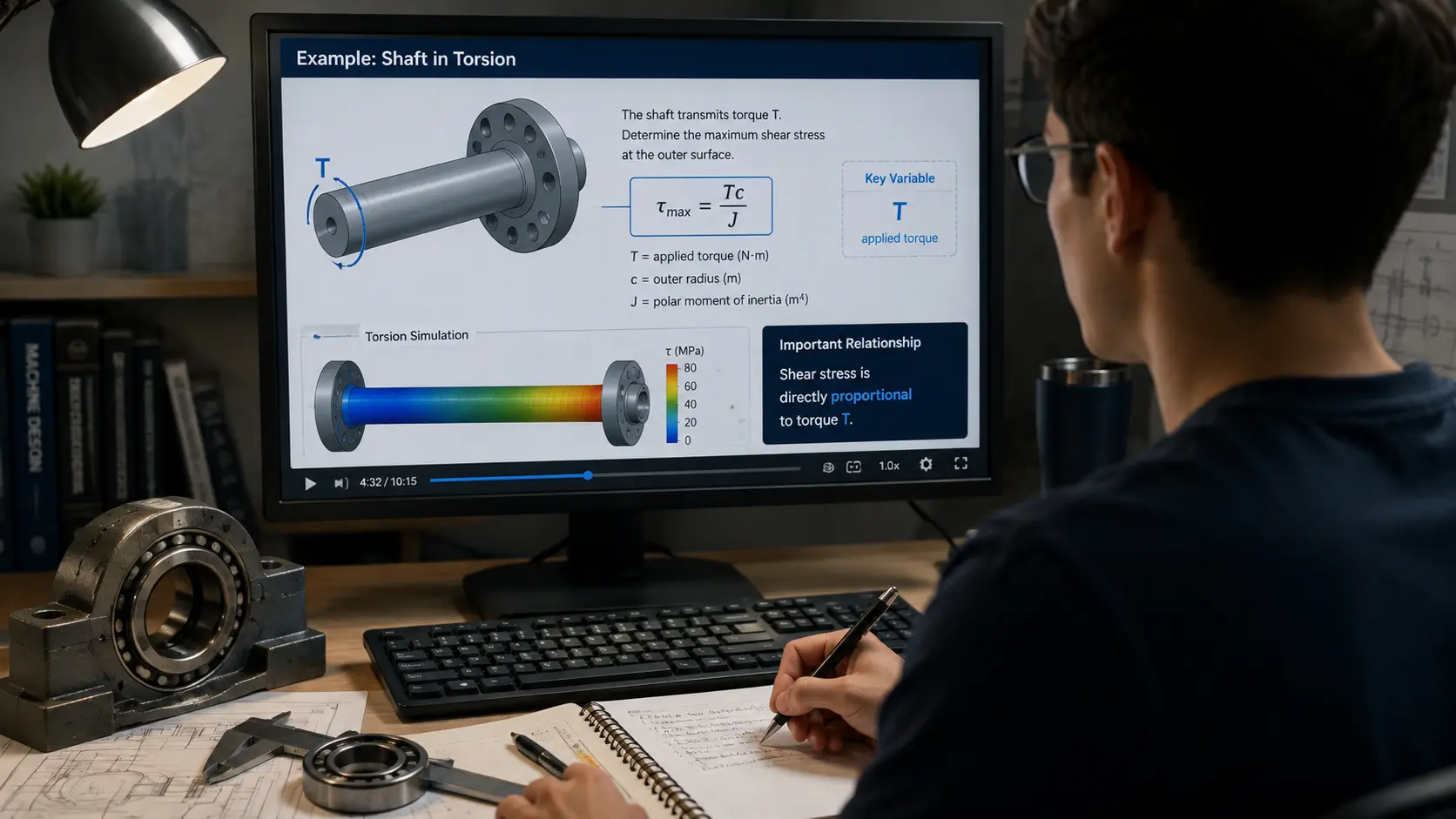
The distinction seems obvious when stated clearly, but curriculum assessment can easily blur it. How a procedure should be explained or demonstrated to students in the first place is a related but separate question — covered in how multimedia videos should be designed for engineering students — this article is specifically about how to assess whether the procedure was actually learned.
Practical assessment should observe the process
Imagine two students produce components that both meet the final dimensional requirement.
Student A checks the drawing, selects an appropriate measuring instrument, verifies workholding, follows the correct sequence, works safely and checks the result.
Student B receives substantial help, uses trial and error, makes unsafe setup choices, and eventually obtains an acceptable part.
If assessment considers only the final component, their performance may appear equal. It is not.
The process contains evidence about competence — planning, tool selection, setup, safety, technical execution, measurement, checking, interpretation. The final result still matters. But it should not always be the only thing that matters.
A correct answer can hide weak competence
Suppose the expected answer is 12.4 mm. Student A obtains 12.4 mm through a correct, understood measurement process. Student B obtains 12.4 mm after repeated guessing and instructor correction. The numbers are the same. The evidence is not.
There is another side to this. Suppose a physical experiment produces noisy measurements. A competent student recognizes instability, possible sensor limitations and measurement uncertainty, and explains why the result should be interpreted cautiously. Another student obtains a clean number but does not notice that it is physically unreasonable.
Who has demonstrated stronger engineering competence? The quality of reasoning matters.
Practical competence includes judgement about the result
Students should learn to ask:
“Does this result make sense?”
That question is central to engineering. A calculation may be numerically correct but use wrong units, unrealistic assumptions or incorrect boundary conditions. Similarly, a measurement can be recorded accurately but come from the wrong location, an unsuitable instrument or a badly configured setup.
Practical assessment should therefore include interpretation. Do not only ask what value a student obtained.
“Why do you trust it?”
Measurement competence deserves direct assessment
Mechanical engineering relies heavily on measurement. Students may need to work with dimensions, temperature, pressure, vibration, speed, electrical quantities and force.
Measurement competence includes more than reading a display. It may require choosing the instrument, understanding range and resolution, correct positioning, repeatability, recognising uncertainty and identifying abnormal measurements.
That is difficult to infer from a written examination alone. Direct observation is stronger evidence.
Safety is part of technical competence
A student should not be considered fully competent in a practical task if they can complete it only by working unsafely.
Safety is not a separate decoration added to technical marks. It is part of correct engineering practice.
Depending on the task, assessment might consider preparation, appropriate PPE, safe equipment setup, isolation procedures, awareness of hazards and response to abnormal conditions.
Consider a learner who correctly explains that power must be isolated before maintenance intervention. During the practical exercise, they begin work without verifying isolation. The written answer demonstrated safety knowledge. The practical behaviour demonstrated something different. Assessment needs both when both matter.
Engineering students should be assessed when things go wrong
Much engineering education focuses on normal operation. The apparatus works. The input is correct. The measurement is stable. The solution follows the expected sequence.
But engineering practice often becomes most demanding when something does not behave as expected. That is where troubleshooting begins.
A practical assessment could introduce a controlled problem:
- Incorrect sensor connection
- Abnormal vibration
- Incorrect coordinate
- Unexpected temperature
- Poor surface finish
- Inconsistent measurement
Then ask the student to observe the problem, identify useful evidence, suggest plausible causes, test or eliminate possibilities, and justify the conclusion.
Now the assessment measures engineering reasoning under uncertainty rather than only procedural recall.
Authentic assessment can bridge classroom and practice
Authentic assessment attempts to make assessment tasks more representative of how knowledge and skills are used beyond the examination room.
A 2024 systematic review of authentic assessment in higher education found reported benefits particularly around problem solving, critical thinking and collaboration, while also identifying practical challenges such as staff preparation, resources and consistent implementation.
Engineering provides a natural environment for authentic assessment because many outcomes already involve design, experimentation, diagnosis and decision-making. A 2024 ASEE study in a mechanical-engineering programme explicitly brought together authentic assessment, engineering simulation and transfer of learning to help students apply knowledge to real-world engineering problems.
This connects directly to why engineering students struggle to transfer classroom knowledge into practical work: authentic tasks close part of that gap by preserving the important features of the real problem.
Authentic does not necessarily mean reproduce an entire factory inside the university. It means preserving the important features of the engineering task.
Practical assessment should include realistic variation
There is a difference between demonstrating a memorized procedure and demonstrating competence.
Suppose students practise one laboratory sequence repeatedly: set this value, press this button, record this reading. If the examination repeats exactly that sequence, students may succeed through procedural memory.
Now make a controlled change: a different specimen, a different measurement range, a changed operating condition, an unexpected reading. The engineering principle remains the same. The learner now has to recognize and apply it. This creates evidence of transfer rather than simple reproduction.
Do not make every practical task unpredictable
Authenticity does not mean deliberately confusing students. Assessment should still be fair, aligned with taught outcomes, and transparent about criteria.
The variation should test the intended competence rather than surprise learners with unrelated difficulty. Introducing too much unfamiliar variation at once risks the same kind of overload described in cognitive load in engineering education — controlled variation should extend a learner's capacity, not exceed it.
For example, if the outcome is to select and use an appropriate measurement technique, then changing the component dimension is reasonable. Introducing an entirely unfamiliar machine may not be.
Rubrics should describe observable behaviour
Consider this criterion: practical understanding, 20 marks. It is difficult to assess consistently. What does 14/20 look like?
A better rubric describes performance. For example, for instrument selection and measurement:
- Beginning. Requires substantial support to select or use the instrument correctly.
- Developing. Selects an appropriate instrument but makes some setup or reading errors.
- Competent. Independently selects and uses an appropriate instrument and records a credible measurement.
- Advanced. Performs the task competently and also evaluates uncertainty, limitations or measurement quality.
The rubric now provides clearer expectations, stronger feedback and greater assessor consistency.
But assessment can become over-rubricized
There is an opposite problem. Imagine a practical assessment with sixty micro-criteria: picks up tool correctly, turns knob, moves left hand, writes number.
Now the assessor spends more time ticking boxes than observing engineering performance. Students may also optimize for the checklist.
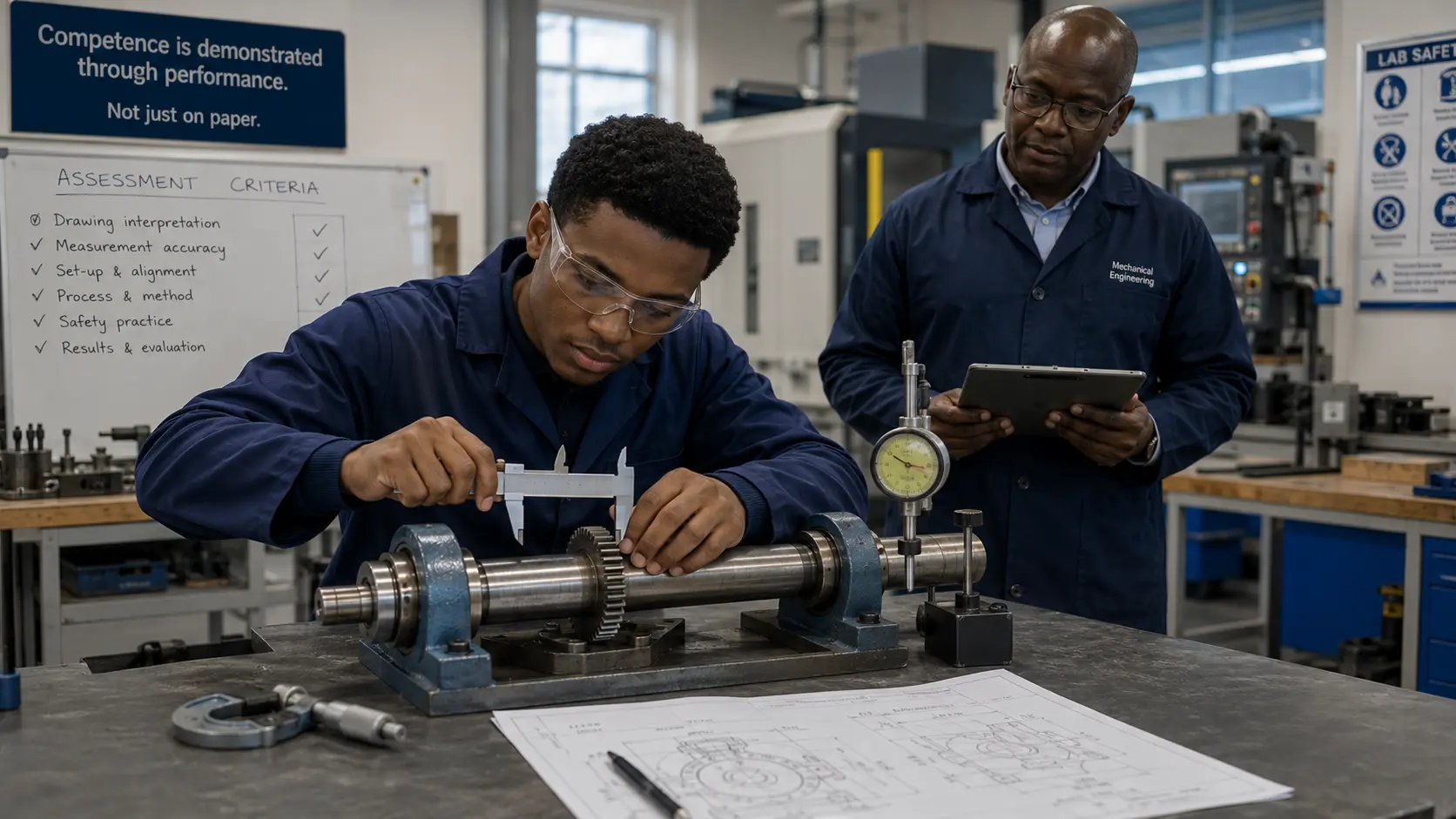
Rubrics should therefore focus on meaningful dimensions such as planning, safe setup, execution, measurement quality, interpretation, troubleshooting and communication. The goal is structured judgement, not bureaucratic observation.
Practical demonstrations are strong direct evidence
If the intended outcome is correctly perform a machine setup, watching the student perform that setup provides direct evidence. The assessor can observe independence, sequence, safety and technical choices.
But practical demonstrations have challenges: equipment availability, assessor workload, consistency, time. That means assessment design may need to combine different evidence sources rather than expecting one practical examination to measure everything.
Simulation can provide useful assessment evidence
Simulation can be particularly valuable when physical assessment is expensive, dangerous or difficult to repeat.
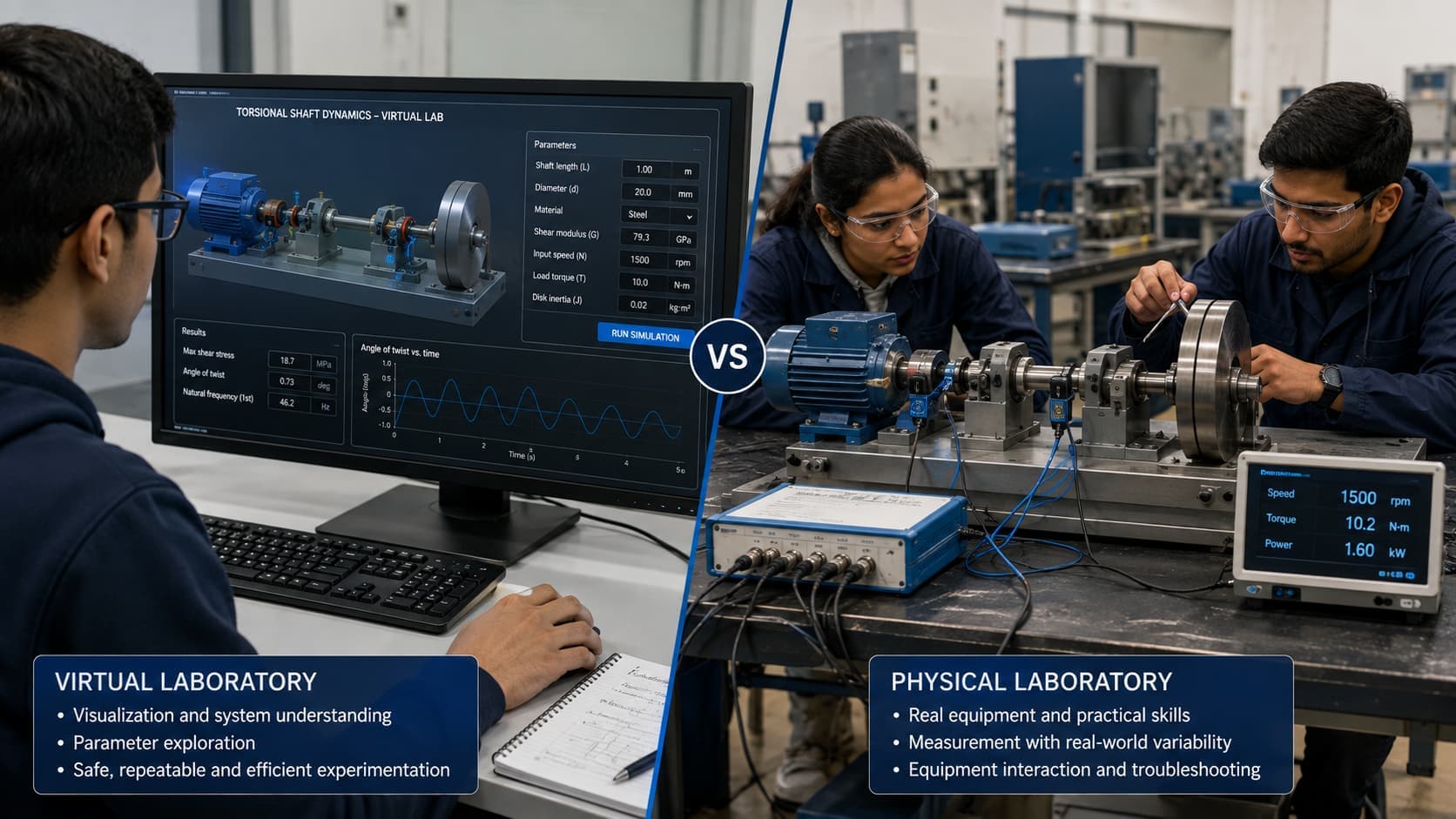
For example, simulation might assess whether a student can predict a CNC toolpath, identify an unsafe program, choose process parameters, diagnose a virtual fault, or interpret system behaviour — an idea covered in more depth in simulation in engineering education: what it teaches well and what it cannot replace.
The 2024 ASEE study on authentic engineering assessment used engineering simulations specifically to expose students to realistic scenarios in a controlled environment.
But simulation should not be used as evidence for capabilities it cannot reproduce well. It cannot fully demonstrate tool handling, physical instrument placement, manual setup or interaction with real equipment.
Assess simulated competence where the skill is cognitive or system-oriented, and use physical performance where physical interaction is part of the competence.
Projects are powerful but can hide individual gaps
Engineering projects can provide excellent evidence of design, integration, teamwork, problem solving and communication.
But consider a team of four. One student handles analysis. One codes. One fabricates. One prepares the report. The final project may be excellent.
Does that prove all four students can independently perform every key competence? No.
Group evidence should therefore sometimes be supplemented with individual technical questioning, personal design justification, individual practical demonstration or individual reflection. This protects the value of teamwork without letting team success hide individual competence.
Oral questioning can expose engineering reasoning
Sometimes the most useful assessment question takes ten seconds: why did you choose this instrument, why did you set the machine this way, what would you check if that measurement doubled, why do you believe this result?
These questions expose reasoning that may not be obvious from observation alone.
But oral questioning should be designed carefully. If one learner receives easy questions and another receives much harder ones, reliability suffers. Assessors can use question banks, defined themes and common criteria.
One successful attempt may not prove competence
Competence implies some reliability. Suppose a learner correctly performs a measurement once. Can they perform it again, on another component, without instructor prompting?
Evidence collected over time can therefore be stronger than one high-stakes event. A practical-skills portfolio might include laboratory observations, completed artefacts, experimental reports, troubleshooting evidence and project contributions.
The aim is not simply to collect documents. It is to build a defensible record of demonstrated capability.
Assessment should evolve as students develop
Early assessment may involve considerable guidance. For example: use this instrument to measure this dimension.
Later: select an appropriate measurement method.
Later still: determine whether this component meets the specified requirement and justify your measurement approach.
The underlying technical area is similar. But learner independence increases. This mirrors the progression used in scaffolding: guided, then partially independent, then independent, then adaptive.
Practical assessment should eventually determine whether the student can perform without the support that was necessary during learning.
Assessment drives what students take seriously
Students pay attention to what earns marks. Imagine a course repeatedly tells students that practical competence is very important. But 90% of the grade comes from formula recall, written derivations and predictable calculations.
Students receive another message: practical competence is interesting, but exams determine success.
Assessment therefore influences learning behaviour. If a programme genuinely values troubleshooting, experimental judgement, safe practice and practical application, then meaningful assessment evidence should come from those capabilities.
No single method captures engineering competence
A strong assessment system may combine several forms of evidence.
- Written assessment. Useful for theory, calculation, analytical reasoning.
- Practical observation. Useful for execution, safety, tool/instrument use.
- Artefact or product. Useful for technical quality, design realization.
- Experiment and report. Useful for measurement, data analysis, interpretation.
- Oral questioning. Useful for reasoning, judgement.
- Project. Useful for integration, open-ended problem solving, teamwork.
- Portfolio. Useful for evidence across time.
This matches ABET's current view that effective assessment may use relevant direct, indirect, quantitative and qualitative measures depending on the outcome being measured.
The principle is not use as many assessment methods as possible. It is use enough appropriate evidence to justify the competence being claimed.
My own perspective
In engineering learning, I have seen the difference between being able to understand or explain something and being able to carry out the actual task.
The practical environment introduces things that written problems often control or remove: equipment, sequence, safety, measurement, judgement, unexpected behaviour.
That does not make theoretical assessment less important. It makes the distinction between different kinds of evidence clearer.
If we want to know whether someone understands the principle, ask them to explain and apply it. If we want to know whether they can perform the task, at some point we need to observe them performing.
The Practical Skills Assessment Cycle
A practical engineering assessment can be designed through nine stages.
- 1. Define the competence. Avoid vague outcomes such as "understand CNC machining." Instead: safely establish a work coordinate system and verify its effect before machining. Now the capability is observable.
- 2. Identify evidence. What would demonstrate competence? Perhaps correct setup, correct verification, explanation of the coordinate relationship, safe machine behaviour.
- 3. Create an authentic task. Place the capability inside a realistic engineering situation. Do not add complexity that does not serve the outcome.
- 4. Observe process and outcome. Record how the learner works and what they produce.
- 5. Probe reasoning. Ask targeted questions where performance alone does not reveal the decision process.
- 6. Introduce controlled variation. Change an appropriate element to test whether the learner can adapt.
- 7. Give actionable feedback. Not "practical skills need improvement," but: instrument selection was correct, but the measurement procedure was inconsistent because the contact position changed between readings.
- 8. Reassess where appropriate. Competence development can be iterative. Students should have opportunities to use feedback and demonstrate improvement where course design allows.
- 9. Confirm independent performance. Eventually remove unnecessary support. The final evidence should answer: can the learner do this without someone guiding every step?
What this means for mechanical-engineering courses
Mechanical engineering offers many opportunities for outcome-aligned practical assessment.
Manufacturing and CNC
Assess setup, coordinate interpretation, tool selection, program verification, measurement and troubleshooting — the same argument developed in teaching CNC effectively: why theory needs hands-on practice. The Python CNC Automation project on this site is one example of connecting G-code generation directly to observable, checkable machine behaviour rather than treating the code as a purely abstract exercise.
Thermodynamics
Assess experimental setup, instrumentation, property interpretation, data quality and energy-balance reasoning.
Mechanics
Assess measurement, experimental validation and interpretation of deformation or stress behaviour.
Maintenance
Assess inspection, fault evidence, measurement, diagnosis and maintenance decision-making.
Engineering software
Assess input choices, assumptions, verification and interpretation — not merely whether a graph or model was generated.
The principle remains the same: assess the engineering behaviour that the course claims students are learning.
Key takeaway
Engineering theory is essential. Students need mathematics, scientific principles and analytical models.
But competence begins to mean something more when those ideas must be applied to real equipment, measurements, uncertain information and practical constraints.
Engineering assessment should therefore move beyond asking only: what does the student know? It should also ask: what can the student actually do with that knowledge?
A strong assessment system combines explanation, calculation, interpretation, performance, diagnosis and decision-making. Not every course needs to assess every level. But if a programme claims practical competence, at least some evidence should come from actual practical performance.
“Do not infer practical competence from theory alone. Assess it where it becomes visible — in engineering action.”
References and further reading
- ABET — Criteria for Accrediting Engineering Programs, 2026–2027. Especially relevant for its definition of assessment, student outcomes, experimentation, data interpretation and engineering judgement.
- ABET — Criteria for Accrediting Engineering Technology Programs. The criteria explicitly emphasize practical abilities such as conducting standard tests, measurements and experiments and interpreting their results.
- Tan et al. — Enhancing Engineering Education through Transfer of Learning, Authentic Assessment, and Engineering Simulations, ASEE 2024. Engineering-specific work connecting authentic assessment, realistic engineering problems, simulation and transfer of learning.
- A Systematic Literature Review on Authentic Assessment in Higher Education, 2024. A broader review showing how authentic assessment has been associated with skills including problem solving, critical thinking and collaboration, while also identifying implementation challenges.