An engineering student can solve a stress problem correctly in class and still struggle to identify the same mechanical principle when standing beside an actual machine.
That does not necessarily mean the student failed to learn the theory.
It may mean something different happened: the knowledge was learned in one form but was not easily recognized when the context changed.
I have experienced that gap in my own engineering education. Some concepts that I could understand theoretically became much clearer when I later encountered them through practical work, projects or real engineering problems.
The equation had not changed. What changed was the context around it. The physical system gave the theory a reference point.
That difference lies at the centre of what education researchers describe as transfer of learning.
Engineering education cannot therefore focus only on whether students can reproduce information or solve familiar classroom problems. A more difficult question is:
“Can learners recognize when the same knowledge is useful in a situation that no longer looks like the example from which they learned it?”
That is where practical engineering competence begins.
What does transfer of learning mean in engineering?
Transfer occurs when knowledge or skill developed in one situation can be used appropriately in another.
In engineering, that might mean learning the principles of bending stress through a textbook beam problem and later recognizing that structural deflection could matter in:
- A machine bracket
- A support frame
- A fixture
- A shaft system
The new problem may not mention bending. It may not provide a clean diagram. It may not even tell the learner which mechanical principle matters.
The student has to recognize the underlying structure of the problem. That is a more demanding task than reproducing a previously demonstrated calculation.
Engineering learning outcomes therefore extend beyond knowledge recall toward analysis, application, design and practical engineering competence. OECD's engineering-learning framework includes practical engineering activities such as laboratories, workshops, projects, supervised industrial experience and software-supported engineering work as important parts of engineering preparation.
Classroom success and practical competence are not identical
Consider a classroom exercise. A chapter is titled:
“Torsion of Circular Shafts.”
The exercise provides:
- Applied torque
- Shaft diameter
- Material information
Then it asks the learner to calculate shear stress. Before doing any mathematics, the student has already received one important piece of information: this is a torsion problem.
Now imagine an operating machine repeatedly experiencing coupling damage. There may be:
- Changing loads
- Misalignment
- Vibration
- Shaft deformation
- Installation issues
- Incomplete maintenance information
Nobody labels the problem. Before using an equation, the engineer must ask:
“What physical mechanism could be responsible?”
That reasoning step is easy to underestimate. Classroom exercises often assess:
“Can you use the method?”
Practical engineering often begins one step earlier:
“Can you determine which method or principle is relevant?”
That gap partly explains why good examination results do not automatically produce confident practical problem solving.
Students can learn the appearance of a problem instead of its underlying principle
Learners naturally look for patterns. That can be useful. But it can also become a limitation.
Suppose conduction is repeatedly taught using a rectangular wall with two labelled temperatures. The learner may gradually associate the wall diagram with the conduction equation.
Then the same principle appears in:
- Furnace insulation
- A machine enclosure
- A pipe
- An engine component
The physical principle is still heat conduction. But the surface appearance is different.
A student who understands only the familiar problem pattern may fail to recognize the connection.
Deeper learning involves understanding underlying structures sufficiently well to use knowledge beyond the original learning context. A useful principle for engineering education is therefore:
“Transfer fails when students learn the appearance of the example more strongly than the engineering principle underneath it.”
Practical situations place more demands on attention
The classroom environment often simplifies the problem deliberately. A learner may receive:
- Clearly defined information
- Correct units
- A diagram
- A specific question
- A known topic
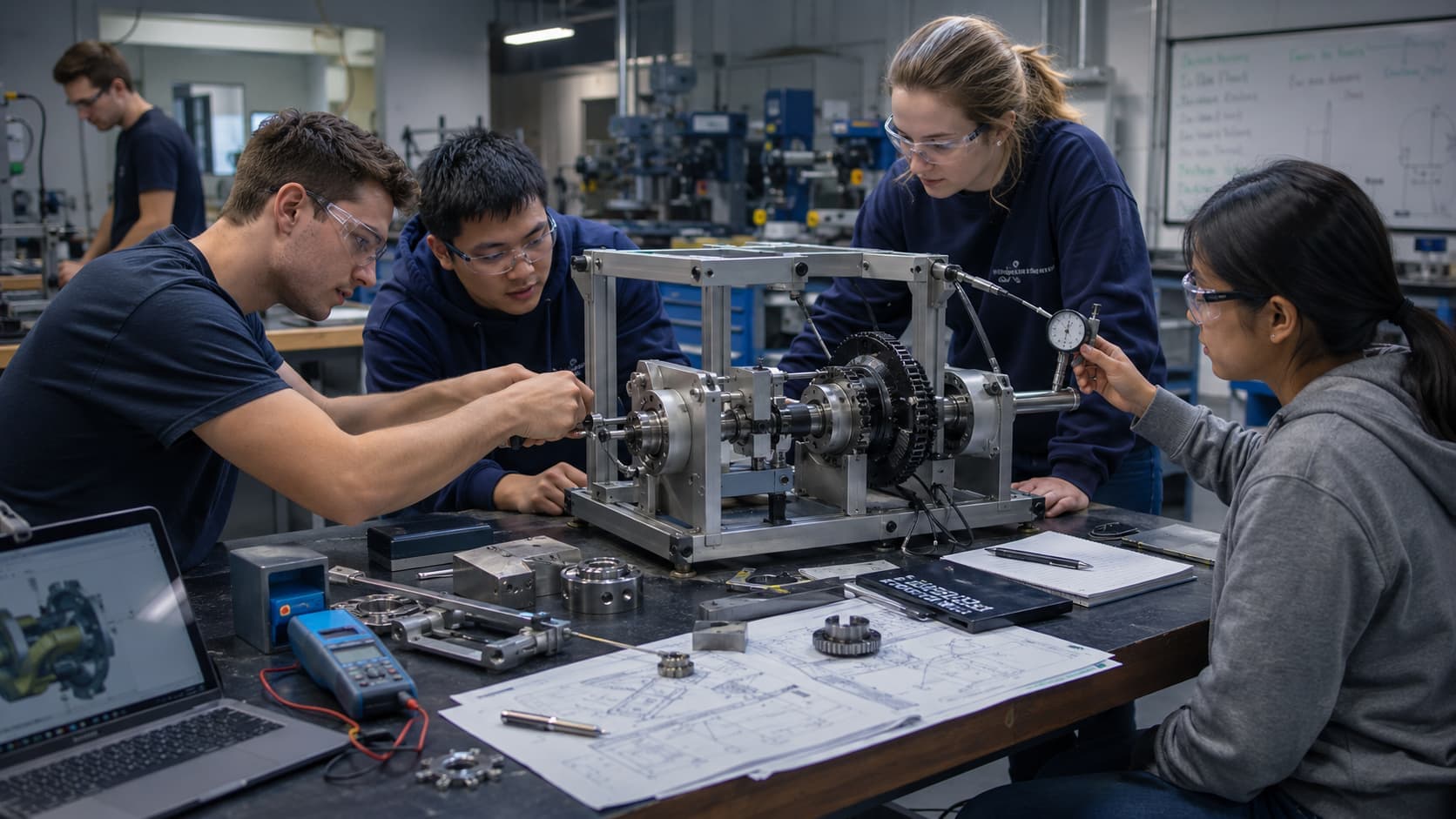
Practical work adds many additional demands. In a workshop, laboratory or industrial setting, the learner may simultaneously need to think about:
- Safety
- Machine condition
- Measurement
- Tooling
- Drawings
- Materials
- Tolerances
- Sequence of operations
- Other people
- Time
- Missing information
The underlying theory may not have become more difficult. The context has.
This is relevant to cognitive load. Cognitive-load research distinguishes between the inherent complexity of material and additional demands introduced by the way a task or instruction is structured.
An inexperienced learner who is still trying to remember the theory may therefore struggle when that knowledge must be used while also handling practical information.
The solution is not to remove authentic engineering complexity permanently. It is to introduce it progressively.
Worked examples are useful—especially early
Worked examples are not the enemy of practical learning. For novice learners, they can be extremely useful.
A good worked example shows:
- How the problem is represented
- Which information matters
- How the reasoning is structured
- How the mathematical steps connect
Research on worked-example learning has repeatedly found advantages for novice learners compared with immediately asking them to solve complex unfamiliar problems themselves.
But worked examples should not become the final learning environment. A learner who always sees complete solutions may become good at following reasoning without becoming equally good at creating it.
A better progression is:
- Worked example
- Partially completed example
- Similar independent problem
- Changed-context problem
- Open practical problem
Support gradually decreases as competence increases.
Variation teaches students what stays the same
If every practice problem looks almost identical, students can succeed by recognizing the format. Variation creates a different opportunity.
Suppose learners study heat transfer through:
- A wall
- A pipe
- Furnace insulation
- A machine casing
The geometry changes. The engineering context changes. But the learner is repeatedly asked:
“What underlying thermal process is operating here?”
Now the student has to separate surface differences from physical principle. That is much closer to the reasoning required in practical engineering.
Variation should therefore be deliberate. It should not simply make questions harder. Its purpose is to help learners discover what remains constant when the context changes.
Prediction develops physical reasoning
Before reaching for an equation, students can be asked:
- What do you expect to happen?
- Should the stress increase or decrease?
- Which part should become hotter?
- Which direction should the fluid move?
- What will happen if the load doubles?
- Which component is likely to deform more?
Prediction forces the learner to construct a physical explanation. Then the calculation, simulation or practical observation becomes a test of that explanation. This changes the sequence from:
“equation → answer”
to:
“physical reasoning → prediction → analysis → comparison”
That is valuable because engineers frequently need an approximate expectation before detailed calculation. If a software package produces a result completely opposite to physical expectation, that discrepancy deserves investigation.
Prediction therefore contributes not only to learning but also to engineering judgement.
Simulation can bridge equations and physical behaviour
Engineering contains many processes that are difficult to see directly. Examples include:
- Stress distribution
- Temperature gradients
- Fluid flow
- Vibration modes
- Internal machine motion
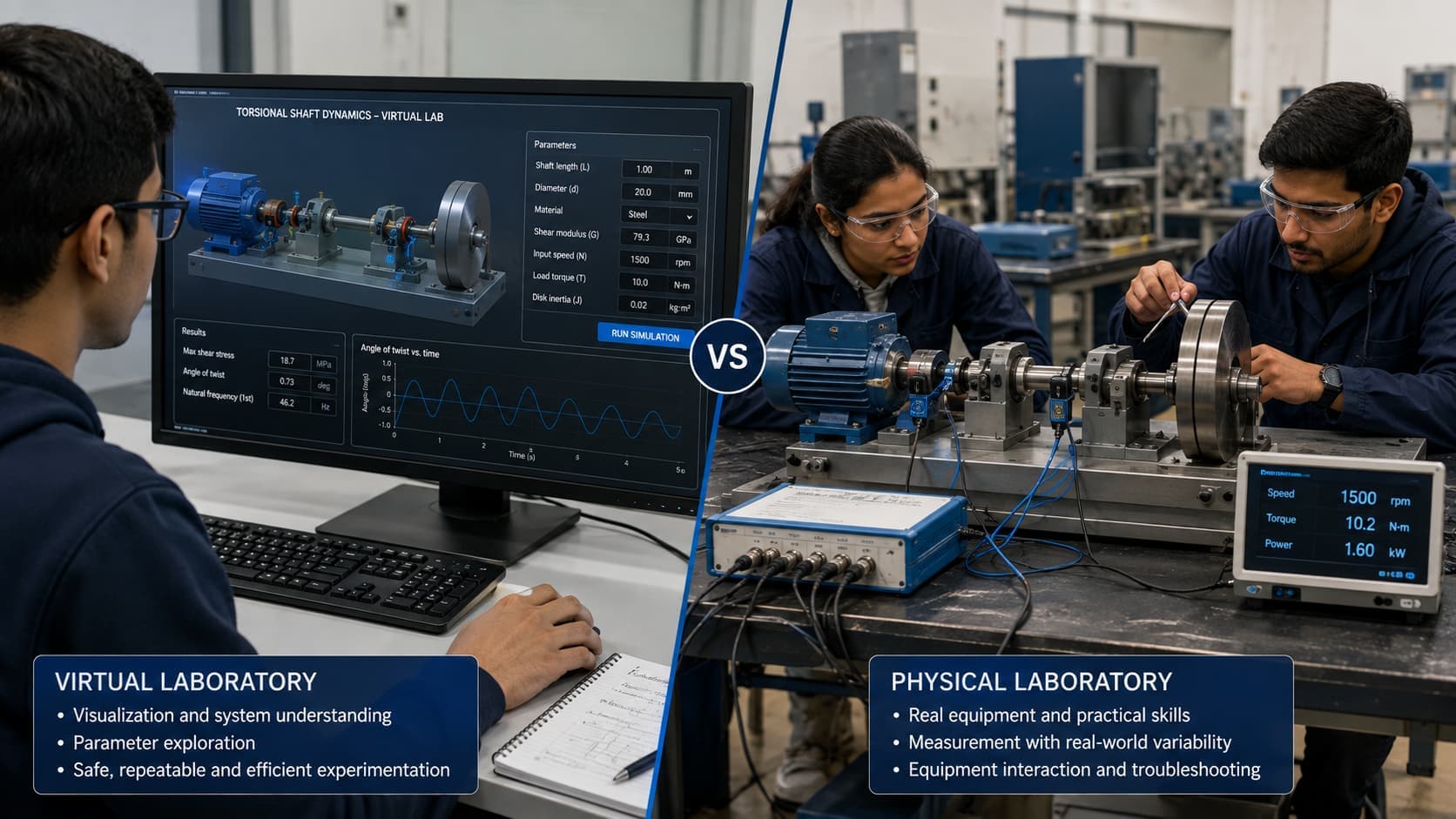
Simulation can make some of these relationships more visible. A student can alter a parameter and observe how the predicted system response changes. This gives simulation an important position between abstract classroom work and physical practice.
TVET and technical-education frameworks increasingly recognize combinations of theoretical teaching, simulated practical learning and work-based experience rather than treating one learning environment as sufficient by itself.
But simulation creates another possible problem. If learners simply:
- Enter values
- Press run
- Copy the result
the software has hidden rather than strengthened the reasoning. A useful simulation activity should ask:
- What do you predict before running it?
- What assumption does the model make?
- Why did the result change?
- Does the output make physical sense?
Simulation should expose engineering relationships rather than become another black box.
Practical work needs reflection
Hands-on activity is valuable. But activity alone does not guarantee transfer.
A learner can successfully complete a workshop task by following instructions:
- Measure here
- Clamp this
- Machine that
- Record the value
- Submit the exercise
The component may be correct. But can the learner explain:
- Why that sequence was used
- Which theory governed the operation
- What would change with another material
- What failure could occur
- What assumptions the classroom model ignored
Those questions turn practical activity into a learning opportunity. The cycle should not stop at:
“I did it.”
It should continue to:
“Why did it work?”
and eventually:
“Where else would this principle apply?”
That final question is fundamental to transfer.
Feedback should diagnose reasoning, not only correctness
Consider two pieces of feedback. The first says:
“Incorrect answer.”
The second says:
“The calculation is correct, but the loading condition does not satisfy the assumption required by the equation you selected.”
Both identify an unsuccessful solution. Only one helps the learner understand where the engineering reasoning failed.
Feedback can address several levels:
- Concept selection
- Assumptions
- Mathematical method
- Measurement
- Interpretation
- Final decision
For practical engineering education, feedback should therefore go beyond whether the final numerical value matches the expected answer. It should help learners see why their reasoning did or did not transfer successfully.
Assessment can unintentionally reward non-transfer
Students usually become good at the activities that determine their grades. If examinations mainly ask them to:
- Define
- List
- Reproduce derivations
- Substitute given values
- Repeat familiar problem types
then studying those activities is rational. But later the same learners may be expected to handle:
“Here is an unfamiliar engineering system. Determine what matters.”
Those are different demands. If engineering education values practical transfer, some assessment should require students to:
- Identify the relevant principle
- Justify assumptions
- Diagnose problems
- Interpret measurements
- Compare alternatives
- Explain limitations
- Apply familiar concepts in unfamiliar situations
Assessment does not need to abandon foundational calculations. It needs to include application and judgement alongside them. A simple principle follows:
“If we only assess reproduction, we should not be surprised when students become good at reproduction.”
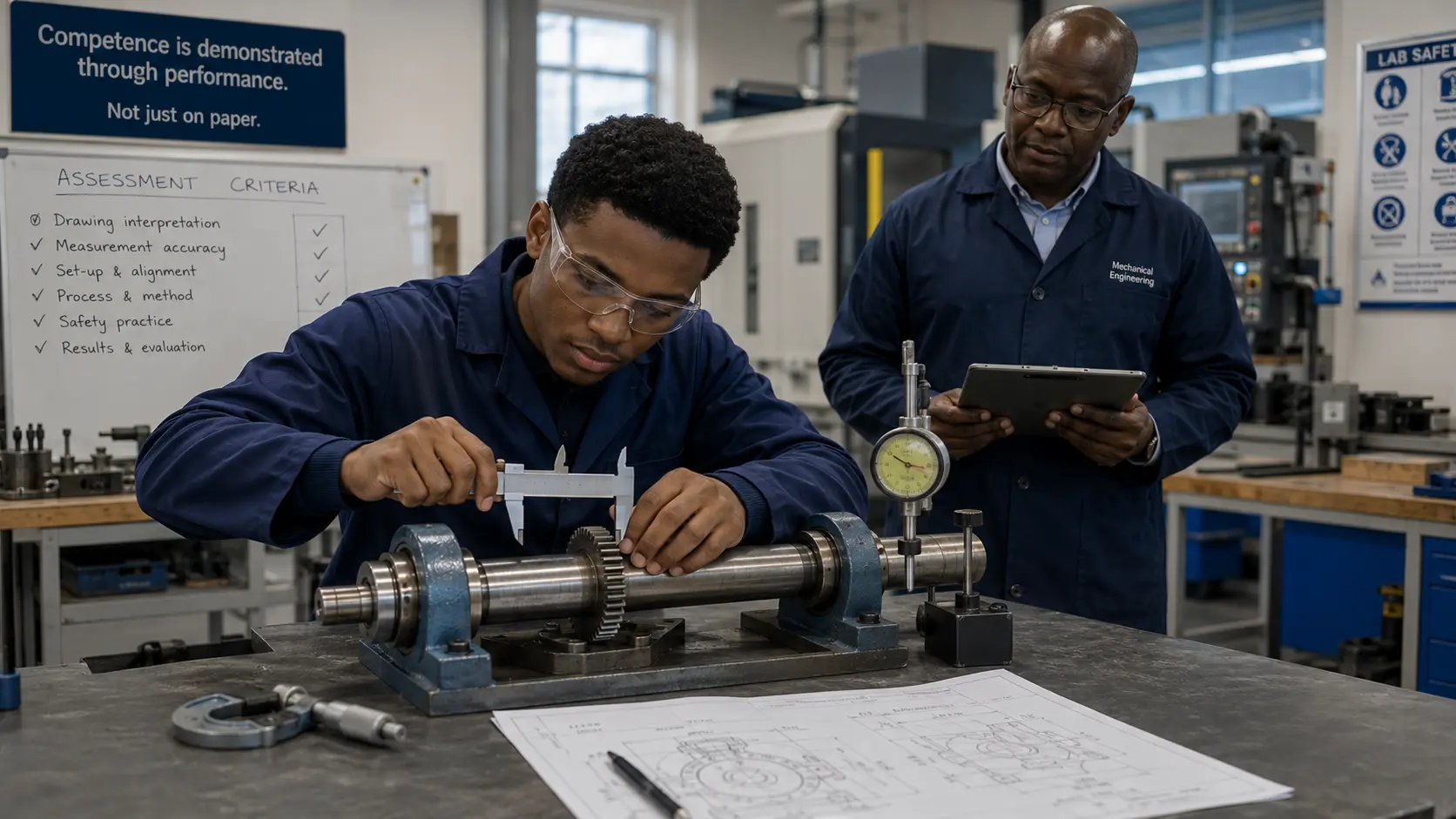
Practical competence is not simply manual skill
When people hear “practical engineering,” they may imagine:
- Operating machinery
- Using tools
- Assembling components
Those abilities matter. But engineering practical competence is wider. It includes:
- Measurement
- Interpretation
- Planning
- Diagnosis
- Judgement
- Safety
- Communication
- Decision-making
An engineer may never personally manufacture every component they design. They still need to understand how real physical and manufacturing constraints affect design decisions.
This is why engineering-learning frameworks combine theoretical knowledge with design, practical work, projects, laboratories and professional engineering skills rather than defining practical competence only as manual ability.
Real engineering problems contain incomplete information
Textbook exercises are usually constructed so that a solution is possible with the information provided. Engineering practice is less cooperative.
A machine may have:
- Incomplete service history
- Noisy measurements
- Unknown previous modifications
- Inaccessible components
- Conflicting observations
- Uncertain loads
Part of the engineering task becomes:
“What do I need to know before I can make a defensible decision?”
That is an important competence. Students therefore need some learning activities where:
- Irrelevant information is present
- Useful information is missing
- Assumptions must be stated
- Additional measurements must be proposed
This prepares them for uncertainty rather than only calculation.
Near transfer and farther transfer
Transfer can occur across different degrees of similarity.
Near transfer
The new problem resembles the learning problem closely. For example:
“A student learns to calculate bending stress in one beam and then solves another beam problem with different dimensions.”
Farther transfer
The new context looks substantially different. For example:
“The student encounters a machine support structure and recognizes that stiffness or bending may contribute to alignment problems.”
The second situation requires stronger abstraction. The learner must recognize the principle despite changes in context, terminology and appearance.
Engineering education needs both. Near-transfer tasks build competence. Farther-transfer tasks test whether the knowledge has become flexible.
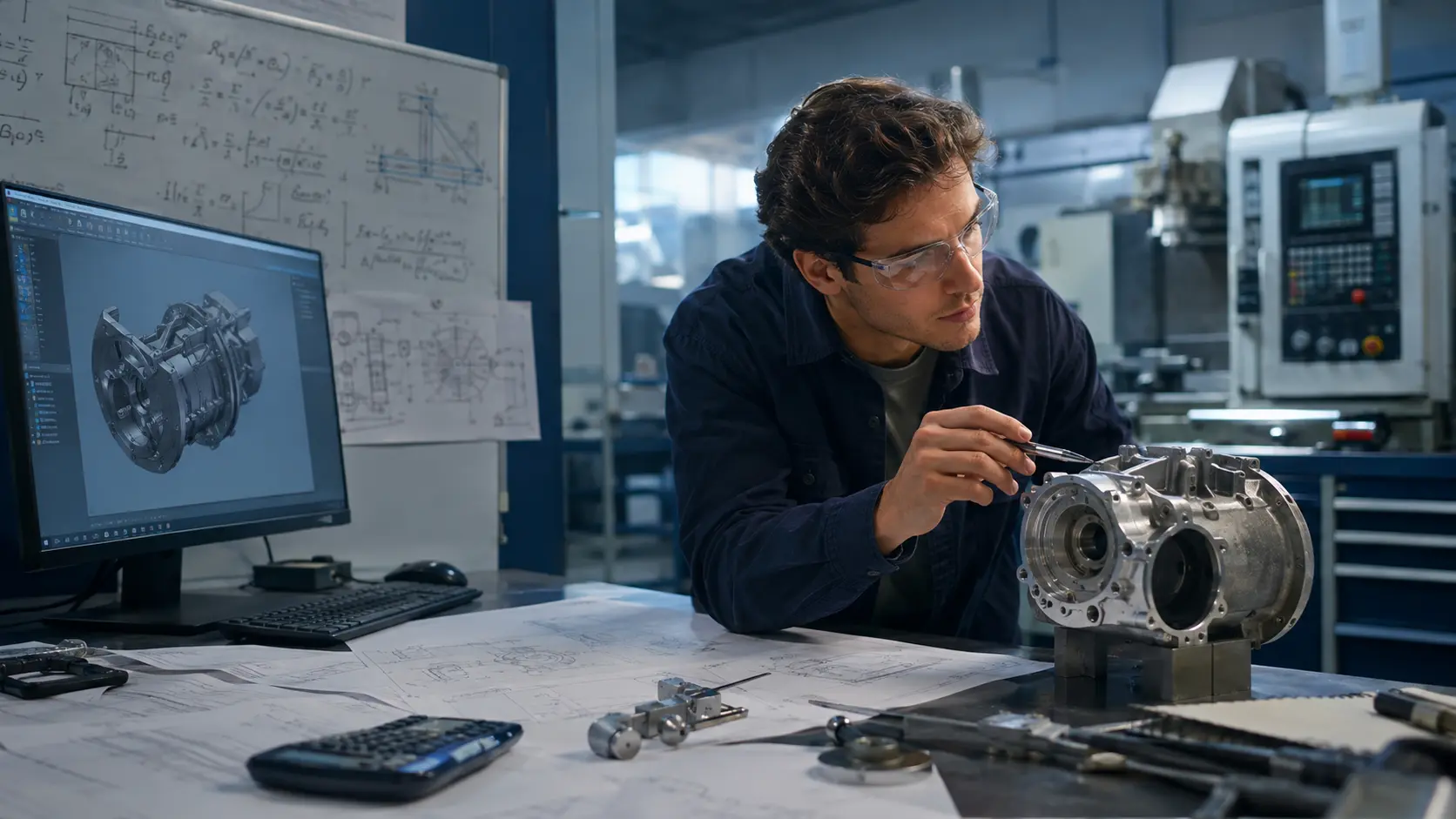
Engineers move between different representations
Mechanical-engineering knowledge rarely exists in only one form. Consider a shaft system. The engineer may move through:
- Physical shaft
- Free-body diagram
- Loading model
- Equations
- Simulation
- Result
- Engineering decision
An experienced engineer moves among those representations relatively naturally. A student may understand each representation individually but struggle to connect them.
For example, they may calculate stress from a diagram. But can they look at the physical shaft and construct the appropriate diagram? That transition is part of transfer.
Education should therefore repeatedly ask students to translate between:
- Physical objects
- Drawings
- Diagrams
- Equations
- Graphs
- Simulation outputs
- Measurements
The Engineering Transfer Cycle
A practical way to think about this process is through seven stages.
1. Understand
What principle is being learned? The aim is not only to memorize an equation but to understand the physical relationship it represents.
2. Recognize
Where does that principle appear when the problem looks different? This is one of the most important transfer steps.
3. Predict
Before calculation or simulation, what behaviour should be expected?
4. Apply
Use the relevant:
- Equation
- Model
- Experiment
- Simulation
- Practical procedure
5. Observe
What actually happens?
6. Explain
Why does the result agree or disagree with the prediction?
7. Adapt
Can the same understanding be used in another engineering context? That final stage distinguishes flexible knowledge from a memorized procedure.
The cycle can then begin again with a more difficult or different problem.
Instructional support should gradually disappear
A learner should not be expected to jump directly from lecture notes to an entirely open-ended industrial problem. A more realistic progression is:
- Concept explanation
- Worked example
- Partially completed problem
- Familiar independent problem
- Changed-context problem
- Simulation or laboratory exercise
- Open practical problem
- Feedback and reflection
- New application
Early in learning, the instructor makes many decisions. Later, the learner increasingly decides:
- Which concept matters
- Which information is needed
- Which method is appropriate
- Whether the result is credible
This progressive removal of support is important because novices can benefit strongly from guided examples, while excessive guidance can become unnecessary as expertise develops.
What this means for mechanical-engineering curriculum design
If transfer is an important educational goal, theory and practical work should not exist as separate worlds. A course could repeatedly connect:
“concept → worked example → simulation → laboratory or workshop application → reflection → different engineering context”
Rather than teaching a concept once and assuming transfer will happen years later, learners should encounter important principles repeatedly in different forms.
For example, vibration might appear in:
- Dynamics theory
- Laboratory measurement
- Machine diagnosis
- CNC machining
- Predictive maintenance
Heat transfer might appear in:
- Thermodynamics
- Engine cooling
- Manufacturing
- Geothermal energy systems
Now the curriculum teaches relationships across engineering rather than isolated subjects.
Why this matters for Industry 4.0
Modern mechanical engineering increasingly combines physical engineering with:
- Sensors
- CNC systems
- Automation
- Programming
- AI
- Simulation
- Digital manufacturing
That makes transfer more—not less—important.
A student may learn vibration in a dynamics course. Later they may need to recognize the same principle inside:
- A machine-health signal
- A predictive-maintenance model
- A CNC chatter problem
They may learn coordinate geometry mathematically and later meet it through:
- CNC motion
- Robotics
- Automation
The challenge is not simply remembering knowledge. It is mobilizing knowledge when its appearance changes.
That capability is central to preparing engineers for technological change. Technology evolves. The ability to recognize and apply underlying engineering principles remains transferable.
Key takeaway
The gap between classroom knowledge and practical engineering work does not mean theory is unnecessary. Nor does it mean that simply increasing workshop hours will automatically solve the problem.
Transfer requires deliberate movement between:
- Explanation
- Different examples
- Prediction
- Simulation
- Practical application
- Feedback
- Reflection
- New contexts
Students need opportunities to learn not only:
“how to solve a known engineering problem”
but also:
“how to recognize the engineering problem hidden inside an unfamiliar situation.”
That is the deeper challenge. And it is one of the clearest differences between knowing engineering content and being able to use engineering knowledge.
References and further reading
- OECD — Engineering learning and practical-activity frameworks. Reference material describing how laboratories, workshops, projects, supervised industrial experience and software-supported activities contribute to engineering learning outcomes.
- UNESCO-UNEVOC — TVETipedia: Competency-Based Training. Describes the knowledge, skills and attitudes required for competent occupational performance, relevant to the distinction between classroom knowledge and practical competence.
- UNESCO-UNEVOC — TVETipedia: Work-Based Learning. Defines learning undertaken through authentic work environments and occupational practice, relevant to combining classroom and workplace learning.
- Cognitive Load Theory (Sweller). Distinguishes the inherent complexity of learning material from additional demands introduced by how a task or instruction is structured, relevant to why unfamiliar practical contexts increase difficulty.
- Worked-example research (cognitive-load tradition). Literature on the worked-example effect, describing advantages of studying worked examples for novice learners compared with immediate unsupported problem solving.
- Kolb — Experiential Learning Cycle resources. Relevant to understanding learning through experience, reflection, conceptualization and further experimentation, referenced here in relation to reflection on practical engineering activity.