The difficulty comes from having to coordinate several of them at the same time.
Engineering students are often asked to do something mentally demanding before they have developed the knowledge structures that make the task manageable.
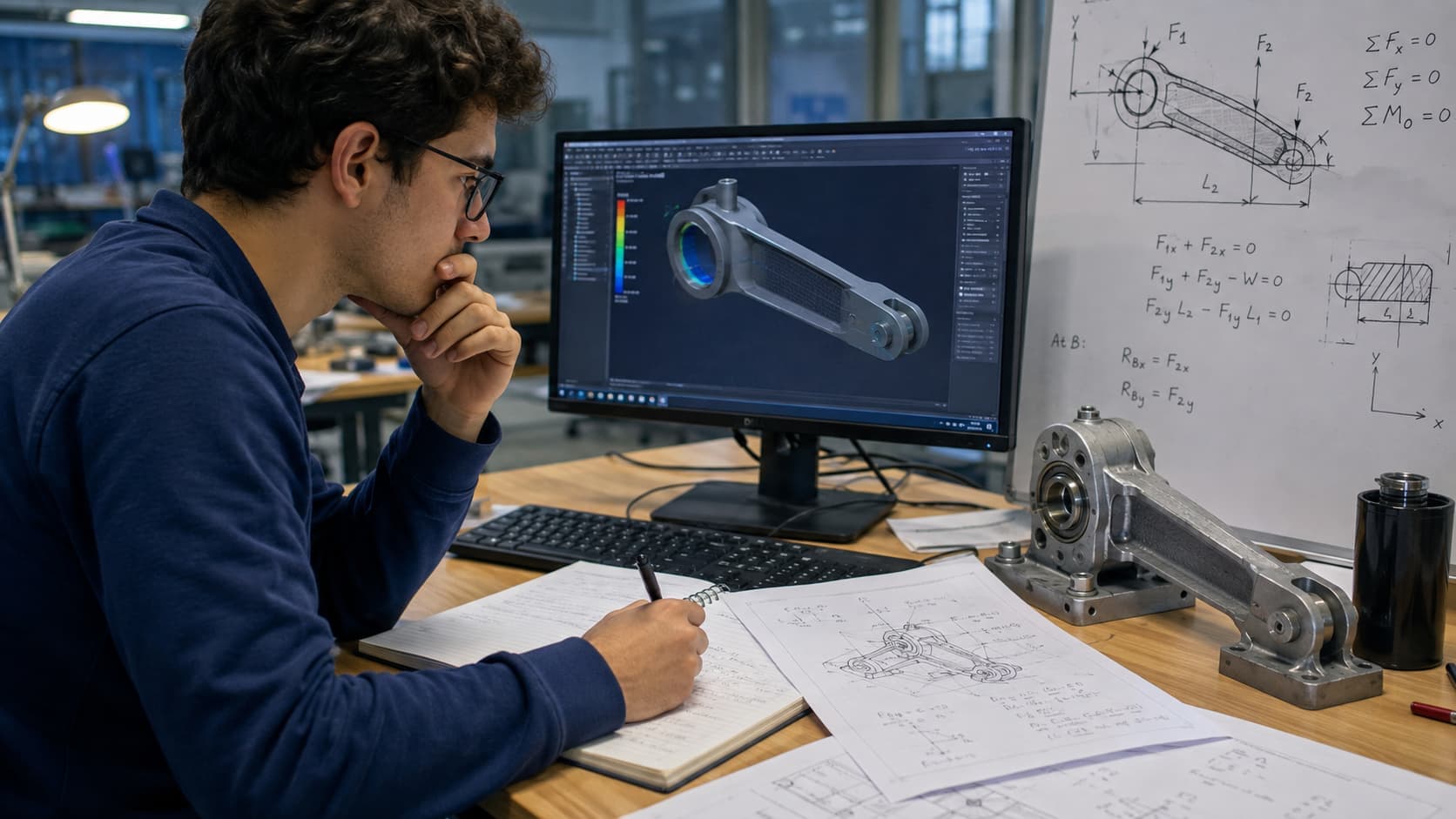
Consider a student learning shaft design.
They may need to think about:
- Forces
- Torque
- Geometry
- Material properties
- Units
- Stress equations
- Allowable limits
- Diagrams
- Software output
None of these elements is necessarily impossible on its own.
I have experienced this in engineering learning myself. There are situations where the individual parts of a problem, software system or practical task make sense when considered separately, but bringing them together creates a much heavier mental demand.
That experience points toward an important idea in learning research: cognitive load.
Cognitive Load Theory examines how instructional design interacts with the limits of human cognitive processing, particularly when learners are dealing with unfamiliar information.
For engineering educators, the practical question is not:
“How can we make engineering easy?”
Engineering is not always easy.
The better question is:
“How can we avoid making an already difficult engineering concept unnecessarily harder to learn?”
What cognitive load means
When learners encounter unfamiliar material, working memory must temporarily hold and process the information needed to understand the task.
That capacity is limited.
Long-term memory works differently.
Once learners have developed organized knowledge structures, familiar information can often be handled much more efficiently.
This helps explain a common engineering classroom experience.
An experienced lecturer may look at a free-body diagram and immediately recognize:
- Loading
- Supports
- Likely equations
- Relevant assumptions
A beginner may see several unrelated arrows, dimensions, symbols and unknowns.
The engineering problem is identical.
The mental task is not.
This is why cognitive load should always be considered relative to the learner's existing knowledge.
Engineering contains genuinely complex material
Some cognitive demand cannot—and should not—be removed.
Consider thermodynamics.
A learner analysing a cycle may need to coordinate:
- Pressure
- Temperature
- Enthalpy
- Entropy
- State points
- Process relationships
- Property data
- Energy balances
Those elements interact.
If one changes, other parts of the analysis may change as well.
Likewise, vibration analysis may require the learner to connect:
- Machine geometry
- Shaft speed
- Failure mechanism
- Sensor location
- Waveform
- Spectrum
- Operating condition
CNC programming may require:
- Coordinate systems
- Tool position
- Work offsets
- Machining sequence
- G-code
- Toolpath behaviour
This is real engineering complexity.
Removing all interaction among those elements would eventually produce an unrealistic representation of engineering practice.
The goal should therefore be to manage when and how that complexity is introduced.
Intrinsic cognitive load
Intrinsic cognitive load refers broadly to the cognitive demand created by the complexity of what must be learned, considered relative to what the learner already knows.
This relative aspect matters.
A basic statics problem may contain many interacting elements for a beginner.
For someone who has solved hundreds of similar problems, several of those elements may already be organized into familiar patterns.
The task has not physically changed.
The learner has.
This is one reason expertise changes what good instruction looks like.
Extraneous cognitive load
Other mental effort can come from the way instruction is designed rather than from the engineering concept itself.
Imagine a student solving a thermodynamics problem.
The diagram is on one page. The equation is on another. The variable definitions are somewhere else.
The student must repeatedly search:
“Diagram → equation → definition → diagram.”
That search does not necessarily deepen thermodynamic understanding.
It consumes mental resources simply because relevant information has been separated poorly.
Other examples include:
- Unclear diagrams
- Unnecessary animation
- Complex software navigation
- Redundant text
- Inconsistent notation
- Irrelevant visual decoration
This is the type of demand instructional design can often reduce.
The important point is not:
“Reduce all cognitive effort.”
Learning itself requires mental effort.
The goal is:
“Reduce unnecessary processing so learners can direct more effort toward understanding the engineering relationships that matter.”
Why novices and experts experience the same task differently
Imagine a simply supported beam with several loads.
A novice may consciously process:
- What kind of support is this?
- Which reactions exist?
- Which direction should I draw them?
- What sign convention should I use?
- Which equilibrium equation applies?
- Where should moments be taken?
- Are the units correct?
For an experienced learner, several of these steps may have become part of a familiar problem structure.
That reduces the number of separately processed elements.
This is often described through the development of schemas in long-term memory.
It explains why a lecturer can accidentally underestimate the difficulty of a problem.
The lecturer does not experience the same problem cognitively as the novice.
Element interactivity matters
Engineering tasks are especially demanding when several pieces of information must be understood together.
Suppose a student is learning stress in a shaft.
Knowing the torque equation separately is not enough.
The learner may need to connect:
Physical shaft → load → geometry → stress distribution → equation → design implication
These elements interact.
When many unfamiliar elements must be coordinated simultaneously, cognitive demand rises.
This does not mean the relationships should be permanently separated.
Eventually, understanding the interaction is the learning goal.
The instructional problem is deciding how much interaction a learner can productively handle at a particular stage.
Worked examples can help beginners
One way of reducing unnecessary search during early learning is through worked examples.
Instead of giving a novice:
“Determine all bearing reactions and shaft loads.”
the instructor can initially demonstrate:
- Identify the system boundary
- Represent the loads
- Draw the free-body diagram
- Identify unknown reactions
- Apply equilibrium
- Check whether the result makes physical sense
The learner can focus on understanding the structure of the solution rather than spending most of their mental effort searching for a possible method.
Research involving novice electrical-circuit troubleshooting learners found that worked examples and example–problem sequences produced lower cognitive load and better learning outcomes than conventional problem solving alone.
Worked examples therefore have an important place in engineering education.
But they should not become permanent.
Worked examples are support, not the final objective
Engineers eventually need to solve problems independently.
That means support should gradually reduce.
A sensible progression may be:
Fully worked example → partially completed problem → guided problem → independent familiar problem → changed-context problem → open engineering problem
The student gradually takes over decisions that the instructor initially made.
This is sometimes called fading guidance.
The reason it matters is that instructional support interacts with expertise.
Guidance that is helpful when the learner is unfamiliar with the task can become unnecessary once the relevant knowledge has been developed.
A 2026 study comparing worked examples and problem-solving sequences found stronger later performance when problem solving was included, rather than relying on worked examples alone.
The broader lesson is not that worked examples are good or problem solving is good.
It is that sequence matters.
The expertise reversal effect
The same instructional design can have different effects on different learners.
A novice might benefit from:
- Explicit diagrams
- Labelled variables
- Step-by-step reasoning
- Hints
An experienced student may find the same support redundant.
They already know much of what the guidance is explaining.
Continuing to force them to process unnecessary support can interfere with efficient problem solving.
This phenomenon is commonly discussed as the expertise reversal effect.
Recent reviews continue to describe how benefits from worked examples and strong guidance can diminish as learners acquire expertise.
For engineering educators, this implies:
“Instruction should adapt as knowledge develops.”
One fixed level of guidance is unlikely to suit every stage of learning.
Split attention in engineering diagrams
Engineering education depends heavily on visual information.
Examples include:
- Free-body diagrams
- Circuit diagrams
- Thermodynamic plots
- Machine drawings
- CNC coordinate diagrams
- Process schematics
The way this information is arranged matters.
Suppose a machine diagram contains labels A, B, C and D.
A distant legend explains what each letter represents.
The learner repeatedly moves their attention:
“Diagram → legend → diagram → legend.”
If the relationship could instead be shown clearly beside the relevant component, some unnecessary searching may be removed.
This is related to the split-attention effect.
The solution is not to put every explanation inside the diagram until it becomes overcrowded.
It is to ask:
“Which pieces of information need to be mentally integrated, and can the visual design make that integration easier?”
That principle applies equally to equations.
If a learner needs an equation, variable definition and diagram simultaneously, separating them unnecessarily may create avoidable processing.
More multimedia does not always mean better learning
Engineering education increasingly uses:
- Animation
- Video
- Simulation
- Narrated explanation
- Diagrams
- Text
These tools can be powerful.
But more channels do not automatically produce better learning.
Imagine an animation of piston motion accompanied by a concise explanation of how pressure and volume change.
The two representations may complement each other.
Now imagine the same animation accompanied by:
- Dense text
- Narration reading the text word for word
- Several decorative graphics
- Unrelated background information
The learner has more information.
But not necessarily more understanding.
Instructional media should therefore be judged by:
“What engineering relationship does this representation make easier to understand?”
rather than:
“How many media formats can we add?”
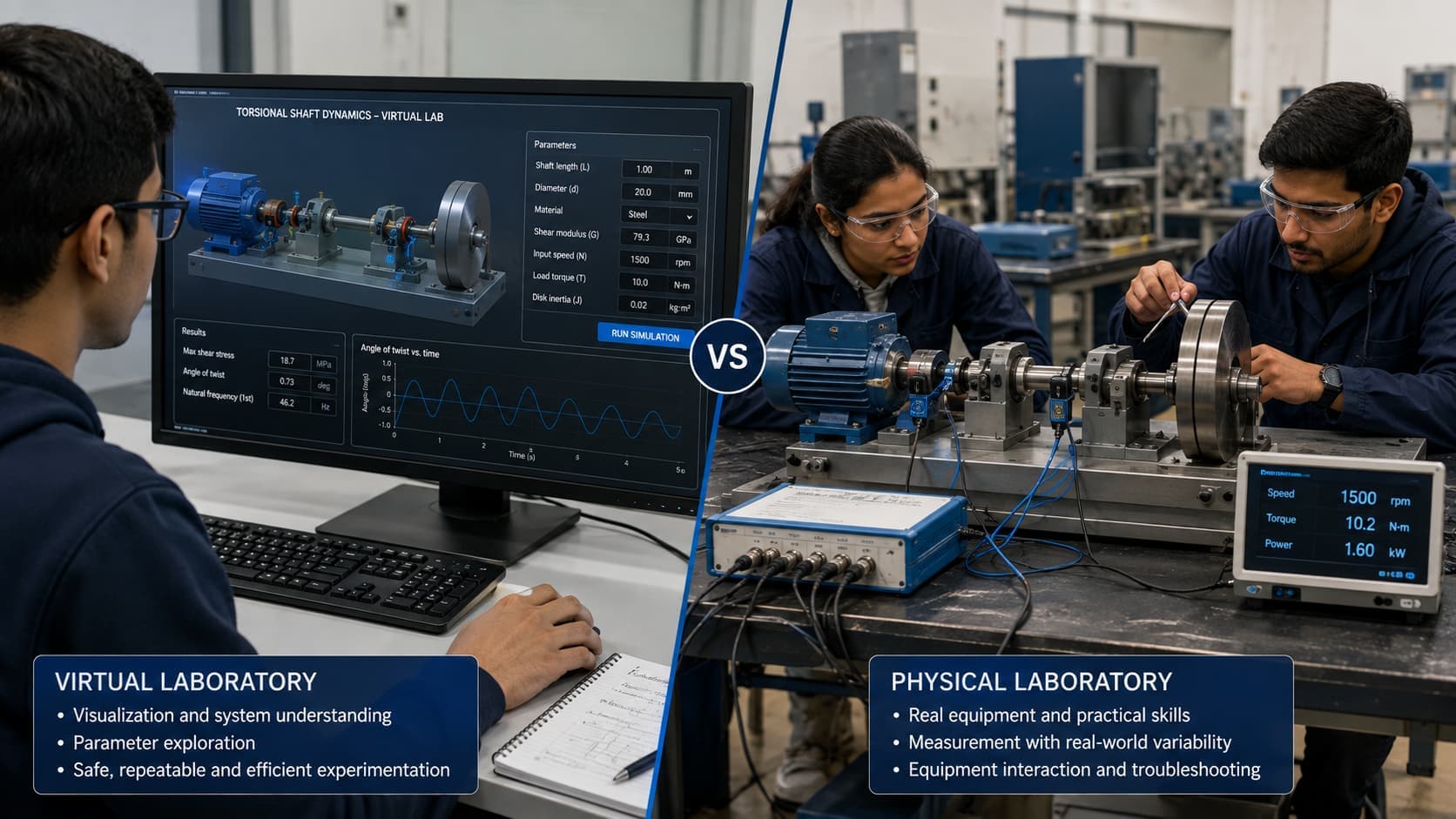
Simulation can reduce cognitive load
Simulation can make invisible physical behaviour observable.
For example:
- Stress distribution
- Temperature gradients
- Fluid flow
- Vibration modes
- CNC toolpath motion
This can reduce the need for learners to imagine every intermediate relationship mentally.
Suppose a learner changes a beam load and immediately sees how predicted deflection changes.
That visual connection can help make an abstract relationship more concrete.
Similarly, a CNC simulation can connect:
G-code → tool movement → machining geometry
This is one reason simulation can be valuable in engineering education.
Simulation can also increase cognitive load
Now consider a sophisticated simulation package.
The learner may have to manage:
- Menus
- Boundary conditions
- Meshing
- Solver settings
- Colour scales
- Plots
- Camera controls
- File management
A beginner may spend most of their effort learning the interface.
The actual engineering concept can become secondary.
This creates an important design principle:
“A simulation reduces unnecessary cognitive demand only when the interface and learning task allow students to focus on the engineering relationship being taught.”
That may mean simplifying the interface at first.
Later, more advanced controls can be introduced as learners develop expertise.
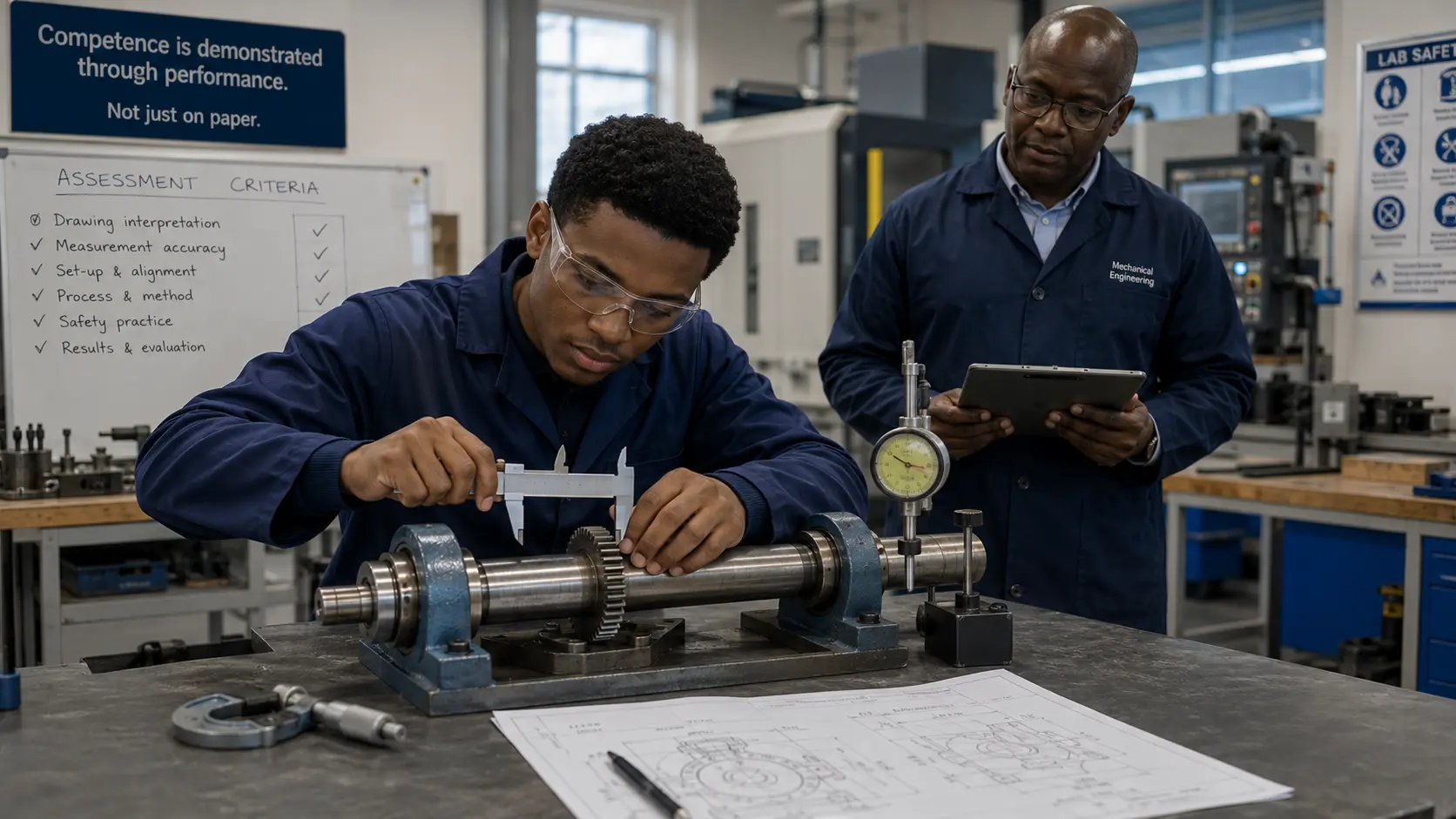
Practical engineering creates cognitive load too
Cognitive load is not only a classroom or multimedia issue.
Consider a student using a machine for the first time.
They may have to think simultaneously about:
- Safety
- Machine controls
- Tooling
- Workholding
- Measurement
- Sequence
- Coordinate system
- Drawing
- Theory
Each item may have been taught previously.
Combining them during practical work creates a much more demanding task.
This partly explains why a learner can understand theory but still appear uncertain in a workshop.
It does not necessarily mean the classroom knowledge disappeared.
The learner may simply be trying to coordinate too many unfamiliar elements at once.
Practical complexity should be introduced gradually
The answer is not to keep workshop tasks simple forever.
Students eventually need to handle authentic complexity.
Early instruction might therefore reduce some nonessential decisions.
For example, an instructor can initially provide:
- Prepared setup
- Clearly identified measurement points
- Defined operating sequence
The learner focuses on one central engineering concept.
Later, the instructor removes support.
The learner must now:
- Choose the measurement
- Plan the sequence
- Identify an error
- Troubleshoot the system
Eventually, the task becomes integrated.
That progression is important because fragmented practice can also fail if students never learn how the parts work together as a complete engineering system.
Why simplifying everything is also a mistake
Cognitive Load Theory is sometimes interpreted as:
“Make everything easier.”
That is not the goal.
If engineering instruction permanently removes:
- Uncertainty
- Interacting variables
- Open-ended problems
- Practical constraints
students may become comfortable only with simplified tasks.
Real engineering requires integration.
The aim is therefore:
“Manage complexity while knowledge is developing, then increase complexity as competence develops.”
That difference is essential.
Cognitive load and transfer of learning
Cognitive load also connects to transfer.
Suppose a student enters an unfamiliar practical problem.
Most of their mental effort is consumed by:
- Interpreting the interface
- Remembering a procedure
- Searching across diagrams
- Decoding unfamiliar notation
There may be little capacity left for noticing:
“This is actually the same mechanical principle I learned previously.”
Well-designed instruction can therefore help learners build stronger knowledge structures first.
Then increasingly varied problems can require them to recognize and apply those structures elsewhere.
This complements the broader challenge of transferring classroom knowledge into practical engineering work.
Cognitive load in engineering software systems
There is another relevant area: software designed for learning.
An engineering-learning system can technically function correctly and still be difficult to learn from.
Consider a CNC learning interface containing:
- Parameter input
- Coordinate system
- Generated code
- Toolpath
- Simulation controls
- Error messages
Presenting everything at once may overwhelm a beginner.
A better learning design might initially emphasize:
Input → generated instruction → machine/toolpath effect
Then additional complexity can be introduced progressively.
The engineering functionality has not changed.
The sequence in which the learner encounters it has.
This distinction is useful when designing educational engineering systems.
My own perspective
In my own engineering learning, I have encountered situations where the individual elements were understandable but coordinating them all at once made the problem considerably harder.
That distinction has become particularly meaningful when thinking about engineering systems and software.
A system can be logically correct from the developer's perspective while still placing too many simultaneous demands on the learner.
The educational question therefore becomes different from the engineering-development question.
Development asks:
“Does the system work?”
Learning design additionally asks:
“Can a learner understand what is happening without spending most of their mental effort operating the system itself?”
Both questions matter.
The Engineering Cognitive Load Check
A practical engineering-learning activity can be reviewed through eight questions.
1. What must the learner process simultaneously?
List the actual elements.
For example:
- Diagram
- Formula
- Units
- Graph
- Interface
- Measurement
- Procedure
If the list is long, identify which interactions are genuinely necessary at this stage.
2. Which complexity belongs to the engineering itself?
Do not accidentally remove the concept being learned.
A vibration lesson eventually requires students to connect machine behaviour to signal behaviour.
That interaction is educationally important.
3. Which complexity was created by the teaching material?
Look for:
- Confusing layout
- Unnecessary search
- Poor labels
- Irrelevant information
- Redundant media
These are better targets for reduction.
4. What prior knowledge does the learner have?
The same task may need different instructional support for a beginner, an intermediate student and an experienced learner.
5. Can related information be integrated more clearly?
Especially in diagrams, equations, machine schematics and software interfaces.
6. How much guidance is appropriate now?
A novice may need worked examples, cues and explicit structure.
7. When should the guidance disappear?
Define how learners will progress toward independent problem solving.
8. Does the final task require whole-system integration?
Eventually, students should handle realistic combinations of technical reasoning, decision-making and practical constraints.
If instruction remains permanently segmented, integration may never develop.
What this means for engineering lecturers
Cognitive-load-aware engineering teaching does not require radically redesigning every course.
Several practical improvements can make a substantial difference.
- Start with prior knowledge. Before teaching a complex system, establish what learners already understand.
- Make the engineering structure visible. Explain relationships, not only procedures.
- Use worked examples strategically. Especially for unfamiliar, multi-step tasks.
- Integrate related representations. Do not make students search unnecessarily among equations, diagrams and definitions.
- Remove irrelevant decoration. Especially from technical visuals.
- Introduce software progressively. Teach the engineering relationship before exposing every advanced feature.
- Vary support by expertise. Do not assume that instructional guidance should remain constant throughout the course.
- Restore authentic complexity. Students ultimately need open engineering problems. Good instructional design should prepare them for complexity, not protect them from it permanently.
What this means for engineering-learning system design
The same principles apply to digital learning tools.
Suppose a system teaches machining parameters.
A poor interface might show simultaneously:
- Feed
- Speed
- Depth
- Tool geometry
- Machine code
- Simulation
- Several plots
- Alerts
- Configuration options
An expert may appreciate all that information.
A beginner may not know where to look.
An educational system can instead progressively reveal information according to the learning objective.
This suggests an important principle for engineering-education technology:
“Technical completeness and instructional usefulness are not the same thing.”
The most capable interface is not automatically the best learning interface.
Key takeaway
Engineering education has a real complexity problem.
But the solution is not to make engineering artificially simple.
Students eventually need to:
- Integrate concepts
- Interpret complex systems
- Solve unfamiliar problems
- Work in realistic environments
The educational challenge is sequencing.
Early instruction should reduce unnecessary cognitive demands.
Worked examples can show structure. Well-designed diagrams can reduce visual search. Simulations can reveal invisible physical relationships. Practical tasks can introduce complexity progressively.
Then guidance should fade.
Learners should increasingly make decisions, integrate representations, solve problems and transfer knowledge.
The goal is not minimum cognitive load.
The goal is:
“To use the learner's limited mental resources on the engineering thinking that actually matters.”
References and further reading
- Van Gog et al. — Effects of worked examples, example-problem, and problem-example pairs on novices' learning. A useful experimental study involving electrical-circuit troubleshooting that demonstrates how sequencing worked examples and problem solving affects novice learning and cognitive load.
- Zeitlhofer & Zumbach — Sequencing problem solving and worked examples: effects on performance, cognitive load, and judgments of learning, 2026. Useful recent evidence showing that sequences containing active problem solving produced stronger later performance than worked examples alone in the studied setting.
- van Nooijen, de Koning & Bramer — A Cognitive Load Theory Approach to Understanding Expert Scaffolding of Visual Problem-Solving Tasks, 2024. A recent scoping review useful for understanding how expert guidance and visual scaffolding interact with cognitive-load principles.
- Teaching with worked examples — Why the selection of problems for exemplification is critical, 2024. Shows that worked examples are not automatically effective: the characteristics and ambiguity of the selected example can influence misconceptions and learning.
- Cognitive Load Theory in Computing Education Research: A Review. Useful caution against invoking cognitive load superficially without considering prior knowledge, measurement, boundary conditions and mixed findings. Particularly relevant to software-supported engineering education.
- Conditions for Effective Learning from Erroneous Examples: A Systematic Review, 2025. Useful recent discussion of guidance fading, expertise reversal and current conceptual debates around germane cognitive load.