A machine can be old and still be useful.
Many manufacturing workshops contain equipment that continues to perform its mechanical function reliably even though its controls, communications and monitoring capabilities were designed long before today's Industrial Internet of Things systems.
That creates an interesting engineering problem.
Replacing a mechanically productive CNC machine solely because it does not provide modern machine data can be difficult to justify. But attaching sensors, gateways and network connections without understanding the machine or the information requirement can create another problem: a connected system that produces data without improving any engineering decision.
I have encountered older equipment in workshop environments that remained mechanically usable while offering little modern digital monitoring. I have also worked experimentally with sensing and data-acquisition concepts. Those experiences reinforce a simple point:
“Modernization should begin with the information you need from the machine—not with the technology you want to install.”
The objective of an IIoT retrofit is therefore not merely to connect an old machine to the internet. It is to add useful visibility while respecting the mechanical, control, safety and reliability functions that already work.
What makes a manufacturing machine “legacy”?
Legacy equipment should not automatically be interpreted as worn out or unsuitable for production. In this context, a machine may be mechanically productive while its digital architecture has become outdated.
An older CNC machine, for example, might have:
- A controller with limited networking
- Proprietary communication interfaces
- Little historical data storage
- No integrated condition-monitoring system
- Limited compatibility with newer manufacturing software
- No convenient interface for modern analytics
The underlying mechanical structure may still be capable of useful work. The challenge is therefore one of digital and information integration, not necessarily mechanical replacement.
NIST's smart-manufacturing work has long recognized that differences among plants and legacy equipment complicate plug-and-play integration, and its manufacturing research has specifically considered retrofit sensing as a route toward adding intelligence to existing equipment.
Start with the information problem, not the sensor
Suppose a workshop wants to modernize an older CNC machining centre. A common technology-first approach might be:
“We need IoT sensors.”
That is not yet an engineering requirement. A stronger starting point would be:
“We need earlier indication of deterioration in the spindle system.”
Now useful questions become possible.
- What physical behaviour changes as the targeted condition develops?
- Could vibration contain useful information?
- Could temperature?
- Does the CNC controller already provide spindle load or operating speed?
- What operating context is required to interpret the measurements?
- What action will maintenance take if an abnormal condition is detected?
The retrofit architecture should emerge from those questions.
The sequence becomes:
engineering decision → required information → available machine data → missing measurements → sensing and integration
not:
buy sensor → collect data → decide later what to do with it
Three ways to obtain information from an older machine
A legacy-equipment retrofit can obtain information from three broad sources.
1. Use data that already exists in the machine
The first question should be whether the machine already knows what you are trying to measure.
Depending on its controller and interfaces, information might already exist for:
- Operating state
- Spindle speed
- Programme state
- Alarms
- Axis information
- Spindle or motor load
- Cycle status
- Operating time
If the controller exposes reliable information, it may be unnecessary to install another sensor to reproduce the same measurement.
The difficulty is often accessibility. Manufacturing equipment from different vendors may expose information through proprietary controller APIs, serial connections, network protocols or vendor-specific software. That is partly an interoperability problem.
2. Add external sensors where the machine lacks the required information
The controller cannot report every physical condition of interest.
An external monitoring system might therefore add:
- Accelerometers for vibration
- Temperature sensors
- Current measurement
- Pressure transducers
- Flow sensing
- Acoustic sensing
- Energy measurement
The sensor should correspond to an actual engineering question. For example, knowing that a spindle is running is not equivalent to knowing how its vibration behaviour is changing.
The controller may provide the first piece of information. A properly designed condition-monitoring measurement may provide the second.
3. Combine machine information with external condition data
The most useful system may combine both.
Suppose the retrofit records spindle vibration. A vibration value by itself may be difficult to interpret if the machine operates over widely varying speeds, loads and machining operations.
Now combine the measurement with:
- Spindle speed
- Machine operating state
- Spindle load
- Programme or cycle context
The condition signal becomes more meaningful because it has operational context. This is one reason industrial data integration is about more than simply transferring numbers from a sensor to a database.
A practical architecture for a legacy-machine retrofit
A useful conceptual architecture is:
Existing machine/controller → operating information
External sensors → physical condition information
Data-acquisition / edge gateway → contextualized machine data → local monitoring / historian / analytics → maintenance or engineering decision
This architecture separates several functions that are sometimes incorrectly collapsed into the single term “IoT.”
- The sensor measures.
- The controller operates the machine.
- The gateway integrates or processes information.
- The data model establishes meaning.
- The application uses that information.
Each layer solves a different problem.
What does an industrial edge gateway actually do?
IoT diagrams frequently include a “gateway” box without explaining it.
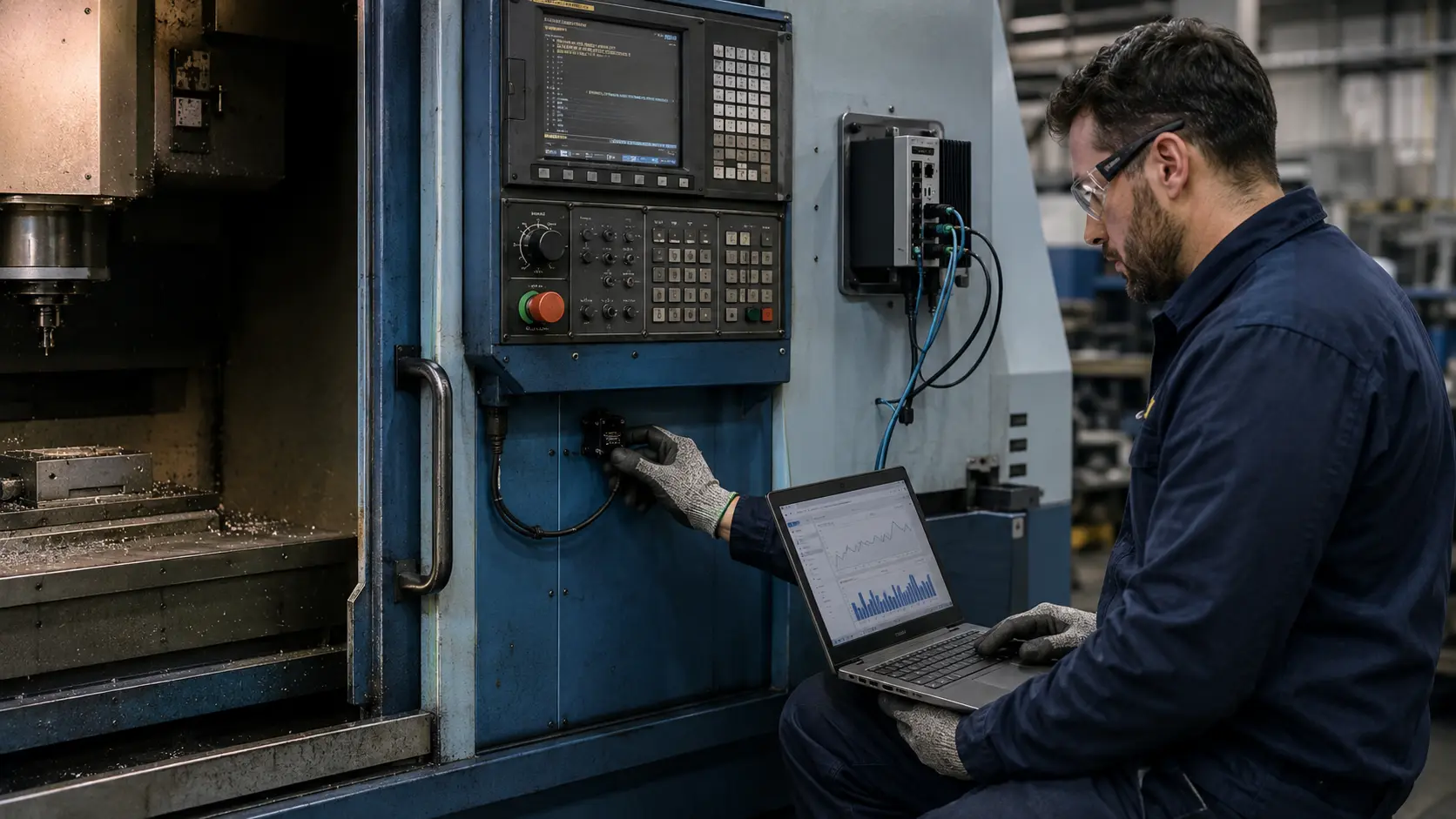
In a legacy-machine retrofit, a gateway or industrial computer may provide several useful functions:
- Communicate with older machine interfaces
- Acquire external sensor signals
- Translate protocols
- Timestamp measurements
- Buffer data when connectivity is interrupted
- Perform local calculations
- Filter high-frequency data
- Normalize information
- Forward selected information to other applications
This can be especially valuable when the original controller is not a suitable environment for additional software. The gateway becomes a boundary between the established machine system and the new information system.
That does not mean every installation requires a dedicated gateway. Architecture should follow the actual requirement.
Why MTConnect matters for machine tools
Manufacturing interoperability becomes difficult when every machine represents information differently. MTConnect addresses this problem specifically for manufacturing equipment.
The standard provides a normalized semantic vocabulary and information model. Manufacturers may use different native terminology, while an MTConnect adapter can translate machine-specific data into standardized MTConnect information.
A simplified architecture is:
CNC controller → MTConnect adapter → MTConnect agent → monitoring or analytics application
MTConnect describes the adapter as the bridge between proprietary machine interfaces and standardized MTConnect data, while the agent organizes and serves that information to applications.
This does not magically make every legacy controller easy to connect. The controller still needs some accessible source of information, and an appropriate interface or translation method must exist.
But it illustrates a critical principle:
“Interoperability requires common meaning, not merely connectivity.”
Where OPC UA fits
OPC UA addresses industrial interoperability more broadly and supports secure, platform-independent information exchange among industrial systems. There is also an OPC UA information model specifically for machine tools.
The current OPC UA for Machine Tools Part 1 specification defines an interface for machine monitoring and job management and provides machine-tool information structures that applications can consume.
A full MTConnect-versus-OPC-UA comparison deserves its own article. For this discussion, the important lesson is simpler:
“Industrial interoperability should use appropriate machine and information standards where practical rather than building unnecessary proprietary data mappings for every application.”
Example: retrofitting an older CNC machine for condition monitoring
Consider an older CNC machining centre. Assume:
- The mechanical machine remains productive
- The controller performs its intended control function reliably
- Modern condition monitoring is limited
- Some controller information can be accessed
- The maintenance objective is improved visibility into spindle condition
A sensible retrofit could combine two information groups.
Existing controller information
Potentially:
- Spindle speed
- Operating state
- Load
- Alarms
Added condition information
Potentially:
- Vibration near the spindle-bearing region
- Temperature
- Electrical behaviour where appropriate
The signals could then be acquired by an edge or data-acquisition system. Instead of analysing vibration without context, the system could associate condition measurements with machine operating conditions.
For example:
Vibration measurement + spindle speed + operating state + load
is potentially more informative than:
Vibration measurement alone.
The data could initially support basic trend monitoring. Later, if sufficient quality data and clearly defined failure behaviour exist, the same architecture could support more sophisticated diagnostics or predictive-maintenance analysis.
This connects directly with my ongoing AI-based predictive-maintenance work for CNC machine tools, which explores condition-monitoring signals and machine-learning methods as inputs to maintenance decisions rather than assuming that AI alone creates a maintenance strategy. HarunLucas.com's project page currently describes that work as being in active development, focused on data preparation, feature analysis and early model experimentation.
Do not confuse monitoring with control
This is one of the most important architectural distinctions in a retrofit.
Suppose the objective is to collect vibration and machine-state information. Does that new system actually need authority to command the CNC? Often, it does not.
A useful conceptual separation is:
Original control system: machine commands → motion → machining process
while separately:
Monitoring system: machine/sensor information → analysis → engineering decision
Keeping those roles separate can reduce unnecessary coupling between a proven machine-control system and newly introduced monitoring technology.
This is not a rule that control systems must never be modified. Some modernization projects legitimately replace or upgrade controls.
The principle is narrower:
“Do not interfere with an established control function unless the retrofit objective actually requires control modification.”
Edge, on-premise or cloud?
IIoT is often described as though all machine information ultimately belongs in the cloud. That is not necessarily appropriate.
Processing can occur at several levels.
At the machine or sensor
Basic signal conditioning or feature extraction.
At the edge
An industrial computer or gateway may filter, aggregate or analyse information close to the machine.
On a plant network
A local historian, server or maintenance platform may store and process information without sending it outside the facility.
In the cloud
Cloud infrastructure can support longer-term storage, multi-site analysis or computational services where justified.
Hybrid
Some information remains local while selected data or derived features move to higher-level systems.
The location should be determined by:
- Latency
- Bandwidth
- Data volume
- Cybersecurity
- Availability
- Computational requirements
- Maintenance needs
- Integration requirements
The architecture should solve the engineering problem rather than conform to a fashionable diagram.
Cybersecurity becomes part of the machine system
Adding connectivity changes the system boundary. An isolated controller presents a different exposure from a machine connected to gateways, plant networks, remote services or cloud applications.
NIST SP 800-82 Rev. 3—the current final edition of its OT security guide—emphasizes that cybersecurity controls for operational technology must account for the performance, reliability and safety requirements that distinguish industrial systems from ordinary information technology.
As of 2026, NIST has initiated work on Revision 4, but that work remains at the pre-draft stage; Revision 3 remains the final published guide.
A retrofit therefore needs to consider issues such as:
- What assets are being connected
- Which devices can communicate with each other
- Network segmentation
- Authentication and access
- Remote access
- Software and firmware maintenance
- Backups
- Data flows
- Recovery if the new monitoring system fails
A retrofit should not create unnecessary production or safety risk simply to make data easier to access.
When retrofitting may not be the right decision
Retrofitting is not automatically cheaper or better than replacement.
Consider replacement or deeper modernization if:
- The mechanical system itself is approaching end of life
- Reliability is already unacceptable
- Critical spare parts are unavailable
- The controller is unsupported and increasingly unreliable
- The required retrofit would involve extensive control redesign
- Documentation is inadequate
- Required measurements cannot be obtained reliably
- Cybersecurity risks cannot be reduced adequately
- The machine no longer meets production or quality requirements
- Retrofit cost and complexity approach the value of replacement
This leads to an important limitation:
“A sensor cannot solve mechanical obsolescence.”
IIoT can add visibility. It cannot restore worn machine geometry, increase insufficient structural capability or guarantee the future availability of obsolete control hardware.
A seven-step retrofit decision framework
Before modernizing a legacy machine, ask:
1. What decision are we trying to improve?
- Maintenance?
- Production visibility?
- Energy management?
- Quality?
- Fault diagnosis?
Without a defined decision, the project risks becoming data collection without purpose.
2. What information is required?
Identify the physical and operating variables relevant to that decision.
3. What information does the machine already provide?
Investigate the controller, drives, PLC, existing sensors and communications before installing duplicate instrumentation.
4. What information is missing?
Add external sensing only where it closes a real information gap.
5. Where should the information be processed?
Machine, edge, plant network, cloud or hybrid.
6. How will the retrofit interact with the existing control system?
Define monitoring and control boundaries clearly. Include cybersecurity from the architecture stage.
7. What action will the resulting information cause?
- Alarm?
- Inspection?
- Maintenance work order?
- Process review?
- Further diagnosis?
If the information will not change a decision or action, reconsider whether it is worth collecting.
From connected machinery to predictive maintenance
Connecting a machine is not predictive maintenance. It is only an enabling step.
A useful progression might be:
machine connectivity → reliable data acquisition → contextualized condition information → baseline understanding → fault detection or diagnosis → prognostics → maintenance decision
This matters because the first article in this series—Preventive vs Predictive Maintenance: When Should You Use Each?—established that predictive maintenance is valuable only when condition information can support a better maintenance decision.
IIoT can make that information easier to collect and integrate. It does not remove the need to understand the machine, the failure mode or the maintenance objective.
Key takeaway
Legacy equipment should not be modernized simply because modern connectivity exists.
Start by asking:
“What information would make this machine easier to operate, maintain or understand?”
Then determine:
- Whether the machine already provides it
- What needs to be measured externally
- How information should be contextualized
- Where processing should occur
- How the new data layer will remain compatible with the existing control function
- How connectivity changes cybersecurity risk
- Whether the resulting value justifies the retrofit
A good retrofit does not try to turn an old machine into a completely different machine. It adds the minimum useful digital capability required to make better engineering decisions.
References and further reading
- MTConnect Institute — MTConnect architecture and Getting Started documentation. Useful for the standardized manufacturing information model, adapters and agents.
- OPC Foundation — OPC UA for Machine Tools, Part 1. Current machine-tool information model covering machine monitoring and job-management interfaces.
- OPC Foundation — What is OPC? Overview of secure, reliable industrial interoperability and platform-independent information exchange.
- NIST SP 800-82 Rev. 3 — Guide to Operational Technology Security. Current final NIST guidance on protecting OT while accounting for industrial performance, reliability and safety requirements.
- NIST — Smart Manufacturing research and legacy-equipment sensing work. Relevant background on integration challenges and retrofit sensing for existing manufacturing equipment.