A machine does not need predictive maintenance simply because sensors and machine learning are available.
It also does not make sense to replace components indefinitely according to a calendar if their actual condition can be measured reliably and maintenance can be scheduled closer to when intervention is genuinely needed.
That is why the preventive-versus-predictive maintenance question is more complicated than asking which method is more advanced.
The better engineering question is:
“What maintenance trigger best matches the way this particular equipment can fail?”
Preventive maintenance generally triggers work according to a predetermined schedule, operating time or usage cycle. Predictive maintenance instead uses information about equipment condition to anticipate when intervention may be required. NIST makes essentially this distinction, describing preventive maintenance as scheduled, timed or cycle-based and predictive maintenance as maintenance initiated from predictions based on observed equipment data such as temperature, noise and vibration.
Neither strategy is universally superior. The right choice depends on how an asset deteriorates, the consequences of failure, whether deterioration produces a measurable signal, how early that signal appears, and whether monitoring it creates enough operational value to justify the investment.
The core difference is the maintenance trigger
Suppose two identical machines have operated for 2,000 hours. Under a preventive-maintenance programme, both might receive the same scheduled maintenance because they have reached the specified operating interval. Under a condition-informed or predictive programme, their maintenance decisions could differ. Machine A may show increasing vibration and temperature consistent with a developing problem. Machine B may remain within its normal operating behaviour. The predictive approach tries to use that difference in equipment condition when determining when intervention is justified.
That does not make scheduled maintenance obsolete. Some tasks are naturally suited to schedules. Others become stronger candidates for condition monitoring. The engineering challenge is knowing which is which.
What preventive maintenance does well
Preventive maintenance involves carrying out maintenance before failure according to predetermined criteria such as calendar time, operating hours, machine cycles or established service intervals. This makes maintenance easier to plan and generally requires less sensing and analytics infrastructure than a predictive programme.
Examples can include:
- Scheduled lubrication activities
- Replacement or cleaning of filters
- Periodic inspections
- Calibration
- Scheduled servicing specified by an equipment manufacturer
- Time- or usage-based inspection of wear components
- Periodic safety-related maintenance activities
The important point is not that every one of these activities must always be preventive. It is that the maintenance trigger is predetermined rather than generated from a prediction of developing equipment condition.
When preventive maintenance makes sense
Preventive maintenance is particularly reasonable when several conditions apply.
The maintenance requirement is reasonably related to time or usage
Some maintenance requirements can be planned effectively using hours, cycles or elapsed time. If the intervention is inexpensive, predictable and supported by sound maintenance knowledge or manufacturer guidance, replacing it with a complex monitoring system may offer little additional value.
Monitoring would cost more than the decision is worth
Sensors are not free simply because their individual purchase price has fallen.
A functioning condition-monitoring system can involve:
- Sensors
- Installation
- Communications
- Data storage
- Baseline development
- Analytics
- Alarm configuration
- Maintenance-system integration
- Competent personnel
- Calibration and upkeep of the monitoring system itself
A 2025 systematic review in the Journal of Manufacturing Systems argues that adoption of condition-monitoring technologies should consider both engineering and financial benefits rather than evaluating only technical detection performance.
That matters especially for inexpensive or low-criticality components. There is little engineering value in spending heavily to predict a failure whose consequences are small and whose component can be replaced quickly.
The failure does not provide a useful measurable warning
Predictive maintenance requires information.
If a failure mechanism develops with no useful measurable precursor—or the precursor appears too late for maintenance to respond—additional monitoring may not create a meaningful predictive advantage.
This is one of the most important limitations to remember:
“Not everything that can fail can necessarily be predicted early enough to change the maintenance decision.”
What predictive maintenance actually means
Predictive maintenance is often described as though it means putting artificial intelligence on a machine. That is too narrow.
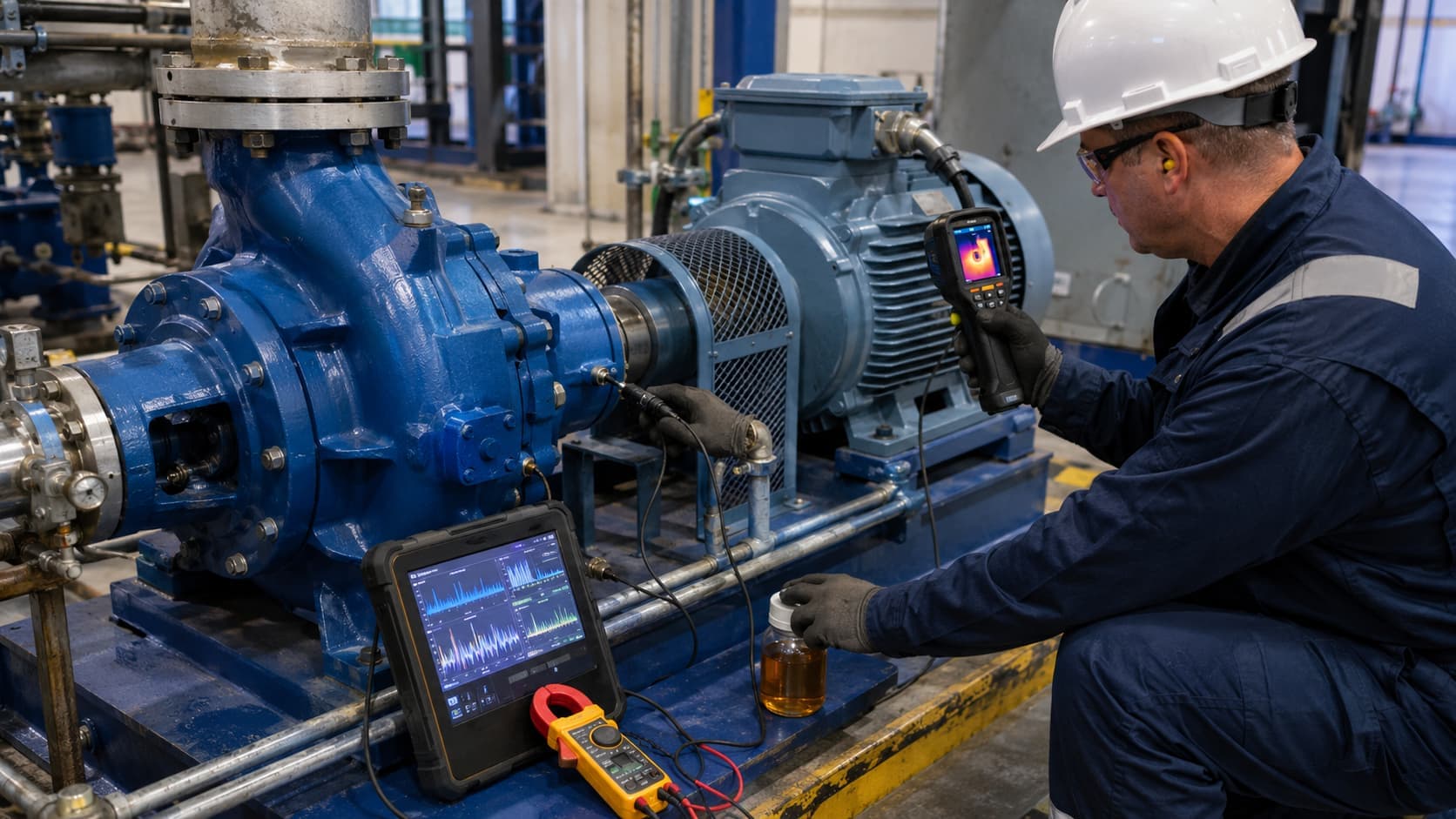
Condition monitoring may involve parameters such as vibration, temperature and other machine-health indicators. ISO 17359:2018 provides general guidelines for establishing machine condition-monitoring programmes, demonstrating that effective monitoring is a structured engineering process rather than simply a sensor-installation exercise.
Predictive-maintenance systems can range from relatively straightforward trend and threshold analysis to advanced prognostics using statistical models or machine learning.
More sophisticated prognostics may attempt to estimate equipment health or remaining useful life. A 2024 review in the Journal of Manufacturing Systems, for example, describes prognostics and health management as using equipment-health information and remaining-useful-life prediction to support predictive maintenance scheduling.
AI therefore can support predictive maintenance. It is not a prerequisite for every useful condition-monitoring programme.
When predictive maintenance becomes worthwhile
Predictive maintenance becomes a stronger candidate when several conditions occur together.
Failure has meaningful consequences
Asset purchase price is not the only measure of importance. A relatively inexpensive component may be critical if its failure stops an entire production process.
Failure consequences can include:
- Production downtime
- Secondary equipment damage
- Safety risk
- Poor product quality
- Expensive emergency repair
- Missed production commitments
- Long replacement lead times
- Disruption to downstream processes
This is why asset criticality and failure consequence matter more than technological enthusiasm.
Deterioration produces a measurable signature
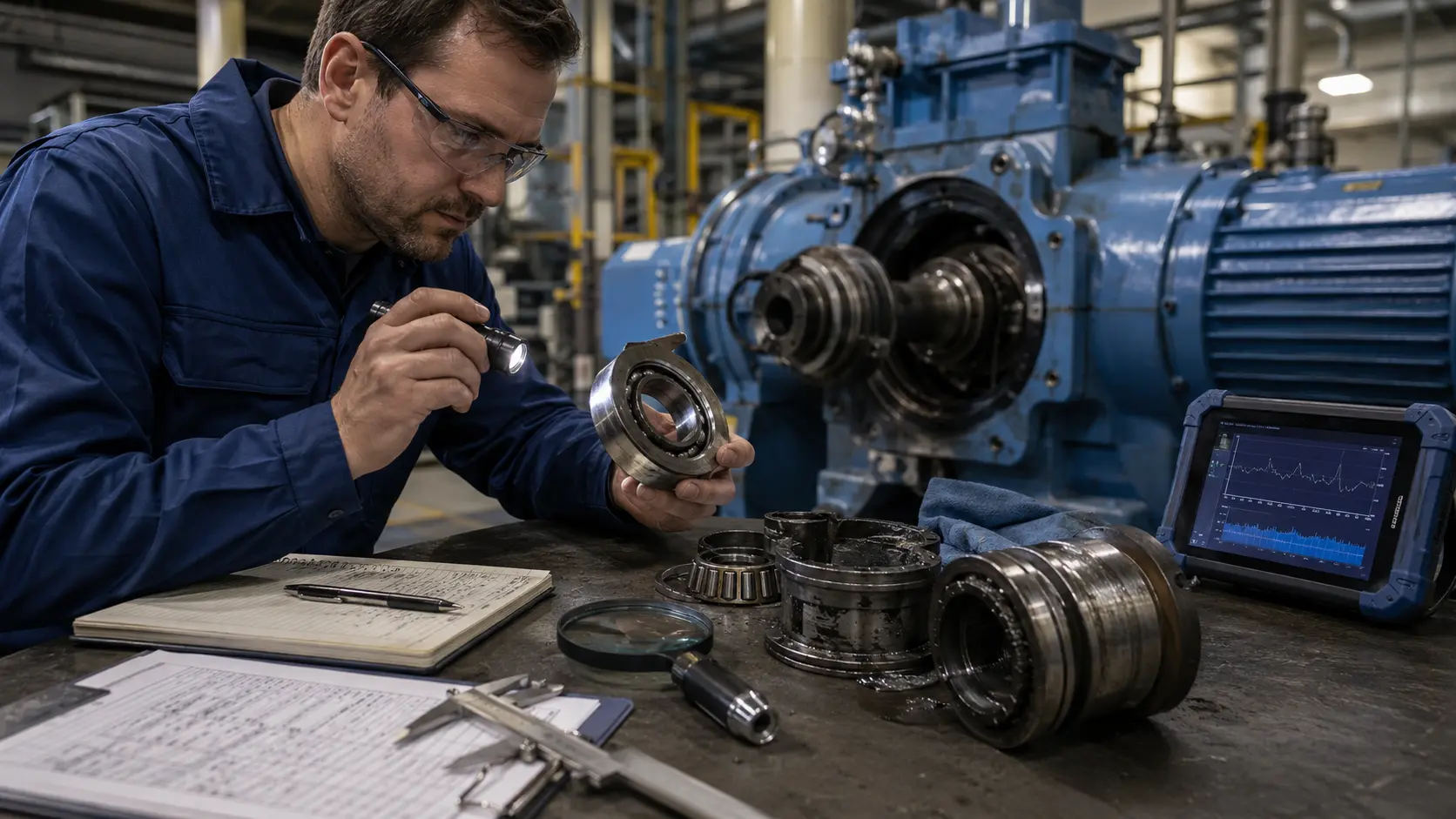
Consider a bearing. Depending on the failure mechanism and operating conditions, developing deterioration may affect vibration behaviour, temperature, lubricant condition or other measurable characteristics. If those changes can be identified consistently before functional failure, there is potentially useful information available for maintenance.
The sequence becomes:
degradation → measurable change → detection → diagnosis/prognosis → maintenance decision
Without a dependable relationship between condition information and the developing failure, predictive maintenance risks becoming expensive data collection.
There is enough warning time to act
Finding an abnormality is not the same as preventing a failure. Imagine that a condition-monitoring system first identifies deterioration only minutes before a component fails, while maintenance needs several hours to stop production safely, obtain parts and perform the repair.
Technically, the system detected the problem before failure. Operationally, it may have provided very little useful warning.
Useful predictive maintenance therefore requires a warning interval that supports action. This is why maintenance engineers need to consider not only whether a failure can be detected, but also when it becomes detectable relative to the time needed to respond.
The organization can trust the data
A predictive decision depends on the signal behind it. Poor sensor placement, changing machine operating conditions, missing data, inappropriate thresholds and badly validated models can all reduce the usefulness of condition information.
Recent research on industrial predictive maintenance continues to identify data quality, implementation and real-world deployment as important challenges.
A predictive system that repeatedly produces false alarms can generate unnecessary maintenance—the exact problem it was supposed to reduce. One that misses developing faults can create even worse confidence.
Preventive vs predictive maintenance at a glance
| Decision factor | Preventive maintenance | Predictive maintenance |
|---|---|---|
| Primary trigger | Time, cycles or usage | Measured/predicted condition |
| Data requirement | Usually relatively low | Usually higher |
| Monitoring infrastructure | Often limited | Frequently required |
| Planning | Regular and predictable | Triggered by equipment health |
| Best fit | Scheduled service needs and suitable age/usage-related tasks | Developing failures with measurable warning signs |
| Risk of unnecessary work | Can be higher if healthy equipment is serviced | Can potentially reduce unnecessary intervention |
| Technical complexity | Usually lower | Usually higher |
| Main limitation | Schedule may not reflect actual condition | Prediction is only useful when condition data and failure behaviour support it |
The table is useful, but it still does not tell us what to choose for a particular machine. For that, a failure-based decision process is better.
Seven questions for choosing the right maintenance strategy
1. What failure are we trying to manage?
Do not begin with the machine. Begin with the failure mode.
“CNC machine failure” is too broad. A CNC machine contains mechanical, electrical, hydraulic, lubrication, control and tooling systems. Different components can fail in different ways. One maintenance policy rarely fits all of them.
2. What happens if the failure occurs?
Consider:
- Safety
- Production
- Repair cost
- Quality
- Secondary damage
- Replacement lead time
- Redundancy
High-consequence failures justify more attention, although that does not automatically make them predictable.
3. Does degradation develop before failure?
Ask whether the failure mechanism progresses through a detectable deterioration stage. If deterioration is gradual, condition monitoring may be possible. If failure is effectively random or its precursor cannot be measured in useful time, predictive monitoring becomes more difficult to justify.
4. Can the deterioration be measured reliably?
A possible indicator is not necessarily a useful indicator. Determine whether vibration, temperature, lubricant condition, electrical current, acoustic behaviour or another variable genuinely reflects the targeted failure mechanism under realistic operating conditions.
5. Is there enough warning time?
Detection needs to occur early enough for maintenance to:
- Evaluate the alarm
- Plan the intervention
- Arrange labour
- Obtain parts
- Coordinate downtime
- Perform the repair
A prediction that arrives after the practical decision deadline has limited value.
6. Will knowing the condition change the maintenance decision?
This question prevents technology for technology's sake. Suppose a component must legally, safely or operationally be replaced every specified interval regardless of condition.
A sophisticated model estimating that it still has additional life may not change the required maintenance action. In such a situation, more information does not necessarily create more value.
7. Is the information worth what it costs to obtain?
The decision should compare the benefits of better maintenance timing with the complete cost of obtaining and using condition information. This is consistent with current condition-monitoring research, which emphasizes evaluating engineering outcomes alongside financial justification.
A CNC example: one machine, several maintenance strategies
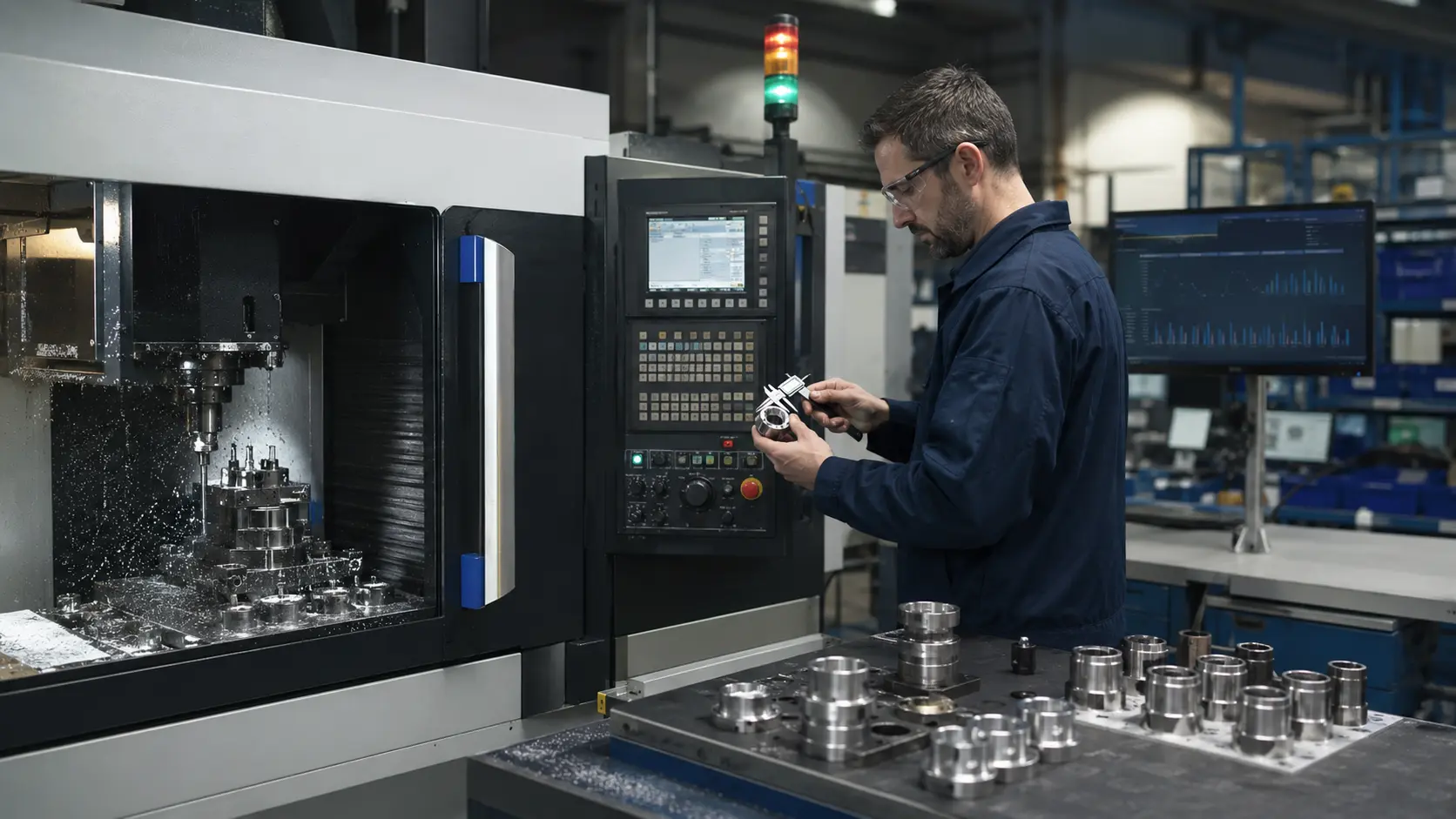
A CNC machining centre illustrates why the preventive-versus-predictive debate should not be treated as an all-or-nothing decision.
A plant might reasonably use scheduled preventive tasks for:
- Routine lubrication-system checks
- Specified filter servicing
- Periodic safety and interlock inspection
- Manufacturer-prescribed servicing
At the same time, selected failure modes may justify condition monitoring. For example, spindle-bearing behaviour could potentially be evaluated using appropriate vibration, temperature or other condition information where the monitored signals and failure mechanism support it. Motor or drive behaviour may also provide useful data depending on the component and available measurements.
The result is not: “This CNC machine uses preventive maintenance.” Nor is it necessarily: “This CNC machine has now become predictive.”
“Different failure modes on the same machine can justify different maintenance triggers.”
That distinction is particularly relevant to my ongoing work exploring AI-based predictive maintenance for CNC machine tools, where the objective is not to assume that machine learning should replace scheduled maintenance but to investigate whether condition data can support earlier and more reliable maintenance decisions.
The project currently explores condition-monitoring data and machine-learning methods for CNC machine health, with development focused on data preparation, feature analysis and early model experimentation rather than claiming a finished industrial deployment.
That research direction also reinforces an important practical principle:
“Prediction should support maintenance judgment, not replace it.”
What workshop experience adds to the discussion
Encountering preventive maintenance in a workshop makes one aspect of this comparison particularly clear: scheduled maintenance remains part of real engineering practice for good reasons. It is understandable, planable and often appropriate.
The objective of newer maintenance technologies should therefore not be to discard existing practice merely because something more sophisticated is available. The better objective is to identify where condition information resolves a limitation of the existing maintenance approach. That is a much higher bar than installing sensors.
Where AI fits
AI becomes valuable when the maintenance problem actually requires the type of pattern recognition or prognostics it can provide.
Machine-learning approaches may help with tasks such as:
- Anomaly detection
- Fault classification
- Health-state estimation
- Failure-probability estimation
- Remaining-useful-life prediction
But AI comes after defining the engineering problem. A large model cannot fix an unsuitable sensor. A high classification accuracy does not matter if the predicted fault has no useful maintenance response. A remaining-useful-life estimate is not valuable simply because a model can calculate one.
The important question remains:
“Does the prediction lead to a better maintenance decision?”
NIST's work on prognostics and health management similarly emphasizes the importance of verification and validation so that PHM technologies can be integrated with confidence into smart-manufacturing operations.
Most facilities need a maintenance portfolio, not one philosophy
The preventive-versus-predictive argument can create a false choice.
A sensible maintenance programme may contain:
- Preventive maintenance
- Condition-based or predictive maintenance
- Inspections
- Corrective work
- Reliability-centred decisions
- And, for appropriately low-consequence components, deliberate run-to-failure strategies
Even within one production line, each asset or failure mode may deserve a different treatment.
This is why the most useful question is not: “Should our organization use predictive maintenance?”
“Which failures become easier, safer or more economical to manage when we know more about equipment condition?”
Start there. Then choose the technology.
Key takeaway
Use preventive maintenance where time- or usage-based intervention is technically sound, straightforward and economical.
Consider predictive maintenance where:
- The failure has meaningful consequences
- Deterioration can be observed
- Reliable condition indicators exist
- The warning interval is long enough to act
- The organization can interpret the information correctly
- And the resulting decision improvement justifies the monitoring cost
Use both when different components or failure modes demand different approaches—which is often the more realistic engineering answer.
The maintenance strategy should follow the failure behaviour. The technology should follow the maintenance strategy. Not the other way around.
References and further reading
- ISO 17359:2018 — Condition monitoring and diagnostics of machines — General guidelines. International Organization for Standardization. Provides general procedures for establishing machine condition-monitoring programmes.
- NIST — Manufacturing Machinery Maintenance. National Institute of Standards and Technology. Defines and distinguishes reactive, preventive and predictive maintenance in manufacturing.
- U.S. Department of Energy — Operations & Maintenance Best Practices Guide, Release 3.0. Covers preventive, predictive and broader operations-and-maintenance practices.
- Huang, C. et al. (2024). Prognostics and health management for predictive maintenance: A review. Journal of Manufacturing Systems, 75, 78–101. Reviews PHM approaches including system-health monitoring and remaining-useful-life estimation for predictive maintenance.
- Benhanifia, A. et al. (2025). Systematic review of predictive maintenance practices in the manufacturing industry. Reviews current manufacturing PdM approaches, implementation issues and enabling technologies.
- Dadfarnia, M., Sharp, M. E., & Herrmann, J. W. (2025). Comprehensive evaluations of condition monitoring-based technologies in industrial maintenance: A systematic review. Journal of Manufacturing Systems, 82, 449–477. Particularly relevant to engineering and financial evaluation of condition-monitoring investments.