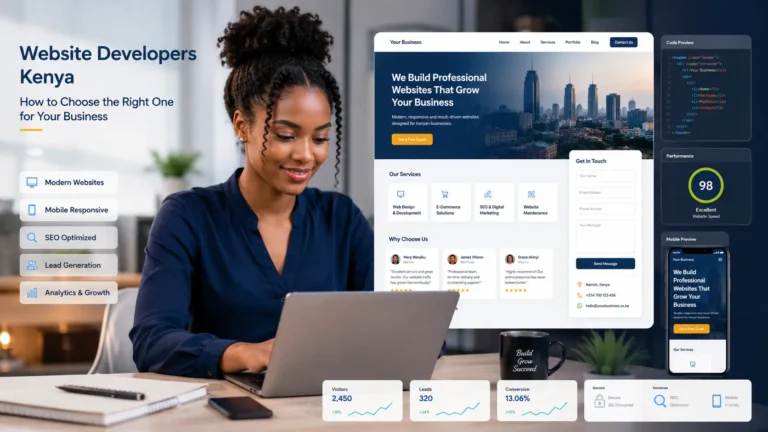

Business website strategy is now more important than simply having a website. Many businesses already have websites, but not all of those websites attract customers, build trust, generate leads, or support real growth.
A website can look beautiful and still fail.
It may have modern colors, good images, and attractive sections. However, if it does not help visitors understand the business, trust the brand, or take action, it becomes just another online brochure.
Today, businesses need more than a website. They need a complete digital system that connects website design, SEO, content, automation, analytics, customer experience, and business goals.
According to DataReportal’s Global Digital Reports, internet use continues to shape how people discover brands, compare services, and make buying decisions online. Therefore, businesses must think beyond online presence and focus on digital performance.
A website should not only exist.
It should work.
What Is Business Website Strategy?
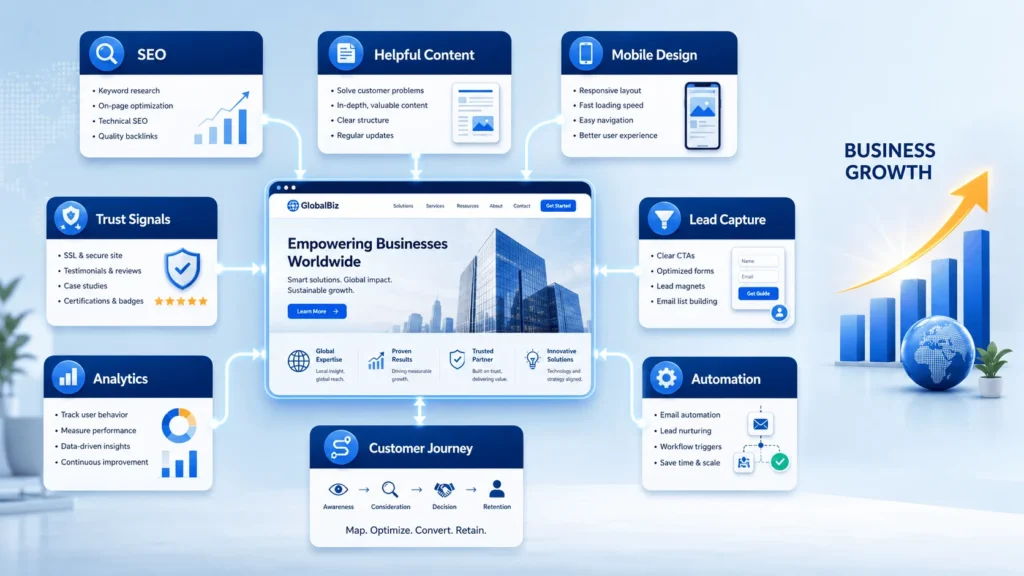
Business website strategy is the plan that connects your website to your business goals.
A basic website may show your homepage, services, about section, and contact details. That is useful, but it is not always enough.
A stronger website setup includes a clear brand message, SEO-friendly pages, helpful content, fast loading speed, mobile-friendly design, lead capture systems, analytics tracking, automation tools, trust-building elements, and a clear customer journey.
As a result, the website becomes more useful to both the business and its customers.
A good business website strategy turns a website from a static online presence into a system that attracts, informs, converts, and supports customers.
Why a Website Alone Is Not Enough
Many businesses invest in a website and then expect customers to come automatically.
Unfortunately, that rarely happens.
A website alone does not guarantee traffic. It does not guarantee trust, sales, or customer inquiries either.
For a website to produce results, people must be able to find it, understand it, trust it, and take action.
This is where many websites fail.
Some websites are not optimized for search engines. Others load slowly, have unclear service descriptions, or lack strong calls-to-action. In some cases, the website looks good on desktop but performs poorly on mobile.
Because of these problems, businesses need a complete digital strategy, not just a website.
Harun Lucas has explained similar challenges in the article Why Most Business Websites in Kenya Fail and How to Fix Yours. Although that article focuses on Kenya, the same lessons apply to businesses across the world.
Business Website Strategy Starts With a Clear Goal
Every website should be built around a clear purpose.
Before designing pages, a business should ask important questions.
What should this website achieve?
Should it generate leads?
Should it sell products?
Should it build trust?
Should it educate customers?
Should it support bookings?
Should it collect inquiries?
Should it showcase projects?
Without a clear goal, the website may look good but fail to serve the business properly.
For example, a consultant may need a website that builds authority and generates consultation requests. On the other hand, an online store may need product pages, checkout systems, and customer support flows.
A service business may need strong service pages, testimonials, FAQs, and quote forms.
Therefore, a business website strategy helps connect the website design to the actual business objective.
Businesses Need SEO, Not Just Web Design
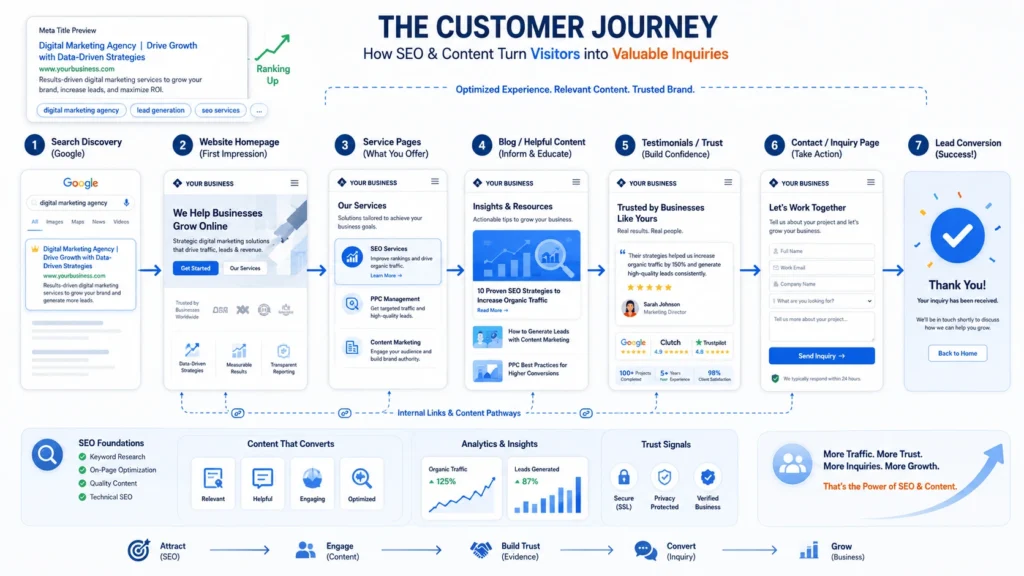
A website that cannot be found is a weak business tool.
SEO, or Search Engine Optimization, helps search engines understand your website. It also helps customers find your pages when they search online.
Google’s SEO Starter Guide explains how SEO helps search engines understand content and helps users find websites through search.
This means SEO should not be treated as an afterthought.
A strong business website strategy should include SEO from the beginning. This includes keyword research, proper page titles, meta descriptions, clear headings, optimized images, internal links, fast page speed, mobile responsiveness, helpful content, and well-structured pages.
A beautiful website without SEO may remain invisible.
However, a strategic website is designed to be both attractive and discoverable.
Businesses Need Helpful Content
Content helps visitors understand your business.
A website needs more than a few short service descriptions. It needs content that answers customer questions, explains your value, builds trust, and supports decision-making.
Helpful content may include service pages, blog posts, FAQs, case studies, guides, portfolio pages, product descriptions, testimonials, and educational resources.
For example, a business offering web development can write about website cost, website strategy, SEO, automation, AI websites, and how to choose a developer.
Harun Lucas uses this approach by publishing useful articles such as Website Developers Kenya: How to Choose the Right One for Your Business and SEO Services in Kenya: How to Rank Higher and Attract More Customers.
This type of content builds authority. In addition, it improves search visibility over time.
Business Website Strategy Improves the Customer Journey
A website should guide visitors from interest to action.
Many websites fail because they leave visitors confused. A visitor may arrive on the homepage, scroll for a few seconds, and leave because the message is not clear.
A strong customer journey answers important questions.
Where does the visitor land?
What do they see first?
Do they understand the offer quickly?
Is the next step clear?
Can they trust the business?
Can they contact the business easily?
Are there enough reasons to take action?
A good website should make it easy for visitors to move from awareness to trust, and then from trust to inquiry, booking, purchase, or consultation.
This is why calls-to-action matter.
Buttons such as “Request a Quote,” “Book a Consultation,” “Start a Project,” or “Contact Us” should appear in the right places. They should not be hidden only at the bottom of the website.
In simple terms, a website should not force visitors to think too hard.
It should guide them.
Businesses Need Speed and Performance
Website speed affects user experience, trust, and search performance.
If a website loads slowly, visitors may leave before reading the content. Slow websites can also make a business look unprofessional.
Google’s PageSpeed Insights can help businesses test website performance and identify areas that need improvement.
A strong business website strategy includes performance optimization. This may involve compressing images, using reliable hosting, reducing unnecessary plugins, cleaning up code, improving mobile performance, and testing website speed regularly.
A website should not only look good.
It should also load fast and work smoothly.
Businesses Need Mobile-Friendly Design
Many customers browse websites using mobile phones.
Therefore, if a website works well on desktop but looks poor on mobile, the business may lose potential customers.
A mobile-friendly website should have readable text, properly sized buttons, simple navigation, clear forms, fast loading, and sections that adjust well on smaller screens.
Mobile design is no longer optional.
It is part of the basic foundation of a modern website.
A proper business website strategy ensures that the customer experience is strong across phones, tablets, laptops, and desktops.
Businesses Need Trust Signals
Trust is one of the biggest reasons customers choose one business over another.
A website should include clear trust signals that help visitors feel confident. These may include client testimonials, case studies, project examples, real contact details, team information, certifications, reviews, security features, clear policies, business location, and professional branding.
Without trust signals, visitors may hesitate to contact the business.
A website should answer the silent question in the visitor’s mind:
“Can I trust this business?”
The stronger the trust signals, the easier it becomes for visitors to take action.
Businesses Need Lead Capture Systems
A website should help convert visitors into leads.
Many websites fail because they provide information but do not capture serious inquiries. As a result, visitors leave without taking the next step.
Lead capture systems may include contact forms, quote request forms, booking forms, newsletter signup forms, downloadable guides, WhatsApp buttons, live chat, CRM integrations, and automated email responses.
A visitor may not be ready to buy immediately. However, a good system allows the business to collect interest and follow up later.
This is where a website becomes more than an online profile.
It becomes part of the sales process.
Business Website Strategy Includes Automation
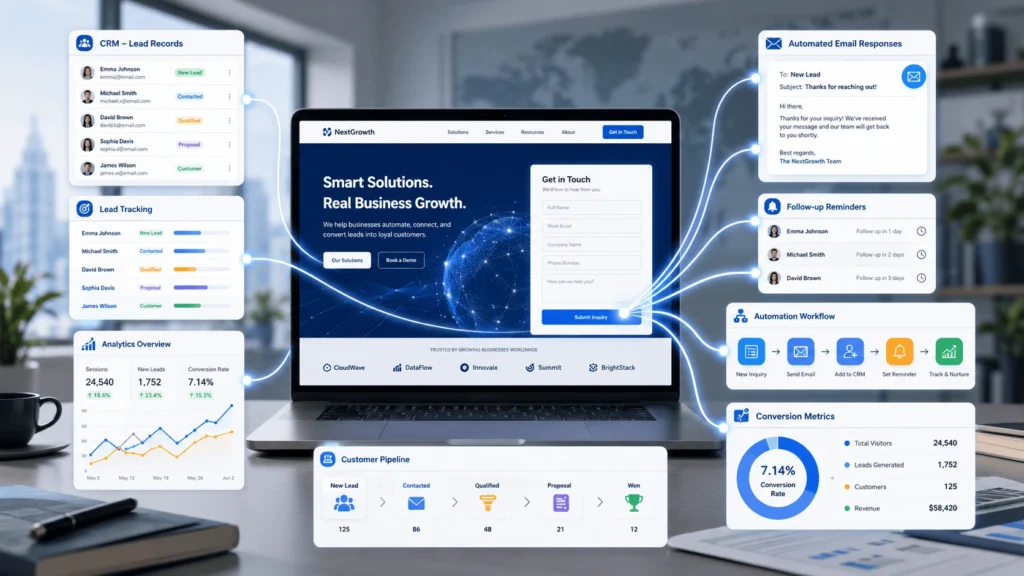
Automation helps businesses reduce manual work and improve customer response.
A modern website can connect with tools that support email replies, lead tracking, booking confirmations, customer segmentation, chatbots, payment notifications, CRM updates, and follow-up reminders.
Automation does not replace human service. Instead, it supports it.
For example, when a customer fills a form, the website can send an automatic confirmation, notify the business owner, save the lead in a CRM, and trigger a follow-up task.
This creates a smoother experience for both the business and the customer.
For businesses exploring smarter platforms, Harun Lucas also writes about AI Websites in Kenya, which explains how AI, automation, chatbots, and analytics are changing business websites.
Businesses Need Analytics
A business cannot improve what it does not measure.
Website analytics help businesses understand how visitors interact with their website. Analytics can show how many people visit the website, which pages they view, where traffic comes from, how long visitors stay, which content performs best, where visitors drop off, and which pages generate inquiries.
This information helps businesses make better decisions.
For example, if many visitors read a blog post but do not contact the business, the page may need a stronger call-to-action. If users leave the homepage quickly, the message or layout may need improvement.
A proper business website strategy includes tracking, reviewing, and improving performance over time.
Businesses Need Ongoing Improvement
A website should not be published and forgotten.
Business needs change. Customer expectations also change. In addition, search trends, technology, and competitors keep changing.
For that reason, a website should improve continuously.
Ongoing improvement may include updating content, adding blog posts, improving SEO, refreshing images, testing calls-to-action, fixing broken links, improving page speed, adding new services, and reviewing analytics.
A successful website is not a one-time project.
It is a long-term digital asset.
Businesses Need Social Media Integration
A website and social media should work together.
Social media helps attract attention and start conversations. A website helps organize information, build trust, and convert visitors.
The best setup connects both.
A social media post can introduce a service. Then, a website page can explain it in detail.
A short video can attract attention. After that, a blog post can provide full guidance.
A LinkedIn post can share an idea. Meanwhile, a website can host the full article.
A WhatsApp message can start a conversation. However, a website can provide the full service details.
Harun Lucas has covered this relationship in the article Website vs Social Media: What Kenyan Businesses Actually Need in 2026. Although the article uses Kenya as the context, the principle applies globally: social media and websites work best when they support each other.
Business Website Strategy Creates a Digital Ecosystem
The best businesses do not treat their website as a separate object.
They treat it as part of a digital ecosystem.
A strong digital ecosystem may include a website, SEO, content marketing, social media, email marketing, CRM, analytics, automation, online ads, customer support tools, and sales follow-up systems.
Each part supports the other.
Social media attracts attention. SEO brings search traffic. Content builds trust. The website explains value. Forms capture leads. Automation supports follow-up. Analytics shows what to improve.
That is how digital growth becomes more intentional.
Common Mistakes Businesses Make With Websites
Many businesses make the same website mistakes.
They build a website without a clear strategy. They focus only on design and ignore SEO. They write thin content that does not explain enough. They hide contact information. They forget mobile users.
In addition, some businesses use slow images and poor hosting. Others fail to track website performance, add trust signals, update content, or connect the website to sales and follow-up systems.
These mistakes turn a website into a weak online brochure.
A business website strategy helps avoid these problems.
What Businesses Should Add to Their Website
To make a website more effective, businesses should consider adding clear service pages, SEO-optimized blog content, case studies, testimonials, FAQs, strong calls-to-action, contact forms, WhatsApp or chat integration, analytics tools, lead tracking, email automation, speed optimization, and regular content updates.
These additions help the website perform better.
However, the goal is not to add everything at once.
The goal is to build a website that can grow with the business.
The Best Website Setup for Modern Businesses
A modern business website should include both foundation and growth features.
The foundation includes professional design, mobile responsiveness, fast loading speed, clear navigation, secure hosting, and strong service pages.
The growth layer includes SEO, content strategy, analytics, automation, lead capture, trust signals, and conversion optimization.
When both layers work together, the website becomes more powerful.
It does not only introduce the business. Instead, it supports marketing, sales, customer service, and long-term brand growth.
Final Thoughts
Businesses need more than just a website because digital competition is no longer about simply being online.
It is about being useful, visible, trustworthy, and easy to contact.
A website is still important. However, it must be supported by strategy, SEO, content, speed, trust signals, automation, analytics, and ongoing improvement.
A website should not just sit online.
It should attract visitors, educate them, guide them, capture leads, and support business growth.
That is the difference between having a website and having a digital growth system.
Ready to Build More Than Just a Website?
If your business already has a website but it is not attracting leads, building trust, or supporting growth, it may be time to improve your digital strategy.
Harun Lucas helps businesses build modern, strategic, and scalable digital solutions through web development, SEO, software systems, automation, AI integration, and digital strategy.
Whether you need a new website, website redesign, SEO support, automation tools, or a smarter digital system, the goal is simple: to create a platform that supports real business growth.
Visit harunlucas.com to explore digital solutions built for the future.
Frequently Asked Questions
Business website strategy is the plan that connects your website to your business goals. It includes SEO, content, user experience, lead capture, analytics, automation, and clear calls-to-action so the website can support real growth.
A business needs more than just a website because design alone does not guarantee traffic, leads, or sales. A website must be supported by SEO, helpful content, fast loading speed, trust signals, automation, and analytics to perform well.
Business website strategy helps with lead generation by guiding visitors toward clear actions such as requesting a quote, booking a consultation, filling a form, or contacting the business through WhatsApp, email, or phone.
Every business website should include clear service pages, strong calls-to-action, contact forms, trust signals, mobile-friendly design, fast loading speed, SEO setup, helpful content, analytics tracking, and easy navigation.
A website can support a business without SEO, but its growth potential will be limited. SEO helps customers find the website through search engines, which makes it easier to attract visitors who are already looking for related products or services.