Which Language Is Better for Real-Time Robotics, AI, and Smart Automation?
Autonomous systems are no longer futuristic ideas. They are already being used in self-driving vehicles, industrial robots, drones, smart manufacturing, and intelligent monitoring systems. But behind every autonomous system is a software decision that shapes performance, safety, and scalability.
One of the biggest decisions engineers and developers face is this: Should an autonomous control system be built with Python or C++?
At first glance, this may look like a simple programming choice. In reality, it affects execution speed, hardware control, AI integration, development time, and system reliability.
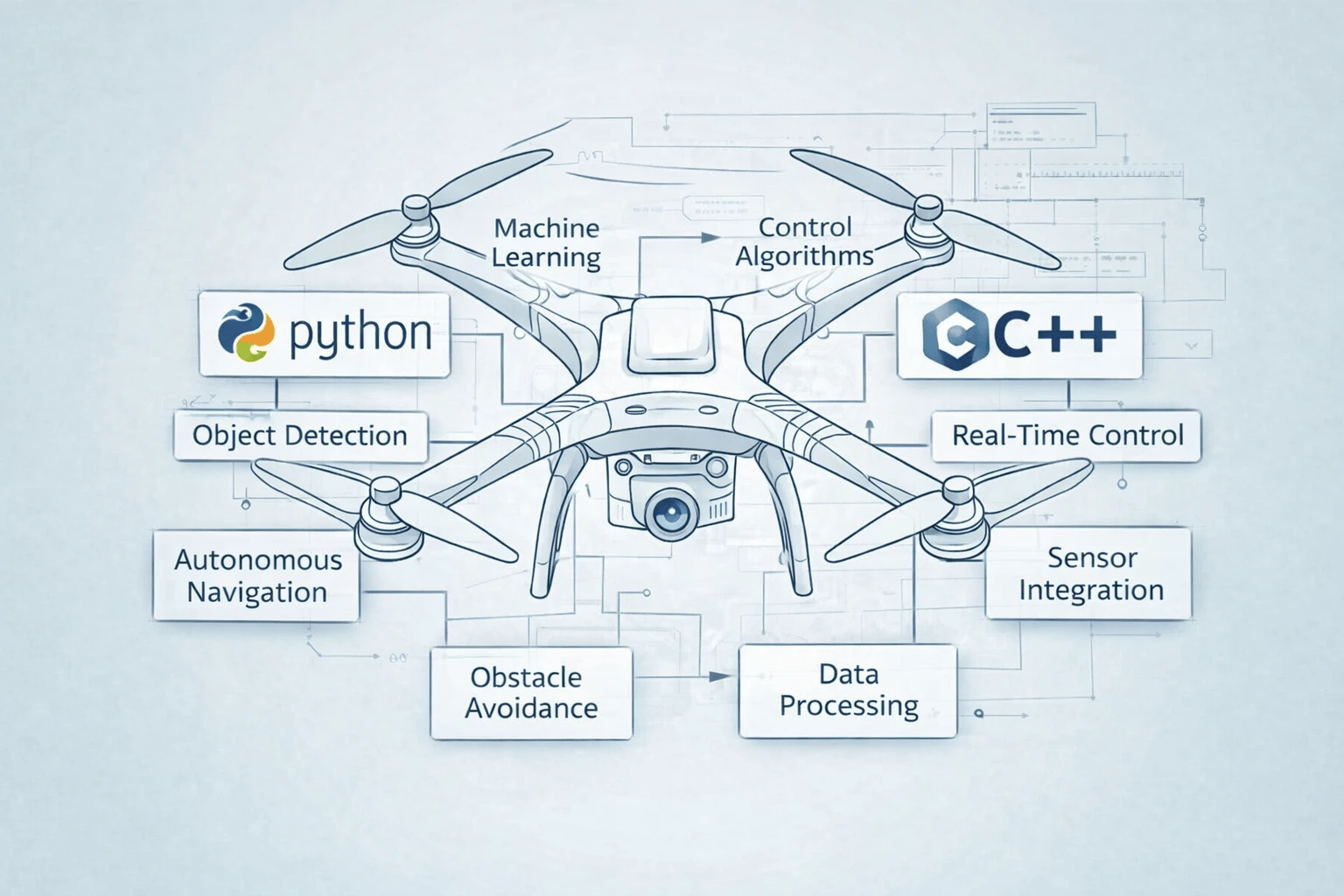
This article compares Python and C++ for autonomous system control in a practical way. Rather than arguing that one language is always better, the goal is to understand where each language fits best and how they can even work together in real systems.
Why This Comparison Matters
Autonomous systems must sense their environment, process data, make decisions, and act — often within very short time limits. In such systems, programming language choice matters because it influences:
- response speed
- memory efficiency
- hardware access
- maintainability
- AI and machine learning integration
- real-time control performance
A poor language decision can make a system slow, difficult to scale, or unsafe in time-sensitive environments.
That is why Python and C++ are often compared. They represent two very different engineering priorities:
- Python focuses on simplicity, speed of development, and AI integration
- C++ focuses on execution speed, low-level control, and real-time performance
Understanding Autonomous System Control
Before comparing the two languages, it helps to understand what autonomous system control actually means.
An autonomous system usually follows this process:
- It collects input from sensors
- It interprets the data
- It makes a decision using logic, rules, or AI models
- It sends commands to actuators or control devices
- It repeats this loop continuously
Examples include:
- a drone stabilizing itself in flight
- a robot arm adjusting movement based on visual feedback
- a self-driving vehicle detecting a pedestrian and braking
- a smart factory system adjusting machine speed automatically
In all these cases, the software must be accurate, stable, and sometimes extremely fast.
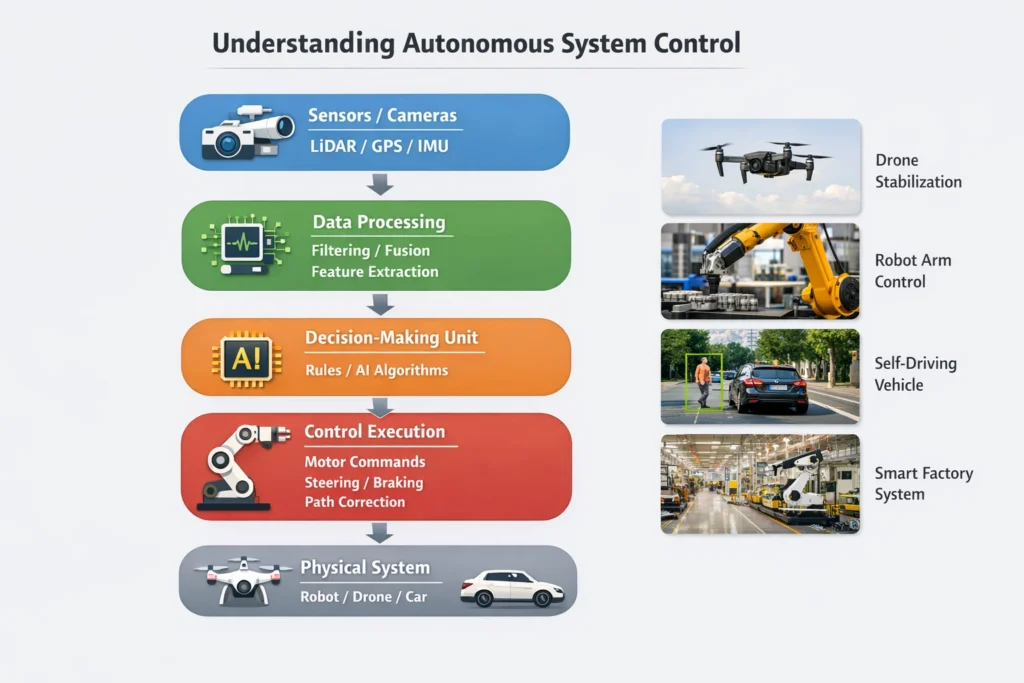
Simple explanation of the diagram
The system first receives information from the environment through sensors. That data is processed and interpreted. Then the decision-making unit decides what the machine should do next. Finally, commands are sent to the hardware. This loop repeats continuously, often many times every second.
Python for Autonomous System Control
Python has become one of the most widely used languages in robotics, AI, and automation. Its biggest advantage is that it allows developers to build systems quickly and connect easily with modern machine learning tools.
Strengths of Python
1. Easy to Learn and Write
Python has simple syntax, which makes development faster. Engineers can test ideas quickly, build prototypes faster, and spend less time dealing with complex syntax.
2. Excellent for AI and Machine Learning
Most AI tools are strongly connected to Python. Libraries such as TensorFlow, PyTorch, NumPy, and OpenCV make Python attractive for perception, computer vision, predictive models, and intelligent decision-making.
3. Fast Prototyping
In research labs, startups, and academic projects, Python is often preferred because developers can move from idea to working demo much faster than in C++.
4. Strong Robotics Ecosystem
Python is widely used in ROS environments, simulation tools, and automation pipelines. It is often used for high-level control and experimentation.
Weaknesses of Python
1. Slower Execution Speed
Python is interpreted and generally slower than C++. In time-critical systems, this can become a serious limitation.
2. Less Suitable for Hard Real-Time Tasks
If a robot must respond within strict timing constraints, Python may struggle compared to a compiled language like C++.
3. Higher Runtime Overhead
Python can consume more memory and may not be ideal for embedded hardware with limited resources.
Where Python Fits Best
Python is ideal for:
- AI-based perception systems
- simulation and testing
- high-level decision logic
- research and prototyping
- data analysis in autonomous platforms
C++ for Autonomous System Control
C++ has long been a core language for robotics, embedded systems, and high-performance control. It is widely used where system timing, efficiency, and direct hardware interaction matter most.
Strengths of C++
1. High Performance
C++ is compiled and runs much faster than Python. This makes it suitable for control loops, motion planning, path tracking, and sensor processing where low delay matters.
2. Better Memory Management
C++ gives developers more control over memory and system resources. This is important in embedded systems and resource-constrained devices.
3. Strong for Real-Time and Low-Level Control
For motor control, sensor drivers, flight systems, and real-time robotics, C++ is often the preferred option because it offers predictable performance.
4. Industry Preference for Core Systems
Many production-level autonomous systems use C++ in their core architecture because it supports performance, safety, and system optimization.
Weaknesses of C++
1. Harder to Learn
C++ is more complex than Python. It requires stronger understanding of memory, pointers, object management, and debugging.
2. Slower Development Time
Writing and testing features often takes longer in C++ than in Python.
3. Less Convenient for Rapid AI Experimentation
Although C++ can support AI applications, most modern AI experimentation and research workflows are easier in Python.
Where C++ Fits Best
C++ is ideal for:
- real-time motor control
- autonomous navigation engines
- embedded robotics systems
- safety-critical applications
- performance-heavy control modules
Real-World Engineering View
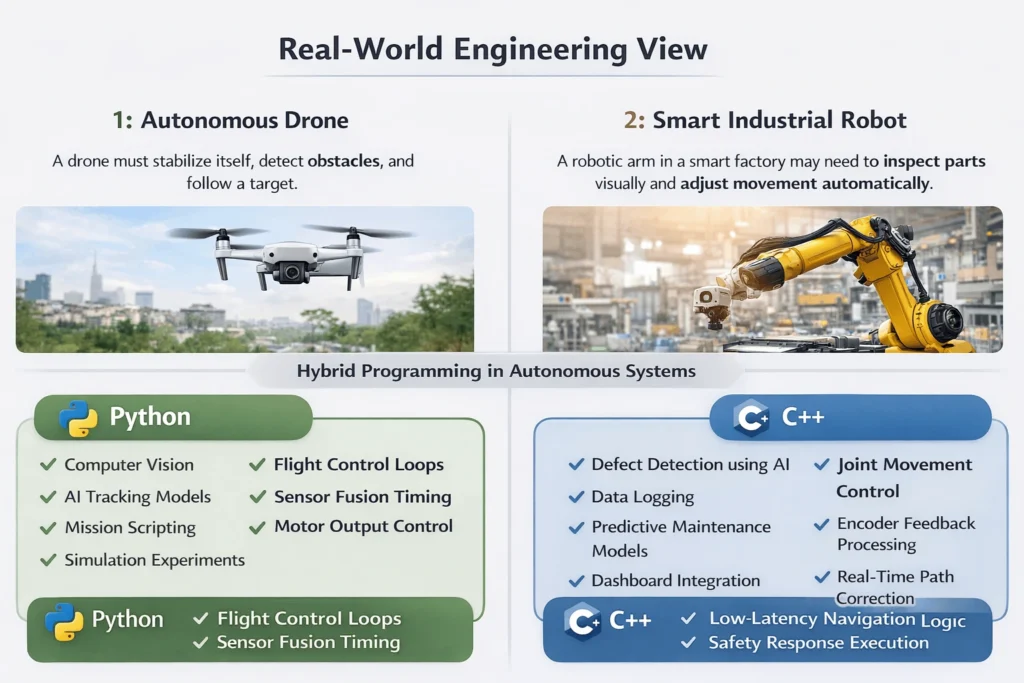
The truth is that real autonomous systems rarely rely on only one language.
In many professional systems:
- Python is used for AI models, simulation, testing, scripting, and high-level logic
- C++ is used for real-time execution, control loops, system integration, and hardware interaction
This hybrid approach is common because it combines flexibility with performance.
For example:
- a self-driving prototype may use Python for object detection and model training
- the actual vehicle control, braking logic, and sensor timing may be handled in C++
So the smarter engineering question is often not Python or C++?
It is Which part of the system should use Python, and which part should use C++?
1: Autonomous Drone
A drone must stabilize itself, detect obstacles, and follow a target.
Python may handle:
- computer vision
- AI tracking models
- mission scripting
- simulation experiments
C++ may handle:
- flight control loops
- sensor fusion timing
- motor output control
- low-latency navigation logic
This division improves both development speed and system reliability.
2: Smart Industrial Robot
A robotic arm in a smart factory may need to inspect parts visually and adjust movement automatically.
Python may handle:
- defect detection using AI
- data logging
- predictive maintenance models
- dashboard integration
C++ may handle:
- joint movement control
- encoder feedback processing
- real-time path correction
- safety response execution
Code Illustration
Python example: high-level decision logic
obstacle_distance = 1.2  # metersif obstacle_distance < 1.5:
    print("Obstacle detected: slow down and reroute")
else:
    print("Path is clear: continue movement")
C++ example: low-level control style
#include <iostream>
using namespace std;int main() {
    double obstacle_distance = 1.2;    if (obstacle_distance < 1.5) {
        cout << "Obstacle detected: slow down and reroute" << endl;
    } else {
        cout << "Path is clear: continue movement" << endl;
    }    return 0;
}
Which Language Should You Learn First?
That depends on your goal.
Start with Python if:
- you are new to programming
- you want to work on AI, automation, and robotics prototypes
- you want fast results for projects and portfolio development
- you are interested in computer vision and machine learning
Learn C++ if:
- you want deeper control over robotics systems
- you are targeting embedded or real-time systems
- you want to work on industrial control or core robotics software
- you want stronger systems programming skills
Best path for an autonomous systems engineer
Start with Python for understanding concepts and building fast prototypes. Then learn C++ to strengthen real-time control, optimization, and deployment skills.
That combination is far more valuable than mastering only one language.
Conclusion
Python and C++ are not enemies in autonomous system control. They solve different problems.
Python is better for speed of development, AI integration, experimentation, and high-level logic. C++ is better for performance, real-time execution, and low-level system control.
If you are building a serious career in robotics, smart manufacturing, autonomous vehicles, or intelligent automation, the most practical strategy is to understand both languages and know where each one creates the most value.
In real engineering, the best systems are often not built by choosing one language blindly. They are built by making the right technical choice for each layer of the system.
Click Here To See My Work

awesome!!