Many Kenyan manufacturers still rely on legacy manufacturing systems that were built for a different time. These systems may still work, but they often lack real-time monitoring, automation, data visibility, remote access, and easy integration with modern business tools.
In today’s competitive business environment, manufacturing is no longer just about machines, labour, and production output. It is also about data, speed, efficiency, safety, maintenance planning, customer demand, and digital decision-making. This is where the Internet of Things, commonly known as IoT, becomes important.
Modernize Your Business Systems
IoT helps manufacturers connect machines, sensors, software systems, and people so that production data can be collected, analysed, and used to make better decisions. For businesses in Kenya, modernizing legacy manufacturing systems with IoT can reduce downtime, improve productivity, strengthen quality control, and create a more reliable production environment.
At Harun Lucas, the goal is to help businesses move from manual, disconnected, and outdated systems to practical digital solutions that support growth. This includes web development, SEO, software systems, AI integration, automation, engineering systems, and digital strategy.
What Are Legacy Manufacturing Systems?
Legacy manufacturing systems are older machines, tools, processes, or software platforms that a business still depends on for daily operations.
These may include:
- Old production machines with no digital monitoring
- Manual stock records
- Paper-based maintenance logs
- Standalone machines that do not communicate with each other
- Excel-based production tracking
- Manual quality control records
- Outdated software that cannot integrate with modern tools
- Production processes that depend heavily on supervisors checking everything physically
A legacy system is not always bad. In many cases, the machines are still strong, reliable, and expensive to replace. The problem is that they may not provide enough visibility into what is happening in real time.
For example, a machine can be running slower than expected, consuming more energy, or developing faults, but the business may only notice when production has already been affected.
That is why modernizing legacy manufacturing systems does not always mean replacing everything. Sometimes, it means adding smart sensors, dashboards, automation tools, and data systems around the existing equipment.
What Is IoT in Manufacturing?
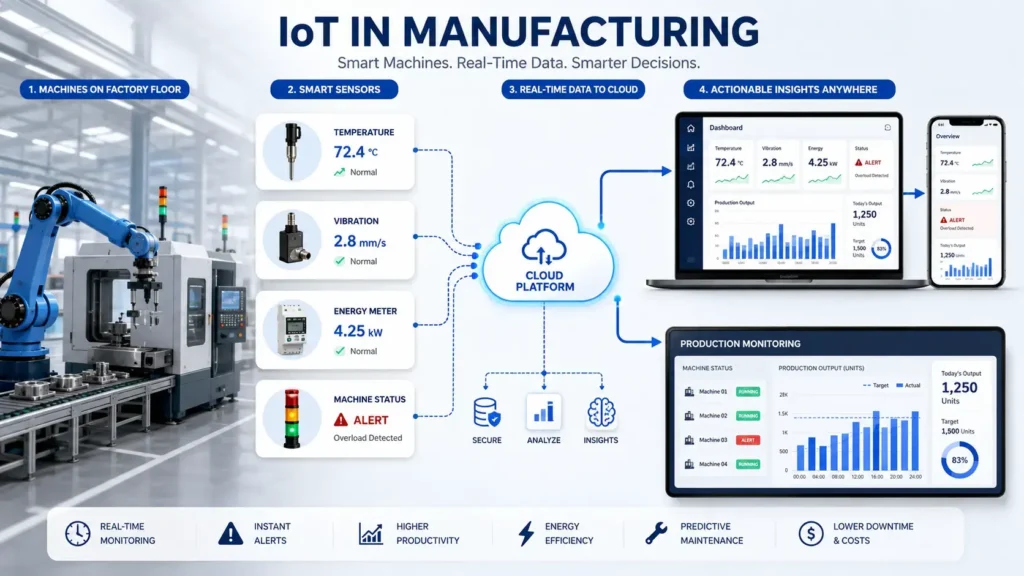
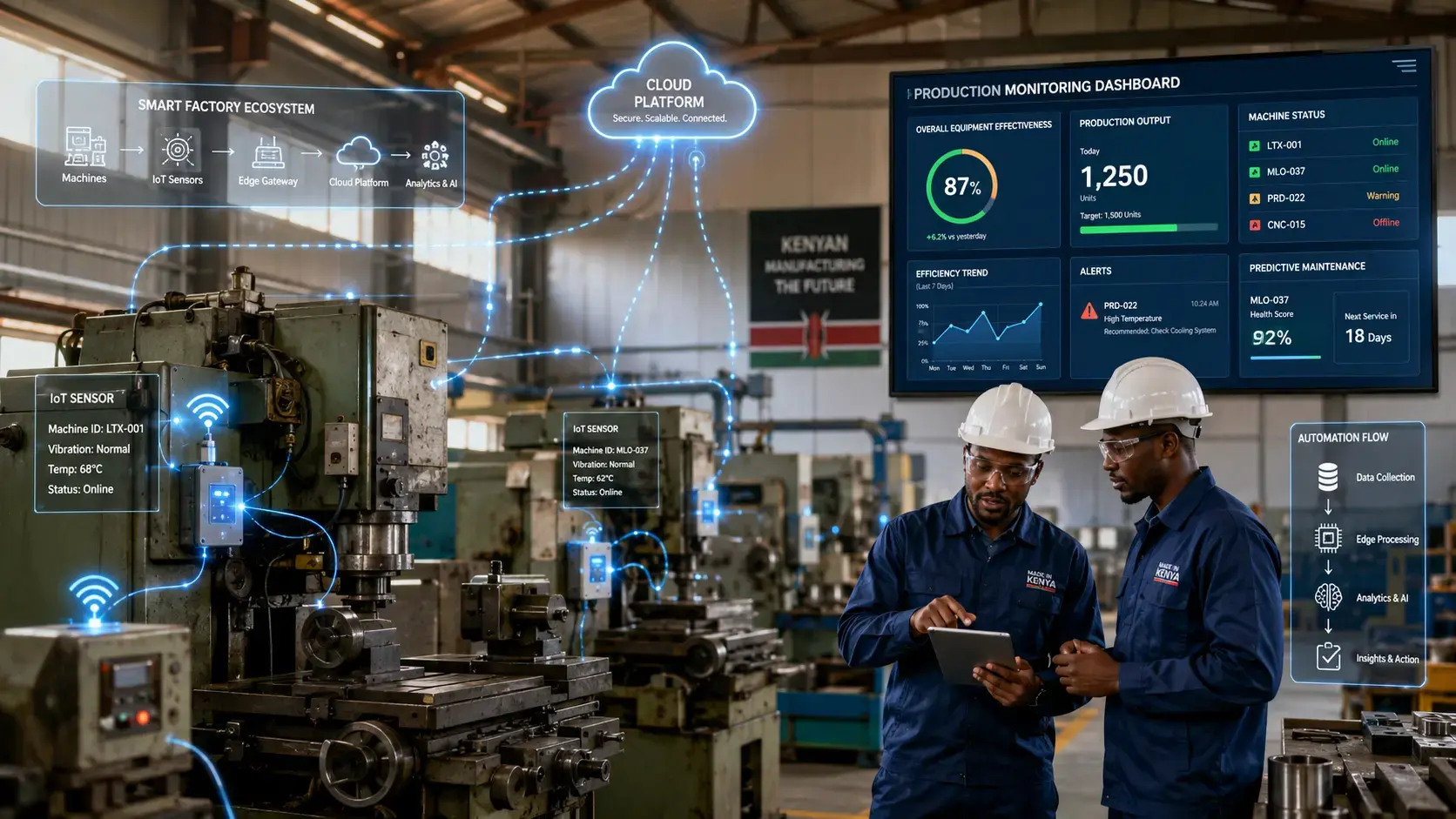
IoT in manufacturing means using connected devices, sensors, and software to collect and share data from machines, production lines, storage areas, and business operations.
In simple terms, IoT allows machines and systems to “talk” to each other.
For example:
- A sensor can monitor machine temperature.
- A dashboard can show production output in real time.
- A system can send an alert when a machine is overheating.
- A stock system can update automatically when raw materials are used.
- A maintenance team can receive notifications before equipment fails.
- A manager can view production performance from a phone or laptop.
This makes production easier to monitor and manage.
According to DataReportal, Kenya had 23.4 million internet users in October 2025, showing that digital adoption continues to influence how businesses, customers, and professionals operate. This matters because manufacturers are also part of the wider digital economy.
Why Modernizing Legacy Manufacturing Systems Matters in Kenya
Kenyan manufacturing businesses operate in a very demanding environment. Costs are rising, customers expect faster delivery, competition is growing, and businesses are under pressure to improve quality and efficiency.
Modernizing legacy manufacturing systems matters because it helps businesses solve practical problems such as:
- Unexpected machine breakdowns
- Delayed production reporting
- Poor stock visibility
- High maintenance costs
- Energy wastage
- Manual errors
- Slow decision-making
- Poor customer communication
- Weak quality tracking
A manufacturer that understands its machines, production speed, downtime, material usage, and quality issues can make better decisions.
For example, instead of guessing why production is low, the business can check real-time data and identify whether the issue is machine downtime, operator delay, poor maintenance, lack of materials, or energy interruptions.
This is the difference between managing through assumptions and managing through data.
How IoT Improves Legacy Manufacturing Systems
IoT can improve legacy manufacturing systems in several practical ways.
1. Real-Time Machine Monitoring
Many factories only know a machine has failed after production stops. With IoT, sensors can monitor machine performance continuously.
A system can track:
- Temperature
- Vibration
- Speed
- Energy consumption
- Running time
- Idle time
- Production output
- Fault patterns
This helps the business detect problems early.
For example, if a motor starts vibrating abnormally, the system can send an alert before a serious breakdown occurs.
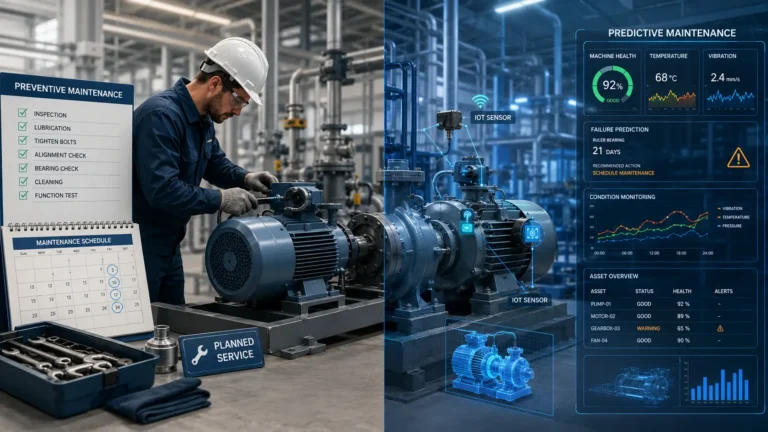
2. Predictive Maintenance
Traditional maintenance is often reactive. A machine breaks down, then repairs begin.
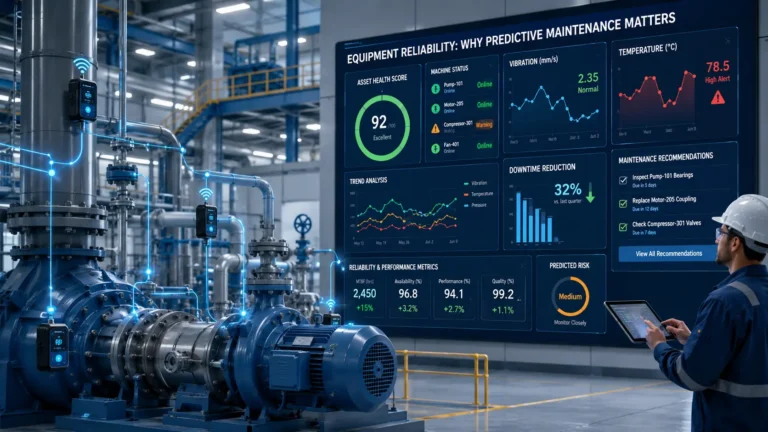
IoT supports predictive maintenance by using data to identify early warning signs. This helps the maintenance team act before the problem becomes costly.
For Kenyan manufacturers, this can reduce:
- Emergency repairs
- Production downtime
- Spare part delays
- Loss of revenue
- Worker frustration
- Customer delivery delays
A simple maintenance dashboard can show which machines need attention, which parts are due for inspection, and which equipment is becoming unreliable.
3. Better Production Visibility
In many businesses, production reports are prepared at the end of the day, week, or month. By then, the issue has already happened.
IoT allows the business to see production performance as it happens.
A production dashboard can show:
- Units produced
- Machine availability
- Downtime
- Operator performance
- Defects
- Material usage
- Production targets
- Shift performance
This helps managers respond quickly instead of waiting for manual reports.
4. Improved Quality Control
Quality problems can be expensive, especially when defects are discovered late.
IoT can help monitor production conditions that affect quality, such as temperature, pressure, speed, humidity, timing, or machine calibration.
For example, in food processing, packaging, fabrication, printing, or assembly work, small variations can affect the final product. IoT helps businesses track those variations and identify where quality problems begin.
This supports better customer satisfaction and fewer rejected products.
5. Energy Monitoring and Cost Reduction
Energy costs are a serious concern for many Kenyan businesses. IoT can help manufacturers monitor how much power machines are using and identify areas of waste.
For example:
- Which machines consume the most power?
- Which equipment runs when not needed?
- Which production line uses more energy per unit?
- Are machines left idle but still consuming electricity?
- Are there abnormal power consumption patterns?
With this data, a business can make smarter decisions about machine use, maintenance, scheduling, and energy efficiency.
Practical Examples for Kenyan Businesses
IoT is not only for large factories. Small and medium manufacturers can also benefit from modernizing legacy manufacturing systems gradually.
Example 1: A Garage or Mechanical Workshop
A mechanical workshop can use digital systems to track jobs, spare parts, technicians, payments, and customer updates.
IoT can also help monitor equipment such as compressors, lifts, pumps, or generators.
This creates better workflow visibility and reduces confusion in daily operations.
Example 2: A Food Processing Business
A food processing company can use sensors to monitor temperature, humidity, storage conditions, machine performance, and production output.
This helps with quality control, safety, and compliance.
Example 3: A Fabrication Workshop
A metal fabrication business can track machine usage, job progress, material consumption, and maintenance needs.
Instead of relying only on verbal updates, the owner can view job status from a dashboard.
Example 4: A Packaging or Printing Business
IoT can help monitor production speed, machine faults, rejected products, and output per shift.
This helps the business improve planning and reduce waste.
Common Mistakes When Modernizing Legacy Manufacturing Systems
Modernization should be practical. Many businesses fail because they rush into technology without understanding the real problem.
Modernize Your Business Systems
Here are common mistakes to avoid.
Mistake 1: Replacing Everything Too Early
Not every old system needs to be replaced. Some machines can still serve the business well if they are supported with sensors, dashboards, and better software.
The best approach is to assess what is working, what is limiting growth, and what can be improved first.
Mistake 2: Buying Technology Without a Clear Goal
A business should not install IoT because it sounds modern.
Start with a clear question:
- Do we want to reduce downtime?
- Do we want better stock control?
- Do we want to monitor machine performance?
- Do we want to improve maintenance?
- Do we want better reporting?
- Do we want to reduce manual errors?
Technology should solve a real business problem.
Mistake 3: Ignoring Staff Training
Even the best system can fail if workers do not understand how to use it.
Before modernizing legacy manufacturing systems, involve operators, supervisors, technicians, and managers. They understand the daily problems better than anyone.
Training also reduces resistance because workers can see how the system helps them work better.
Mistake 4: Poor Data Management
IoT creates data, but data alone is not enough. The business must know what to do with it.
A good system should provide clear dashboards, useful alerts, and reports that support decision-making.
This is where software systems, automation, and AI integration can become valuable.
Kenya’s National AI Strategy 2025–2030 highlights the country’s focus on AI, innovation, and digital transformation for socio-economic development, making it important for businesses to start preparing for smarter technology adoption.
Mistake 5: Forgetting Website and Digital Visibility
Modern manufacturing is not only about internal systems. A business also needs a strong online presence.
Customers, suppliers, partners, and investors often search online before contacting a business. A professional website helps communicate credibility, services, capacity, and contact information.
If your business still depends only on referrals or social media, read this guide: Website vs Social Media: What Kenyan Businesses Actually Need in 2026.
You can also learn why many websites fail here: Why Most Business Websites in Kenya Fail and How to Fix Yours.
Step-by-Step Guide to Modernizing Legacy Manufacturing Systems with IoT
Modernization should be done in stages. You do not have to digitize everything at once.
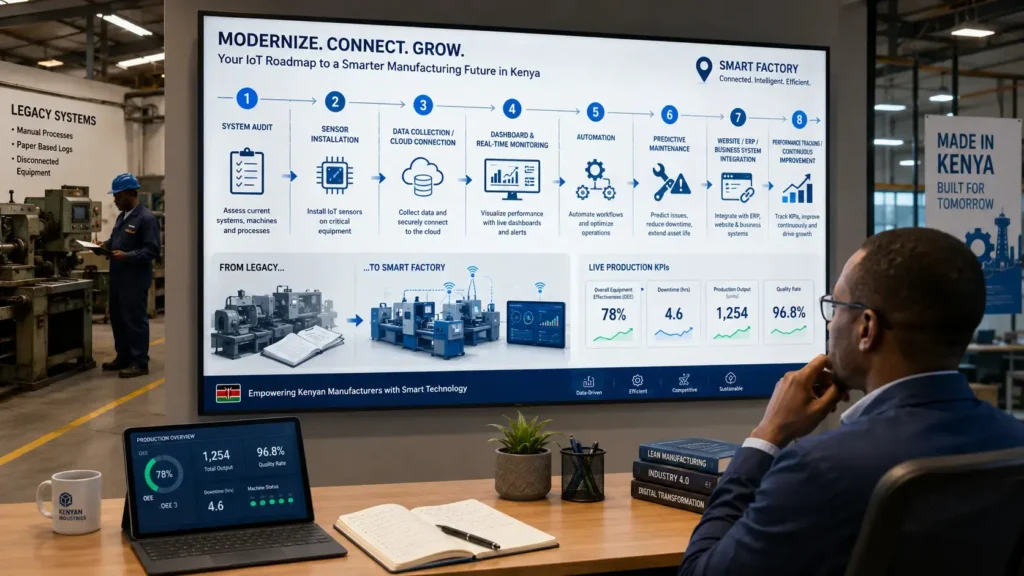
Step 1: Audit Your Current Systems
Start by listing the machines, processes, software tools, and manual records your business depends on.
Check:
- Which machines are critical?
- Which processes cause delays?
- Where do most errors happen?
- Which reports take too long?
- Which equipment breaks down often?
- Which departments lack visibility?
- Which tasks are repeated manually?
This audit helps you identify where IoT or automation can create the biggest impact.
Step 2: Identify the Most Important Business Problem
Do not start with technology. Start with the problem.
For example:
- “We lose production time because machines fail unexpectedly.”
- “We do not know our real production output until the end of the day.”
- “We struggle to track stock and raw materials.”
- “Maintenance records are scattered.”
- “Customers keep asking for job updates.”
- “Supervisors spend too much time preparing reports.”
Once the problem is clear, the right digital solution becomes easier to design.
Step 3: Start with a Small Pilot Project
A pilot project reduces risk.
For example, you can start with one machine, one production line, or one process.
A simple pilot may include:
- Sensors on one machine
- A basic dashboard
- Automated alerts
- Digital maintenance logs
- Daily production reports
- Simple performance tracking
After testing, the business can improve the system before expanding it.
Step 4: Connect IoT Data to a Dashboard
Data should be easy to understand.
A good dashboard can show:
- Production status
- Machine condition
- Downtime
- Maintenance alerts
- Energy usage
- Job progress
- Stock movement
- Quality issues
The dashboard should be simple enough for managers, supervisors, and technical teams to use.
At Harun Lucas, this is where software systems, automation, AI integration, and web-based dashboards can support manufacturing and engineering operations.
Step 5: Improve Your Website and Customer Communication
A modern manufacturing business should also communicate professionally online.
Your website can show:
- Company profile
- Services
- Production capacity
- Industries served
- Case studies
- Contact details
- Quotation request forms
- Product catalogues
- Blog articles
- Search-optimized service pages
Google’s SEO Starter Guide explains that SEO helps improve a website’s presence in search and makes it easier for search engines to crawl, index, and understand content.
If you are planning a business website, this article may help: Website Cost in Kenya 2026.
Step 6: Measure Website and System Performance
Digital systems must be fast, secure, and reliable.
For websites, tools like Google PageSpeed Insights can help check page performance on mobile and desktop. Google says PageSpeed Insights reports on user experience and provides suggestions for improvement.
For manufacturing systems, performance can be measured using:
- Machine uptime
- Production output
- Downtime reduction
- Maintenance response time
- Defect rate
- Energy consumption
- Order completion time
- Customer response time
This helps the business know whether modernization is creating real value.
Where Harun Lucas Fits In
Modernizing legacy manufacturing systems requires more than installing devices. It requires understanding business operations, engineering systems, software, automation, data, websites, and digital strategy.
Harun Lucas supports businesses by connecting these areas in a practical way.
Services and solutions may include:
- Business websites
- SEO strategy
- Software systems
- Automation tools
- AI integration
- Web-based dashboards
- Engineering system support
- Workflow digitization
- Digital business strategy
- Performance-focused web development
For many businesses, the best starting point is not a complex system. It may be a professional website, a simple dashboard, a quotation system, a stock tracker, a maintenance log, or an automated customer communication process.
The goal is to build systems that solve real problems.
Visit harunlucas.com to learn more or use the contact page to discuss your project: Contact Harun Lucas.
Final Thoughts
Modernizing legacy manufacturing systems with IoT is not just a technology trend. It is a practical way for manufacturers to improve efficiency, reduce downtime, monitor operations, and make better decisions.
For Kenyan businesses, the future belongs to companies that can combine strong technical operations with smart digital systems.
You do not have to replace everything at once. Start small. Identify the biggest problem. Use data. Automate repetitive tasks. Improve your website. Build systems that support growth.
Whether you run a workshop, factory, processing plant, fabrication business, or technical service company, IoT and digital systems can help you move from manual operations to smarter, more reliable business processes.
If your business is still depending on outdated systems, manual reports, disconnected tools, or a weak online presence, Harun Lucas can help you design a practical digital solution that fits your goals.
Need Help Modernizing Your Business Systems?
Harun Lucas helps businesses build professional websites, SEO strategies, software systems, automation tools, AI integrations, and engineering-focused digital solutions.
Whether you need a business website, an internal system, a dashboard, or a digital strategy for your manufacturing operations, you can start with a simple conversation.
Visit harunlucas.com or contact Harun Lucas today to discuss your project.
Frequently Asked Questions
Legacy manufacturing systems are older machines, production equipment, software tools, or manual processes that are still being used in a factory or workshop. These systems may still function well, but they often lack modern features such as real-time monitoring, automation, data reporting, remote access, and predictive maintenance.
Modernizing legacy manufacturing systems with IoT means connecting older machines and production processes to smart sensors, software dashboards, cloud platforms, and data systems. This allows manufacturers to monitor machine performance, production output, energy use, downtime, temperature, vibration, and other important data in real time.
No. In many cases, manufacturers do not need to replace old machines. IoT can be introduced by adding sensors, controllers, gateways, and monitoring software to existing equipment. This makes modernization more affordable because businesses can improve their current machines instead of buying completely new ones.
IoT is important because it helps manufacturers make better decisions using real-time data. Instead of waiting for a machine to fail or relying only on manual records, IoT systems can show what is happening on the production floor as it happens. This can improve efficiency, reduce downtime, support maintenance planning, and increase productivity.
IoT can reduce downtime by monitoring machine conditions such as vibration, temperature, pressure, speed, and operating hours. When abnormal patterns are detected, the system can alert the maintenance team before a serious breakdown occurs. This supports predictive maintenance, where problems are addressed early before they stop production.