Predictive maintenance is changing how businesses manage machines, equipment, and engineering systems. For many years, companies relied heavily on preventive maintenance to reduce breakdowns and keep operations running. However, as industries adopt sensors, data analytics, automation, and smarter systems, predictive maintenance is becoming a more strategic approach.
Every business that depends on machines needs a maintenance plan.
Without one, equipment failures can lead to downtime, production delays, safety risks, poor service delivery, and higher repair costs.
Still, many businesses struggle to understand the difference between preventive maintenance and predictive maintenance. Both approaches are useful, but they work differently. Preventive maintenance follows a planned schedule, while predictive maintenance uses data and equipment condition to decide when maintenance should happen.
In simple terms, preventive maintenance asks, “When is the next scheduled service?” Predictive maintenance asks, “What is the current condition of this asset, and when is it likely to fail?”
Understanding this difference can help businesses reduce unnecessary maintenance, improve reliability, and make better engineering decisions.
What Is Preventive Maintenance?
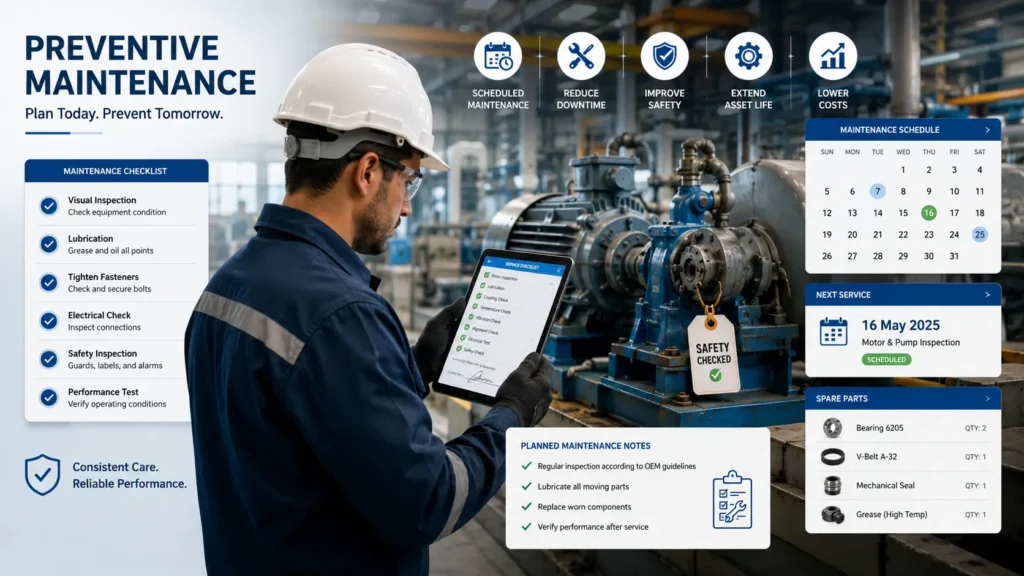
Preventive maintenance is a planned maintenance approach where equipment is serviced at scheduled intervals to reduce the risk of failure.
For example, a company may service a generator every three months, inspect a conveyor system every month, or replace machine parts after a certain number of operating hours.
This approach is based on time, usage, or manufacturer recommendations.
Preventive maintenance may include:
regular inspections,
lubrication,
cleaning,
calibration,
part replacement,
safety checks,
and scheduled servicing.
The goal is to prevent failure before it happens.
Because of this, preventive maintenance is much better than waiting for equipment to break down before taking action. It helps businesses create order, reduce surprise failures, and keep assets in better working condition.
However, preventive maintenance also has limits.
Sometimes equipment may be serviced too early, even when it is still in good condition. In other cases, a machine may fail before its next scheduled service because the real condition changed faster than expected.
That is where predictive maintenance becomes useful.
What Is Predictive Maintenance?
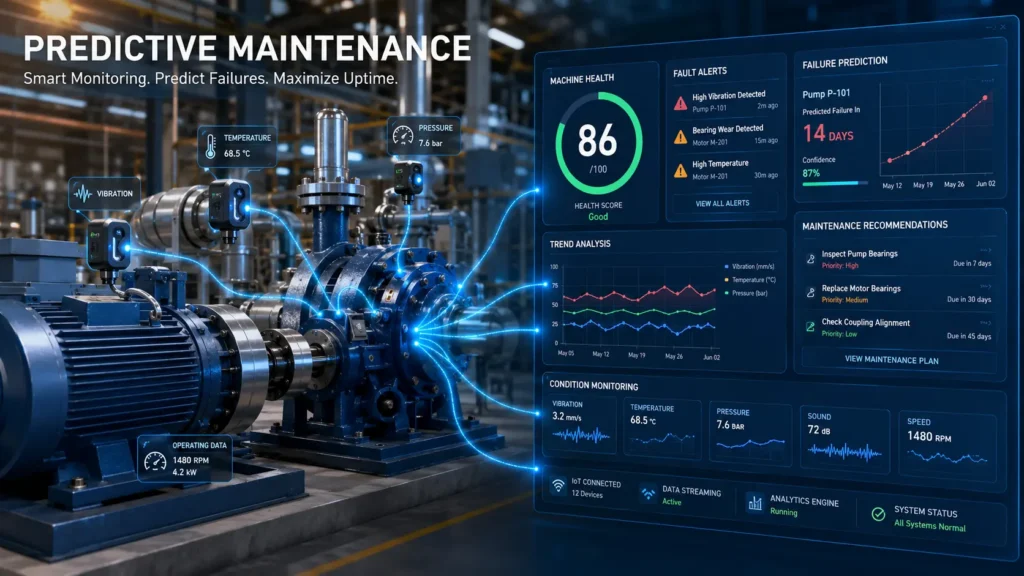
Predictive maintenance is a maintenance strategy that uses data, monitoring tools, and analytics to predict when equipment may need attention.
Instead of relying only on fixed schedules, predictive maintenance looks at the actual condition of the equipment.
IBM defines predictive maintenance as an approach that uses operational data and real-time condition monitoring to predict when assets need maintenance. This may include data from vibration, temperature, sound, lubrication, and other condition monitoring methods.
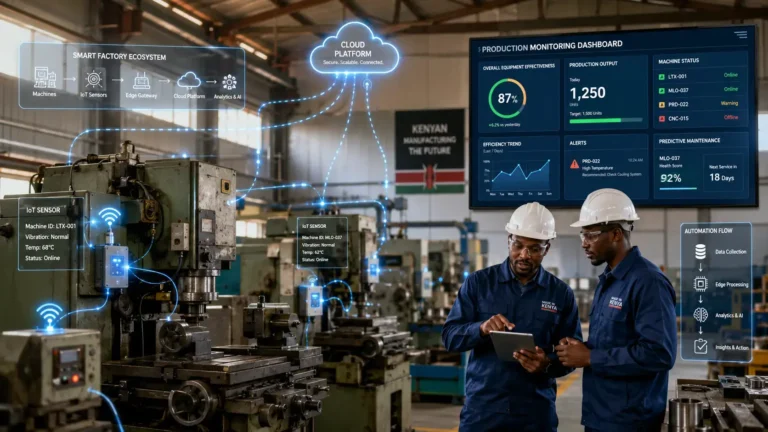
For example, a machine may be monitored using sensors that track vibration levels. If vibration starts increasing abnormally, the system can warn the maintenance team before a serious failure happens.
Predictive maintenance may use:
IoT sensors,
machine data,
vibration analysis,
thermal monitoring,
oil analysis,
sound monitoring,
machine learning,
and maintenance history.
As a result, maintenance becomes more data-driven.
Instead of servicing equipment only because the calendar says so, businesses can service equipment when the data shows that action is needed.
Predictive Maintenance vs Preventive Maintenance
Predictive maintenance and preventive maintenance both aim to reduce equipment failure. However, they are not the same.
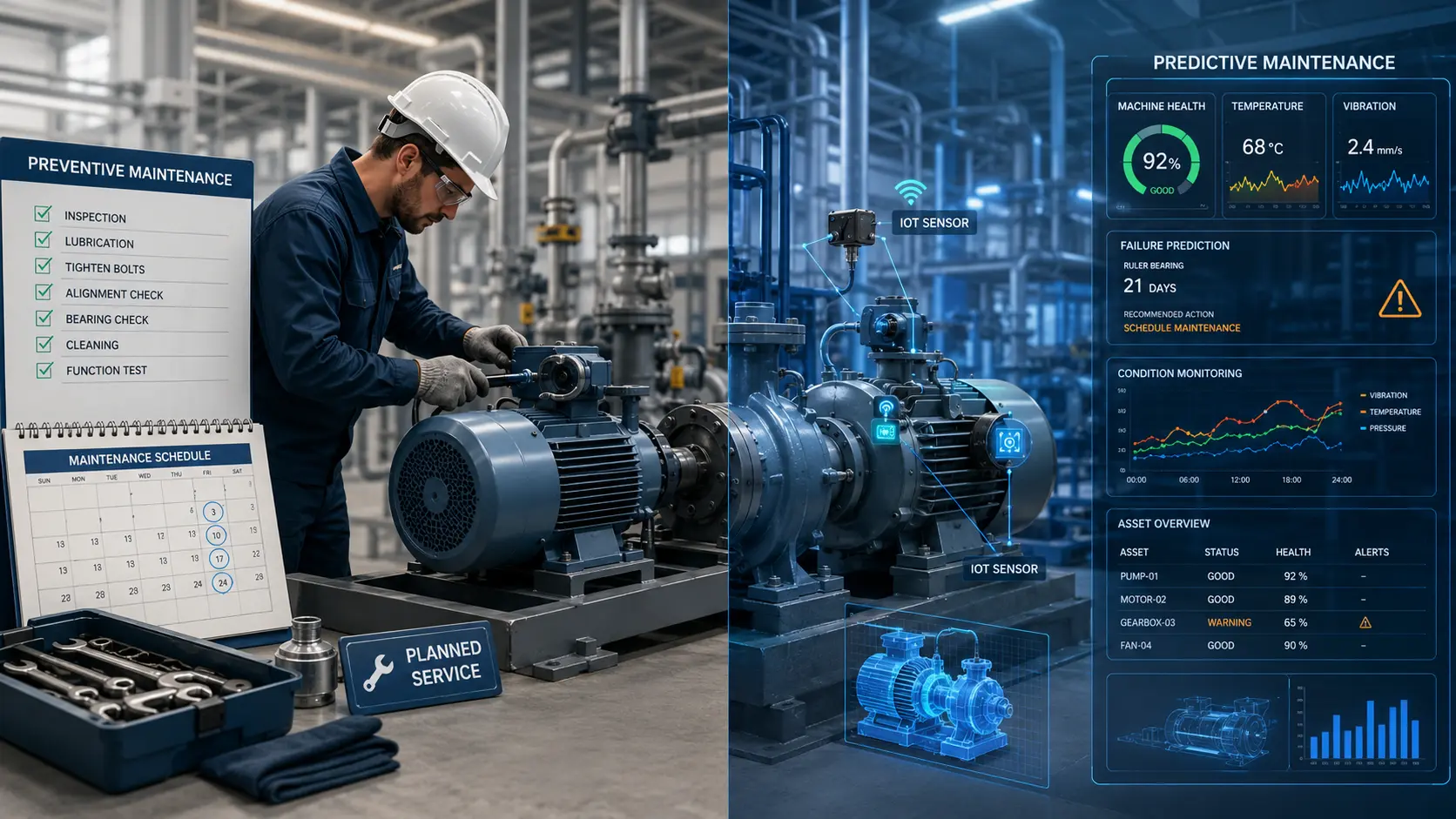
Preventive maintenance is schedule-based. Predictive maintenance is condition-based.
Preventive maintenance uses time, usage, or planned intervals. Predictive maintenance uses data, sensors, and real equipment behavior.
Preventive maintenance can be easier to start because it does not always require advanced technology. On the other hand, predictive maintenance may need sensors, data systems, monitoring tools, and technical expertise.
Even so, predictive maintenance can help businesses avoid unnecessary maintenance by understanding the actual condition of equipment. IBM explains that predictive maintenance can flag and fix issues earlier by focusing on equipment condition rather than relying only on expected wear.
In practical terms, preventive maintenance is about planned care. Predictive maintenance is about intelligent care.
Both are useful, but the best choice depends on the equipment, business size, risk level, budget, and available data.
Why Preventive Maintenance Still Matters
Preventive maintenance is still important because not every business is ready for predictive systems.
Many companies operate assets that can be managed well through scheduled inspections and regular servicing. For such businesses, preventive maintenance provides structure and discipline.
It helps teams know what should be checked, when it should be checked, and who should do the work.
Preventive maintenance is useful for:
basic equipment,
low-risk assets,
small businesses,
facilities with limited data,
equipment with clear service intervals,
and assets where manufacturer schedules are reliable.
For example, regular oil changes, belt inspections, filter replacements, and safety checks can prevent many common problems.
In addition, preventive maintenance is easier to document. This makes it useful for compliance, audits, safety programs, and maintenance planning.
Although it may not be as advanced as predictive maintenance, it remains a strong foundation for good asset management.
Why Predictive Maintenance Is Growing
Predictive maintenance is growing because businesses want to reduce downtime, control costs, and improve asset reliability.
In many industries, unplanned downtime can be expensive. A single equipment failure can stop production, delay deliveries, affect customers, and increase repair costs.
Predictive maintenance helps businesses move from guessing to knowing.
By using real-time data and analytics, companies can identify early warning signs and act before a failure becomes serious.
AWS explains that predictive maintenance uses data to estimate and plan maintenance schedules for operational equipment. This helps organizations monitor equipment condition and make better maintenance decisions.
This approach is especially useful in industries such as manufacturing, logistics, energy, transport, construction, healthcare facilities, and building services.
As technology becomes more affordable, even growing businesses can begin using simple monitoring tools before moving into advanced predictive systems.
Business Benefits of Predictive Maintenance
Predictive maintenance can provide several business benefits.
First, it can reduce unplanned downtime. When warning signs are detected early, teams can plan repairs before the equipment fails completely.
Second, it can reduce unnecessary maintenance. Instead of replacing parts too early, businesses can use data to understand whether the asset still has useful life.
Third, it can improve safety. Equipment failures can sometimes create hazards for workers, customers, or surrounding systems. Early detection helps reduce those risks.
In addition, predictive maintenance can improve planning. Maintenance teams can order spare parts, schedule technicians, and plan downtime at a better time.
It can also extend equipment life because problems are identified before they cause serious damage.
For businesses that depend on engineering systems, these benefits can support better productivity, lower operating costs, and stronger reliability.
Limitations of Predictive Maintenance
Predictive maintenance is powerful, but it is not perfect.
It requires good data. If the data is poor, incomplete, or unreliable, the predictions may also be weak.
It may also require investment in sensors, software, analytics tools, training, and system integration.
In addition, predictive maintenance needs skilled people who can interpret the data and make practical decisions. A system may detect abnormal vibration, but an engineer or technician still needs to understand what it means and what action should follow.
Another challenge is implementation.
Some businesses collect data but do not use it properly. Others install tools without creating a clear maintenance process. As a result, the technology exists, but the business does not get full value from it.
Therefore, predictive maintenance should not be treated as a shortcut. It should be part of a clear maintenance strategy.
Common Mistakes Businesses Make With Maintenance
Many businesses make the same mistakes when managing equipment.
One common mistake is waiting for machines to fail before taking action. This reactive approach can lead to expensive downtime and emergency repairs.
Another mistake is relying only on fixed schedules without checking the actual condition of the equipment. This may lead to unnecessary servicing or missed warning signs.
Some businesses also fail to keep proper maintenance records. Without records, it becomes difficult to identify patterns, recurring faults, and equipment history.
In addition, many teams ignore small warning signs. Noise, vibration, overheating, leaks, and unusual performance should not be dismissed.
Poor communication is another issue. If operators notice problems but do not report them early, maintenance teams may only respond when the issue has already grown.
A good maintenance system should connect operators, technicians, engineers, managers, data, and decision-making.
When Should a Business Use Preventive Maintenance?
A business should use preventive maintenance when equipment can be effectively managed through regular servicing and inspections.
This approach works well when:
failure patterns are predictable,
service intervals are clear,
equipment risk is moderate,
technology budget is limited,
manufacturer recommendations are reliable,
and condition monitoring is not yet available.
For example, facility equipment such as pumps, generators, HVAC systems, vehicles, and small production machines may benefit from preventive maintenance.
However, preventive maintenance should not be careless. The schedule should be based on equipment type, operating conditions, risk level, and past performance.
If a machine operates in a harsh environment, it may need more frequent inspections. Meanwhile, equipment used lightly may not need the same level of servicing.
This is why maintenance planning should always consider real operating conditions.
When Should a Business Use Predictive Maintenance?
A business should consider predictive maintenance when equipment failure is expensive, risky, or difficult to manage through schedules alone.
This approach is useful when:
downtime is costly,
equipment is critical to operations,
failures can create safety risks,
assets already produce useful data,
sensors can be installed,
maintenance costs are high,
and the business wants better reliability.
Predictive maintenance is especially useful for rotating equipment, motors, compressors, pumps, turbines, conveyors, heavy machinery, production lines, and other critical assets.
For example, if a factory relies on one key production machine, waiting for failure can be costly. A predictive system can help detect early signs of wear before the machine stops.
Because of this, predictive maintenance is often best for high-value or high-risk assets.
Can Preventive and Predictive Maintenance Work Together?
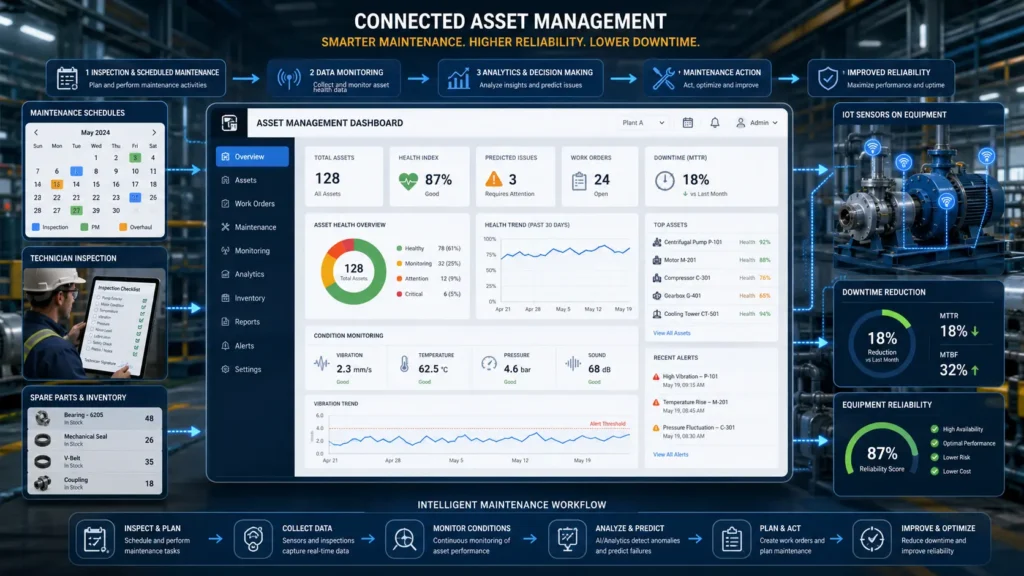
Yes. Preventive and predictive maintenance can work together.
In fact, many businesses should not think of them as competitors.
Preventive maintenance provides a basic structure. Predictive maintenance adds intelligence and data-driven decision-making.
For example, a company may still perform regular safety inspections while using sensors to monitor vibration and temperature. The scheduled inspection provides routine control, while the predictive system provides early warning.
This blended approach is often practical.
A business can start with preventive maintenance, improve record keeping, identify critical assets, and then introduce predictive maintenance gradually.
That way, the company does not need to transform everything at once.
Instead, it builds a smarter maintenance culture step by step.
The Role of Data in Predictive Maintenance
Data is the foundation of predictive maintenance.
Without data, predictions are only guesses.
Useful maintenance data may include:
operating hours,
temperature,
vibration,
pressure,
speed,
load,
energy use,
failure history,
maintenance records,
and environmental conditions.
Over time, this data can reveal patterns.
For example, a motor may show increased vibration before bearing failure. A pump may show pressure changes before performance drops. A machine may overheat before a breakdown occurs.
IBM’s documentation explains that predictive maintenance looks for patterns in equipment usage and environmental information that correlate with failures. These patterns can then support predictive models and asset health scoring.
This is why businesses need proper data collection, clean records, and clear analysis.
Good data turns maintenance from a guessing activity into a decision-making system.
The Role of IoT and AI in Predictive Maintenance
IoT and AI are making predictive maintenance more practical.
IoT sensors can collect equipment data continuously. This may include vibration, sound, temperature, pressure, flow, and energy consumption.
AI and machine learning can then analyze the data to detect patterns, anomalies, and possible failure risks.
For example, a system may learn what normal machine behavior looks like. If the machine begins operating outside that normal pattern, the system can alert the maintenance team.
AWS notes that predictive maintenance is one of the useful applications of IoT because sensors can help predict machine health and reduce downtime without unnecessary maintenance.
This does not mean every business needs advanced AI immediately.
A business can start small with simple monitoring and improve over time.
The most important step is to build a maintenance culture that values data, planning, and continuous improvement.
Preventive Maintenance vs Predictive Maintenance in Engineering Systems
Engineering systems are made up of people, machines, processes, data, and decisions.
Because of this, maintenance should not only focus on equipment. It should also focus on how the entire system works.
Preventive maintenance helps create order in the system. It ensures that inspections, servicing, and routine checks happen consistently.
Predictive maintenance improves the system by adding real-time insight and better decision-making.
Together, they help businesses reduce failure, improve safety, and support operational performance.
This connects well with Harun Lucas’ engineering systems approach, where digital tools, software systems, and practical engineering thinking work together to solve real-world problems. You can explore more about digital and engineering-focused solutions at harunlucas.com.
How Businesses Can Start Improving Maintenance
Businesses do not need to start with expensive systems immediately.
A practical approach works better.
First, identify critical assets. These are the machines or systems whose failure would seriously affect operations, safety, or cost.
Next, review current maintenance records. Look for repeated failures, frequent repairs, high-cost assets, and downtime patterns.
After that, create a preventive maintenance schedule for important equipment. This gives the business a clear starting point.
Then, improve inspection checklists and reporting. Operators and technicians should know what to check and how to report early warning signs.
Once the basics are working, the business can begin adding condition monitoring tools.
For example, vibration monitoring, temperature checks, oil analysis, and energy monitoring can provide useful insights.
Finally, use the data to make decisions. Data only becomes valuable when it leads to better action.
Best Maintenance Strategy for Modern Businesses
The best maintenance strategy is not always purely preventive or purely predictive.
The best strategy depends on the business.
For low-risk assets, preventive maintenance may be enough.
For critical assets, predictive maintenance may provide better value.
For complex operations, a combination of preventive, predictive, and corrective maintenance may be necessary.
A smart maintenance strategy should answer these questions:
Which assets are most critical?
What happens if they fail?
How often do they fail?
What does downtime cost?
What data is available?
What tools can monitor performance?
What skills does the team need?
What maintenance approach gives the best value?
When businesses answer these questions, they can move from random maintenance to strategic asset management.
Why Maintenance Strategy Supports Business Growth
Maintenance is not only an engineering activity.
It is also a business growth issue.
When equipment works reliably, businesses can deliver products and services on time. Teams become more productive. Customers receive better service. Costs become easier to control. Safety risks reduce. Planning also becomes more predictable.
On the other hand, poor maintenance affects everything.
It can increase downtime, damage customer trust, raise costs, reduce quality, and create pressure on employees.
Therefore, maintenance should be seen as part of business strategy.
A company that invests in maintenance is not only protecting machines. It is protecting productivity, safety, reputation, and long-term growth.
Final Thoughts
Preventive maintenance and predictive maintenance both play important roles in modern business operations.
Preventive maintenance gives businesses a structured way to care for equipment through scheduled inspections and servicing.
Predictive maintenance goes further by using data, sensors, and analytics to understand the actual condition of equipment and predict possible failures.
For many businesses, the best approach is not choosing one and ignoring the other. Instead, the stronger approach is to use preventive maintenance as a foundation and predictive maintenance as a smarter decision-making layer.
As industries become more digital, businesses that understand maintenance strategy will have an advantage.
They will reduce downtime, improve reliability, control costs, and make better use of their engineering systems.
Ready to Build Smarter Engineering Systems?
If your business depends on machines, equipment, processes, or digital systems, maintenance should not be treated as an afterthought.
Harun Lucas helps businesses and professionals think strategically about engineering systems, software solutions, automation, digital tools, and technology-driven improvement.
Whether you need a smarter digital system, automation support, technical content, or engineering-focused digital solutions, the goal is simple: to create practical systems that improve reliability, efficiency, and growth.
Visit harunlucas.com to explore digital solutions built for the future.
Frequently Asked Questions
Preventive maintenance is based on a planned schedule, while predictive maintenance is based on equipment condition and data. Preventive maintenance happens at fixed intervals. Predictive maintenance happens when data shows that equipment may need attention.
Predictive maintenance can be better for critical or expensive equipment because it uses real-time data to reduce unnecessary maintenance and detect problems early. However, preventive maintenance is still useful for routine inspections, basic assets, and businesses without advanced monitoring tools.
Examples of predictive maintenance include vibration monitoring for motors, temperature monitoring for bearings, oil analysis for engines, pressure monitoring for pumps, and AI-based fault detection in production machines.
Yes. Small businesses can start with simple condition monitoring tools before investing in advanced systems. For example, they can track operating hours, inspect equipment regularly, monitor temperature, record failures, and use basic sensors for critical machines.
Maintenance strategy helps businesses reduce downtime, improve safety, control repair costs, extend equipment life, and support reliable operations. A good strategy helps the business move from emergency repairs to planned and data-driven maintenance.